By Fiona MacDonald, 25 September 2014, ABC,Discovery News
Scientists have discovered fossils of some of the earliest known multicellular organisms, which lived 600 million years ago - and looked a lot like pomegranates.
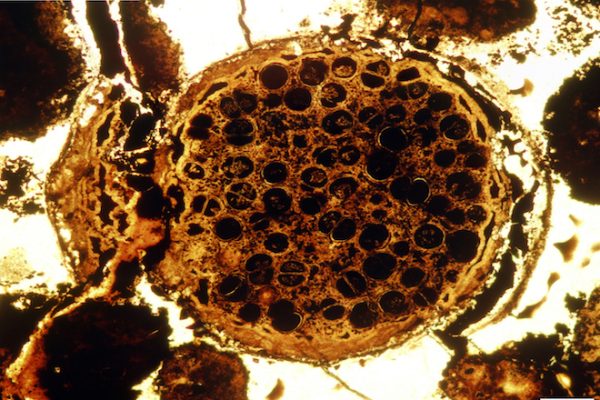
The fossils were discovered in southern China and predate the Cambrian explosion - the period that began around 542 million years ago and was believed to give rise to most of the major animal phyla we see today. The discovery may help scientists to better understand the early evolution of complex multicellular organisms.
To put that 600 million year age stamp into perspective,Jennifer Viegas from Discovery News has provided some helpful comparisons. For example, 600 million years ago was:
- about 370 million years before the first dinosaurs emerged
- approximately 180 million years before there were land plants, which drastically changed Earth's landscape and created new habitats
And if that’s not mind-blowing enough, these fossils are so weird that researchers don’t know how to classify them as yet. The discovery is described inNaturetoday.
Lei Chen of the Chinese Academy of Sciences, who helped uncover the ancient fossils, explained that these remains "have been overlooked in previous studies." This is because they’re so strange and ahead of their time that scientists had struggled to characterise the fossils.
“Our work shows evidence that this organism developed multiple kinds of cells 600 million years ago," one of the authors, Shuhai Xiao, from Viginia Tech in the US, told Stuart Gary for ABC Science. "This is an important discovery for cell differentiation, and a critical step towards multicellular life."
Crucially, the fossils display some of the key characteristics of multicellular organisms, including cellular differentiation and programmed cell death.
"One of the more important types of cellular differentiation is the separation of reproductive cells from non-reproductive cells, and we believe we have also found evidence for this," said Xiao.
The Ediacaran Doushantou Formation, where the fossils were found, would probably have been under a warm shallow sea, and is filled with strange fossils, although most have been characterised as bacteria or algae, or occasionally very early types of animal life, such as relatives of sea sponges.
But these new microfossils don’t fit into any of these groups, and the researchers believe this is because they may be an early group that died off and have no evolutionary link with today’s living animals.
Another option is that they represent an ancient type of multicellular algae.
"We have not proved that these are animal embryos, although it remains one of two possibilities and certainly narrows down the options," Xiao told the ABC.
Further research is now needed to work out exactly where this group fits on the tree of life.
Sources: ABC,Discovery News


 Events
 Text Size: