by Marie-Therese Walsh PhD, 31 Mar. 2015, SciGuru Science News
Brood care is an altruistic behaviour that promotes fitness and survival of the next generation at a cost to the parents. It has independently evolved in various different animals, including insects. The most common forms of brood care are egg brooding and offspring attendance. However, fossil evidence of this remarkable behaviour is very rare and particularly so in insects. In a new paper in the online journal eLife, the oldest ever fossil evidence of (Wathondara koteja) insect brood care is reported, dating back 100 million years ago. This is 50 million years earlier than previously uncovered fossil evidence of insect brood care. The study comes from an international team of researchers in China, the United Kingdom, Germany and Poland.
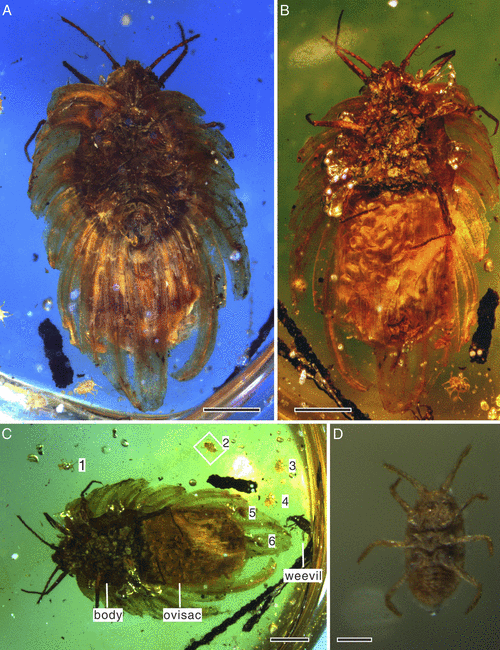
Wathondara kotejai gen. et sp. nov. Simon, Szwedo and Xia from mid-Cretaceous Burmese amber.
(A) Habitus in dorsal view, stacked image with a blue filter. (B) Habitus in ventral view, stacked image with a green filter. (C) Habitus in ventral view, stacked image with a green filter. Note the weevil under the adult. The numbers 1–6 represent six first-instar nymphs. (D) Enlargement of a nymph in (C). Scale bars of (A, B and C) represent 1 mm; scale bar of (D) represents 0.1 mm.
Courtesy: DOI: http://dx.doi.org/10.7554/eLife.05447.003
The fossil was found in a piece of amber recovered from a mine in Myanmar (Burma). It dates back to the mid-Cretaceous period and is the only Mesozoic record of an adult female scale insect. When she became trapped, she had eggs preserved in a wax ovisac, as well as several young nymphs that would have hatched within the sac and remained there for some days before entering the outside world. This represents a primitive form of brood care, as the eggs and nymphs would be protected from adverse environmental conditions and from predators until their own wax coverings were sufficiently developed. This find represents the oldest, unequivocal evidence of insect brood care. It shows that this type of egg-brooding reproductive strategy, which is still observed in modern insects, has been conserved over 100 million years. The research team have named the new species Wathondara kotejai, for the goddess of earth in Buddhist mythology and the late Polish entomologist Jan Koteja.
The findings may also help explain early diversification of scale insects. While flowering plants and ants are thought to have been important drivers for radiation of the most diverse scale insect groups, neither of these factors were present in the evolutionary history of basal groups. Brood care promotes offspring survival and lead author Prof Bo Wang of the Chinese Academy of Sciences said: "Brood care could have been an important driver for the early radiation of scale insects, which occurred during the end of the Jurassic or earliest Cretaceous period during the Mesozoic era."
The study is more exciting in that it is so rare to find fossilised evidence of animals, and especially insects, caring for their young. Wingless females like the one in the study did not move around much, so were less likely to be trapped. Previous direct evidence of brood care came from Cenozoic ambers, from the era beginning about 65 million years ago with the extinction of the dinosaurs and extending to the present. The fossilised evidence in the current study is from a time when dinosaurs still dominated the earth. Prof Wang concluded: "Although analysis seemed to suggest that ancient insects evolved brood care, this is the first direct, unequivocal evidence for the fossil record."
Science news reference:
Brood care in a 100-million-year-old scale insect. Wang B, Xia F, Wappler T, Simon E, Zhang H, Jarzembowski EA, Szwedo J. eLife (2015). DOI: 10.7554/eLife.05447.


 Events
 Text Size: