June 25, 2016,By James Maynard, Tech Times
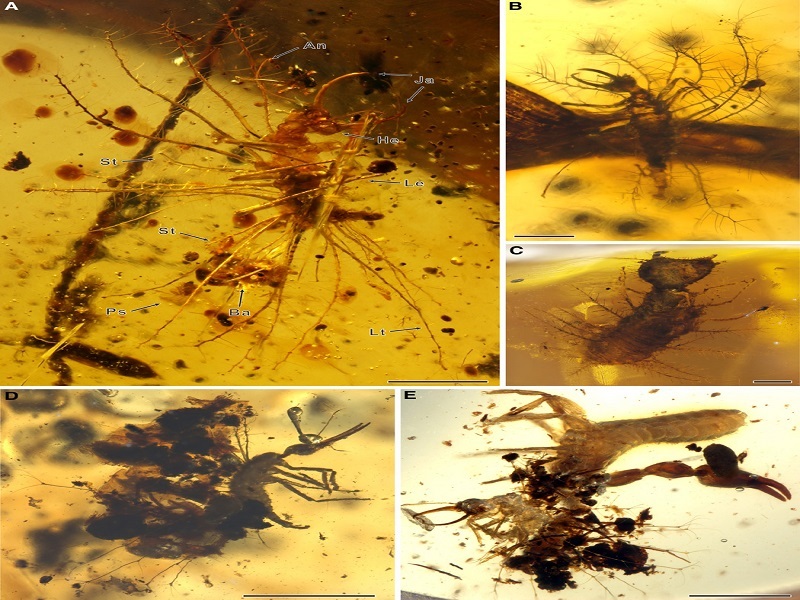
Insects were using pieces of the natural world for camouflage, even 100 million years ago. What secrets are fossils trapped in amber revealing to biologists? ( Science Advances )
Insect fossils trapped in amber reveal detailed, new information on how these ancient animals used sophisticated camouflage 100 million years ago. These new findings show how a sophisticated defense technique was already being honed back in that period.
Debris carrying is a behavior of insects which requires a significant amount of processing power in brains. The animal not only needs to know how to recognize targets, but also needs to understand a desire to collect the materials. Both mental and physical adaptations are required to carry the gathered goods and use them for camouflage.
Despite the importance of this behavior for insects, only a sparse fossil record of the actions has been seen in amber. Just a single insect, dating from the age of dinosaurs and discovered in Spain, has been found, preserved while the ancient animal was gathering debris.
Insects have developed a wide range of techniques to keep themselves hidden from predators in the wild. This included the use of debris found in the environment to disguise themselves from hunters. In a way, these insects used pieces of leaves and other debris as a form of ancient invisibility cloak.
"These fossils are the oldest direct evidence of camouflage behavior utilizing trash in the fossil record and show unequivocal evidence of camouflage in immature lacewings and reduviids dating back more than 100 million years. They demonstrate that the behavioral repertoire, which is associated with considerable morphological adaptations, was already widespread among insects by at least the Mid-Cretaceous," the Chinese Academy of Sciences reported in a press release.
Researchers at that institution now report finding several other examples of insects trapped in amber while gathering various materials. These natural relics were collected in France, Burma and Lebanon, and include such insects as assassin bugs, lacewings and owlflies. A wide range of materials was found along with the fossils, including plant matter, wood fibers and the exoskeletons of insects.
One of the most bizarre finds was the preserved remains of a pseudoscorpion and a lacewing larva, captured soon after the two engaged in battle. By the time they became encased in amber, the lacewing had killed the pseudoscorpion, and had sucked the body dry, which it wore like a jumpsuit. This would make the lacewing look, and smell, like another species.
This new study provides biologists with new data concerning the interrelationships between insects and their natural habitat tens of millions of years in the past. By examining the materials each insect carried, it is possible to infer how various species related to one another in the wild.
Analysis of the amber fossils is profiled in the journal Science Advances.
From: http://www.techtimes.com/articles/167051/20160625/how-did-insects-use-camouflage-100-million-years-ago.htm


 Events
 Text Size: