
Recently, a new high-resolution biomarker study of the Zal section in NW Iran (Fig. 1), was conducted by Ph.D. student JIAO Shenglin, his advisor Prof. ZHANG Hua from the Nanjing Institute of Geology and Palaeontology, Chinese Academy of Sciences (NIGPAS), and an international team. This study systematically reveals ecological disturbance and microbial community dynamics across the P–T transition in Northwest Iran.
The study is published in the international journal Palaeogeography, Palaeoclimatology, Palaeoecology.
The Permian–Triassic (P–T) transition witnessed the most severe biocrisis in the Phanerozoic, yet microbial community dynamics across this interval remain poorly constrained in key regions of the Paleotethys. The well-preserved, continuous marine records from Iran (western Paleo-Tethys) provide a critical archive of this event. Comparative studies between the western (Iran) and eastern (South China) Paleo-Tethys are essential for a holistic understanding of environmental and biological dynamics, though many questions about Iran's specific environmental and microbial records remain.
Research reveals the simultaneous emergence of a triple environmental crisis: First, biomarkers point to a major shift in primary producers—from eukaryotic green and red algae toward bacteria—with cyanobacteria becoming dominant at the extinction horizon. Second, the sediment record captures recurring bottom water anoxia, strong water-column stratification, and sustained intervals of euxinic conditions. Third, marked increases in terrestrial organic matter, likely linked to wildfire activity and soil erosion, indicate that land-derived nutrients may have intensified marine eutrophication (Fig. 2).
Notably, these biomarker patterns align with negative δ13C shifts and match trends reported from South China (Fig. 3), suggesting that ecological decline occurred synchronously across the Paleotethys. Collectively, the results point to volcanism-driven environmental collapse on land and widespread marine anoxia as key factors that magnified the end-Permian biocrisis (Fig. 4).
This work is supported by the National Key Research and Development Program of China and the Jiangsu Innovation Support Plan for International Science and Technology Cooperation Program.
Reference: Jiao, S.L., Zhang, H.*, Arefifard, S., Cai, Y.F., Gorgij, M.N., Liu, X.Y., Ni, W., Tang, L.K., Cao, J., Shen, S.Z., 2026. Ecological disturbance and microbial community dynamics across the Permian–Triassic transition in Northwest Iran. Palaeogeogr. Palaeoclimatol. Palaeoecol. 682, 113432. https://doi.org/10.1016/j.palaeo.2025.113432.

Fig.1 Chromatogram of the saturated and aromatic fractions of selected samples of the Zal section

Fig.2 High-resolution chemostratigraphy of the Zal section through the P–T transition.
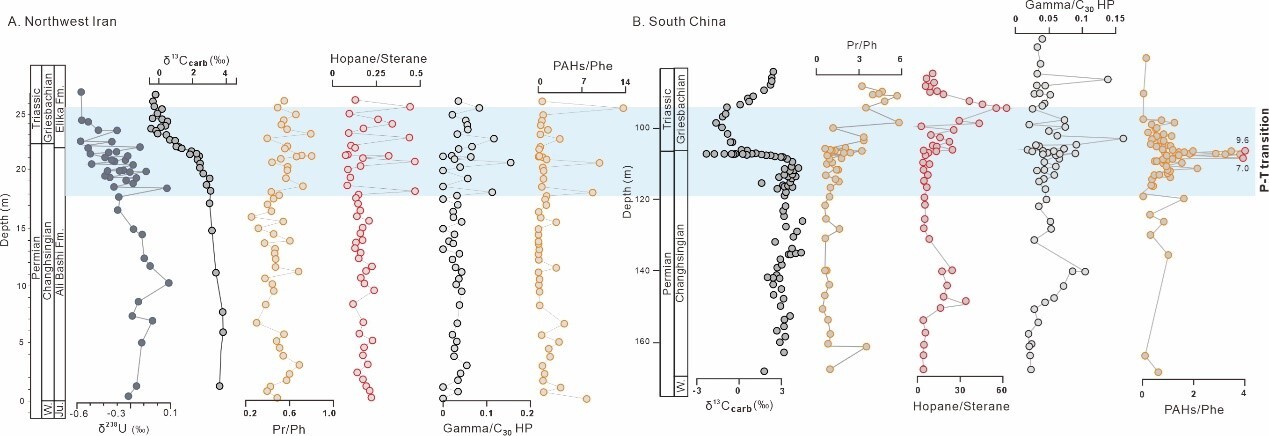
Fig.3 Comparison of the geochemical records during the P–T transition between the Zal section in Northwest Iran and the Meishan and Shangsi sections in South China.
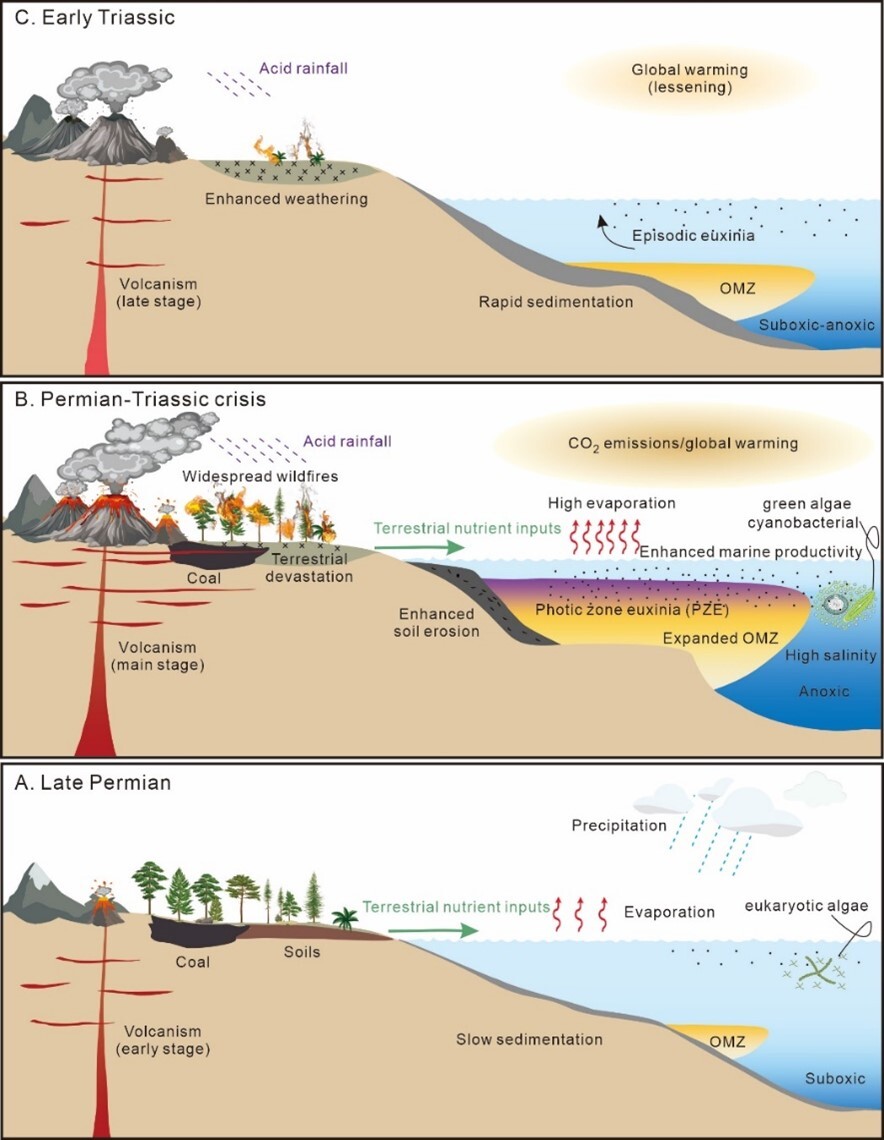
Fig.4 Conceptual models of oceanic anoxia and ecological disturbance in terrestrial–marine systems from the late Permian to Early Triassic.
Download: