
Thousands of newly analyzed fossils discovered at a rock quarry in southern China and dating to 512 million years ago provide new details about what life was like for creatures that survived the mass extinction that capped off a pivotal period of rapid evolution and expansion known as the Cambrian explosion.
During the early stages of the Cambrian era, which stretched from about 541 million to 485 million years ago, increasingly complex life forms filled the seas, setting the stage for the evolution of nearly every phylum alive today. Then, about 513.5 million years ago, major tectonic shifting disrupted the world’s oceans and wiped out about half of the species known to have lived at the time—an obliteration known as the Sinsk Event. Until now, researchers knew little about how this mass extinction affected soft-bodied sea creatures like the distant ancestors of modern sea worms and jellies.
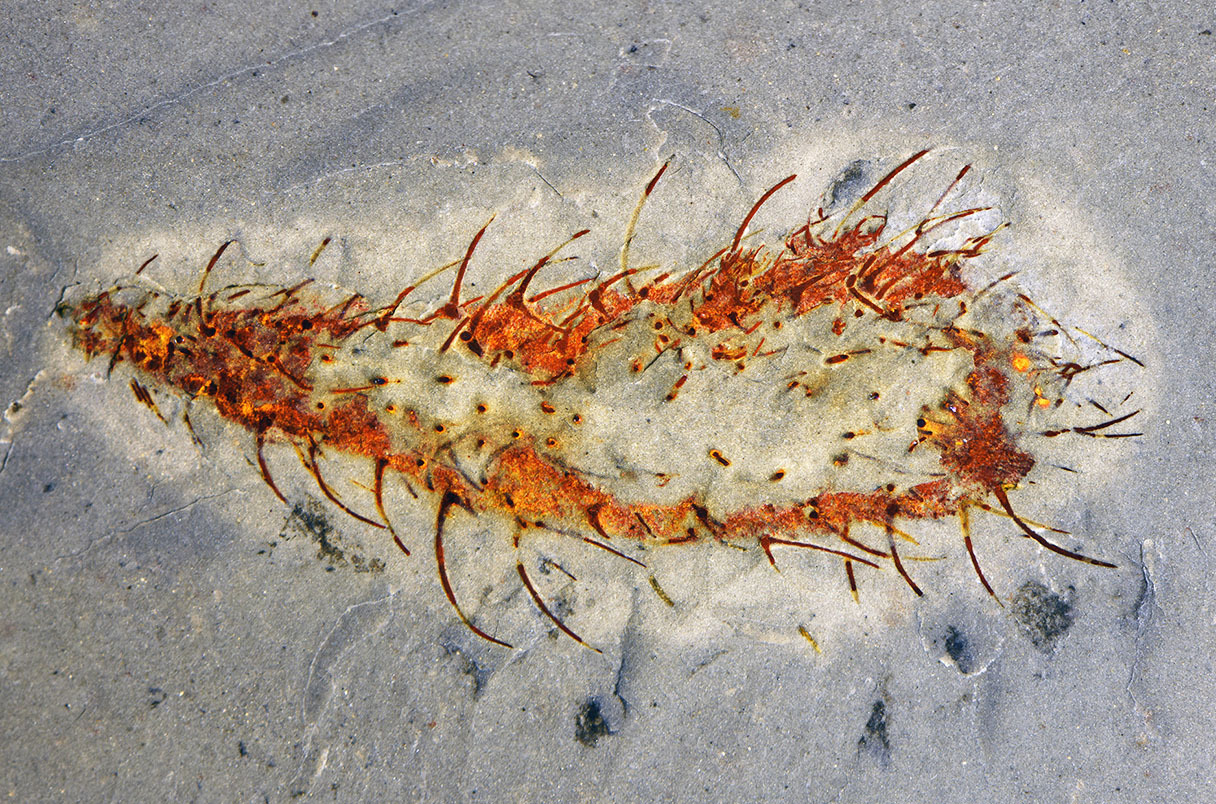
The newly described fossils representing 153 species—including a tiny, tubular, spiky Allonnia specimen, pictured above—indicate soft-bodied animals in deep water fared better than those in shallow water, scientists report today in Nature.
The fossils—more than half of which were previously unknown—include arthropods, sponges, and other invertebrates. Such diversity hints at a complex food web, the authors write. Evolutionary links between these fossils and their contemporaries found elsewhere around the world suggest underwater ecosystems were more interconnected during the early Cambrian than was previously believed.
Download: