
The North Qilian Mountains area is a key region of the Qilian Orogenic Belt, located between the Hexi Corridor area and the Qilian terrane. During the past few decades, trilobites of the Koumenzi Formation have been documented from the relatively deeper-water settings, but the shallow-water trilobites of similar horizons were poorly known. However, shallow-water trilobites not only display strong endemism but also provide greater biogeographical information.
Recently, Assistant Professor WEI Xin and other colleagues of the Nanjing Institute of Geology and Palaeontology, Chinese Academy of Sciences (NIGPAS), conducted systematic study on the shallow-water trilobites of the Koumenzi Formation (Katian) in the Qilian area.
A low diversity (seven species of six genera) trilobite fauna is recognized as the Pliomerina Association. Of these, Dulanaspis and Amphilichas are reported for the first time in the North Qilian Mountains. The shallow-water Pliomerina and relatively deep-water Birmanites-Sinocybele associations were found to occur in the Qilian and Menyuan areas, respectively, during the Katian. They exhibit a distinctive ecological differentiation with water depth from inner shelf to out shelf environments. The Pliomerina Association of the Qilian area clearly belongs to the Pliomerina and/or Sinocybele Province of the Proto-Tethys Archipelagic Ocean.
Faunal evidence indicates that the palaeogeographical position of the North Qilian Mountains area was situated closer to the Kazakh terranes during the Katian, particularly to the Chu-Ili and Chingiz-Tarbagatai terranes. For example, Dulanaspis levis was reported from the Dulankara Formation (Katian 1) of the Chu-Ili terrane; Remopleurides cf. sibiricus was found in the Karagach Formation (Katian 1) of the Chingiz-Tarbagatai terrane. Two species of Pliomerina, P. cf. longhuangensis and P. sp., appear to be endemic to the North Qilian Mountains.
The research result was published in Palaeoworld. This work was supported by the National Key Research and Development Program of China (2023YFF0803602), the National Science Foundation of China (42472018) and the State Key Laboratory of Palaeobiology and Stratigraphy (20231101, E226030037).
Reference: Xin Wei, Yu-Chen Zhang, Ren-Bin Zhan, Yi Wang, Peng Tang, Yong Wang, Ya-Tao Zhang, Jia-Qi Song. 2025. Shallow-water trilobites from the Koumenzi Formation (Katian, Upper Ordovician) of Qilian, northeastern Qinghai, China: Biogeographical links with Kazakh terranes. Palaeoworld 34, 200940. https://doi.org/10.1016/j.palwor.2025.200940.
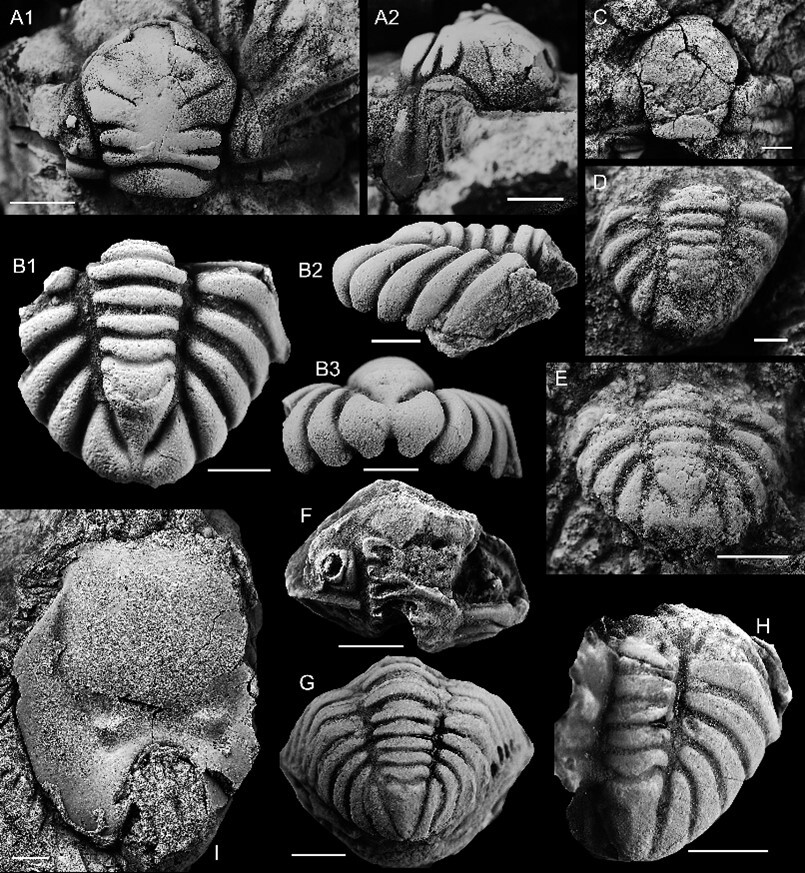
Pliomerina cf. longhuangensis (A-E), Pliomerina sp. (F-H), asaphid gen. et sp. indet. (I)
Trilobites from the Koumenzi Formation in the North Qilian Mountains (Qilian area); Pliomerina cf. longhuangensis (A-E), Pliomerina sp. (F-H), asaphid gen. et sp. indet. (I)
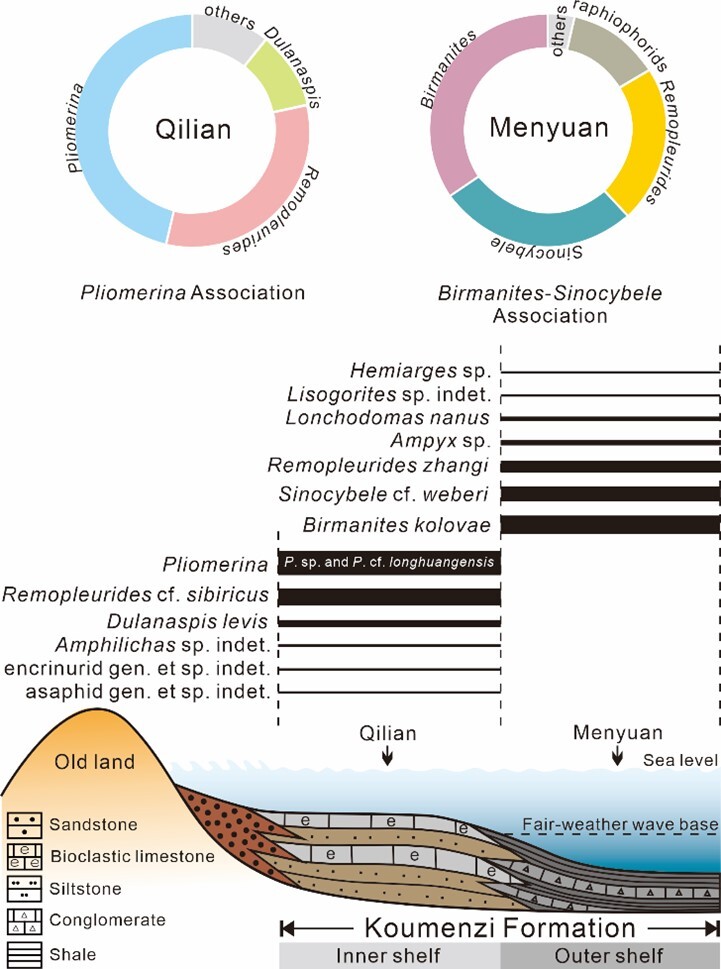
Ecological distribution of the Pliomerina Association (Qilian area) and Birmanites-Sinocybele Association (Menyuan area) from the Koumenzi Formation in the North Qilian Mountains.
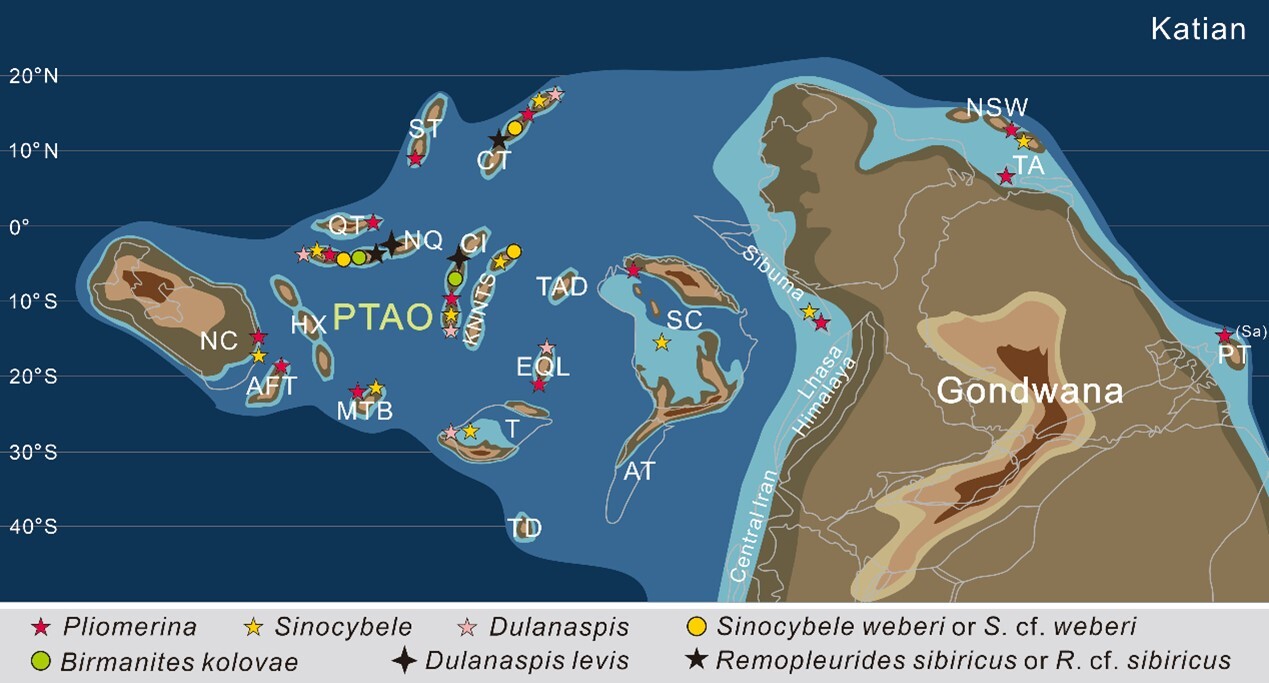
Palaeogeographical map of the Proto-Tethys Archipelagic Ocean (PTAO) and the low-latitude Gondwana during the Katian (Late Ordovician), showing known occurrences of the key genera and species reported from the Koumenzi Formation.
Download: