
A recent study by Assistant Professor CHENG Cheng and Professor ZHANG Hua from the Late Paleozoic research team at the Nanjing Institute of Geology and Paleontology, Chinese Academy of Sciences (NIGPAS), in collaboration with researchers from Nantong University, Hefei University of Technology, and Nanjing University, has been published in Palaeogeography, Palaeoclimatology, Palaeoecology. The work deciphers how pulsed volcanism in the Emeishan Large Igneous Province (ELIP) triggered the collapse of the Late Paleozoic Ice Age (LPIA) during the Guadalupian–Lopingian (G–L) transition through disruptions in the global carbon cycle.
The Late Paleozoic Ice Age (LPIA) was the longest-lasting icehouse climate of the Phanerozoic, and its transition to a greenhouse state represents a critical turning point in Earth's climate evolution. The Guadalupian–Lopingian (G–L) transition, marking the final stage of the LPIA, records key evidence of deglaciation and perturbations in the global carbon cycle. Although the Emeishan Large Igneous Province (ELIP) has been proposed as a potential trigger for this transition, the mechanistic linkages between volcanism and deglaciation had remained inadequately understood.
The research team conducted high-resolution integrated geochemical analyses of carbonate-dominated strata from the Xikou section in Zhen’an, South Qinling, including mercury geochemistry, paired carbonate and organic carbon isotopes (δ13Ccarb, δ13Corg), redox-sensitive trace elements (e.g., MoEF), and chemical weathering indices (e.g., chemical index of alteration, CIA). The results reveal five distinct volcanic pulses during the Capitanian to Wuchiapingian stages, each showing synchronous correspondence with negative carbon isotope excursions, elevated chemical weathering indices, and enrichments in redox-sensitive elements (Fig. 1).
This coupled volcanic-climatic-oceanic pattern demonstrates that ELIP eruptions released massive amounts of 13C-depleted CO2, triggering recurrent warming episodes that progressively destabilized the P4 glaciation and led to ice-sheet collapse. Notably, this pattern can be extended to the global deglaciation of the LPIA, where eruptions from the Tarim II (ca. 290 Ma), Tarim III (ca. 280 Ma), and Emeishan (ca. 260 Ma) large igneous provinces uniformly triggered interglacial phases (Fig. 2).
Additionally, an early Wuchiapingian +1.4 ‰ shift in Δ13C (δ13Ccarb -δ13Corg) indicates enhanced organic carbon burial under declining volcanic activity, which contributed to the atmospheric oxygenation and facilitated ecosystem recovery- processes that in turn supported post-eruptive climatic cooling.
By correlating volcanic activity with climate proxies from a single section, this study establishes pulsed volcanism as a principal driver of icehouse-greenhouse transitions. The findings offer critical insights into carbon-cycle–climate feedbacks, with direct relevance to understanding modern global warming dynamics.
This study was supported by the National Natural Science Foundation of China, the Nanjing Institute of Geology and Palaeontology (Chinese Academy of Sciences), and the Jiangsu Provincial Department of Education.
Reference: Cheng Cheng*, Hua Zhang*, Dan Wang, Shuangying Li, Shuzhong Shen. Pulsed volcanism in the Emeishan Large Igneous Province drove deglaciation during the Guadalupian-Lopingian transition. Palaeogeography, Palaeoclimatology, Palaeoecology, 2025, 679, 113302. https://doi.org/10.1016/j.palaeo.2025.113302.
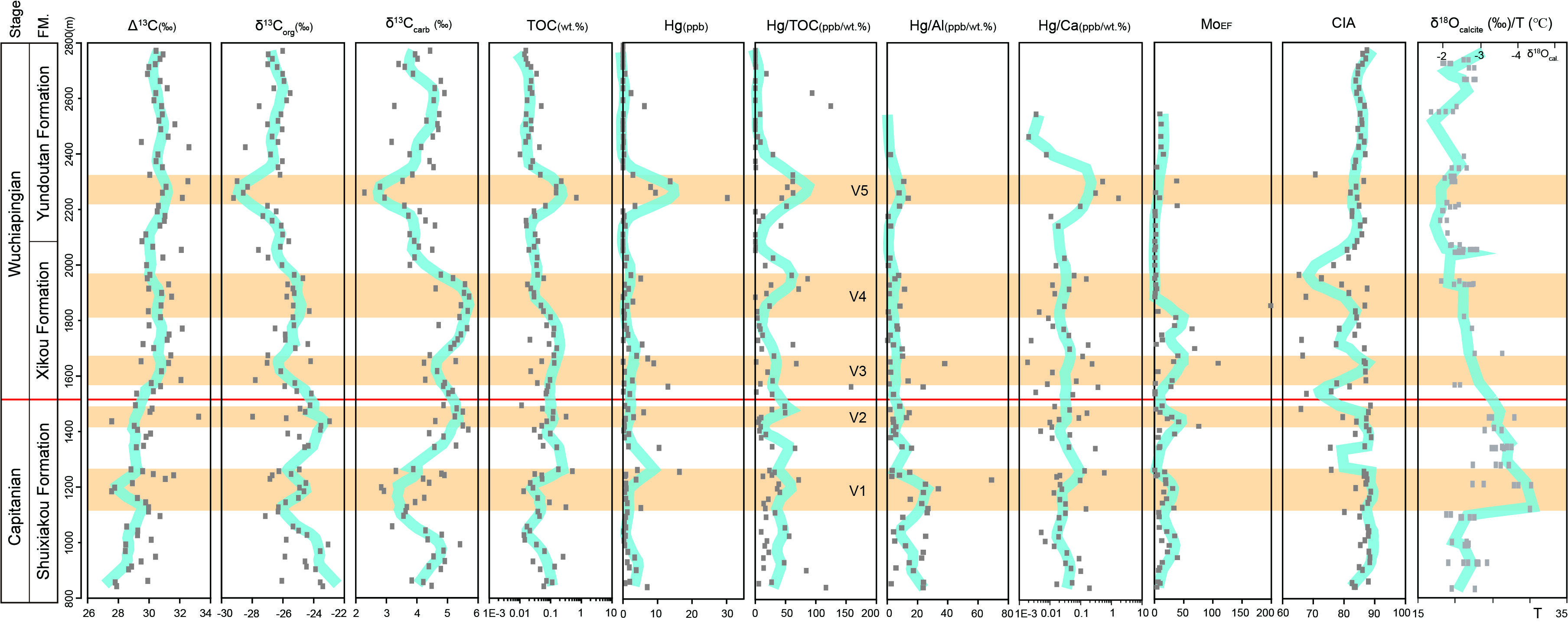
Fig. 1 Geochemical and isotopic records from the Xikou section spanning the Capitanian to Wuchiapingian stages
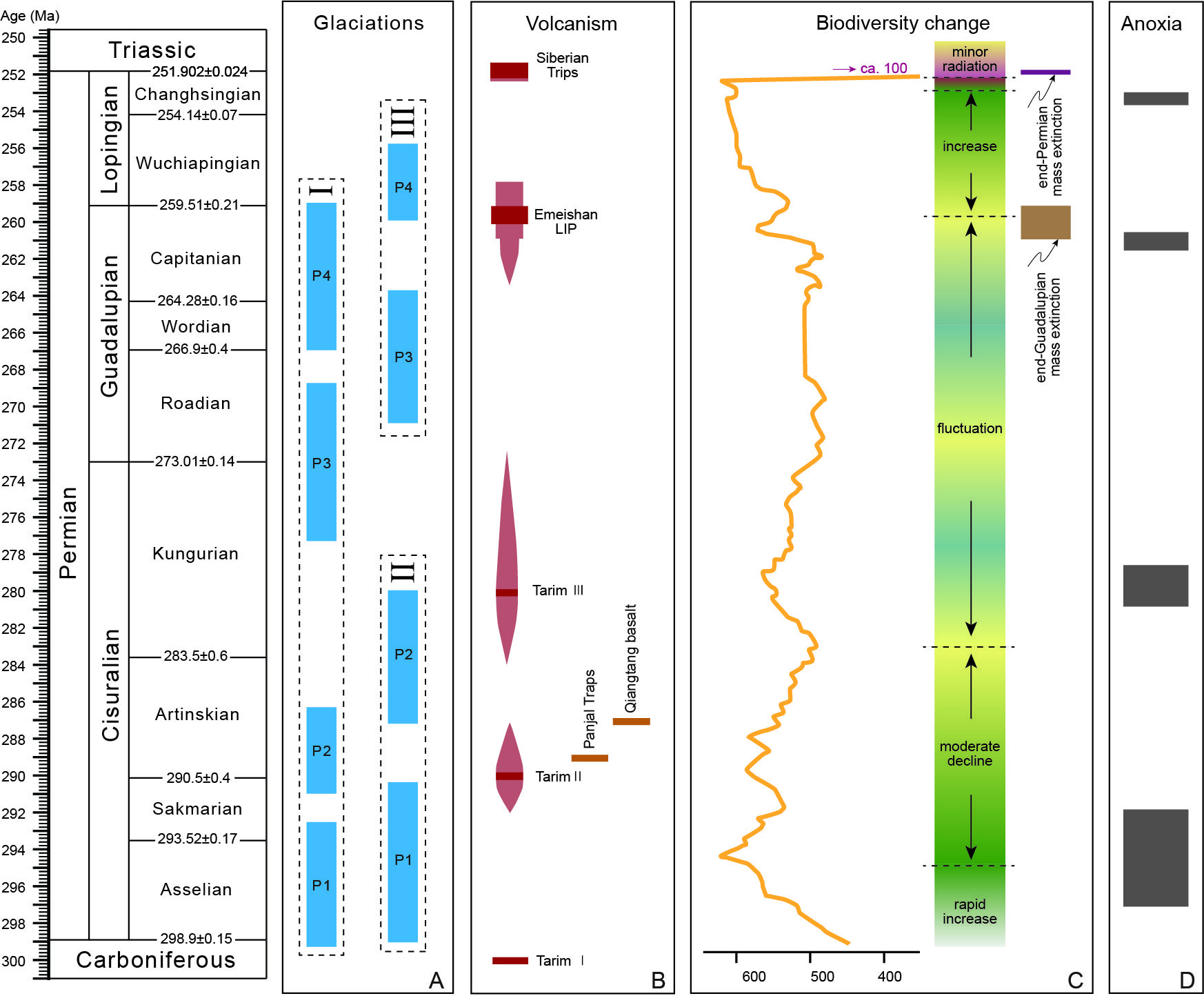
Fig. 2 Correlation among Permian glaciations from eastern Australia, Large Igneous Provinces, biodiversity changes, and anoxic events
Download: