
As important predators in the Palaeozoic marine ecosystem, cephalopods evolved complex shell structures and forms during the Ordovician. The Katian Stage, a critical period at the peak of the Great Ordovician Biodiversification Event, also yielded numerous cephalopod fossils. Previous research on middle Katian cephalopods has primarily focused on documenting occurrences and systematic descriptions, lacking comprehensive overviews and syntheses.
Recently, the Early Palaeozoic research team at the Nanjing Institute of Geology and Palaeontology, Chinese Academy of Sciences (NIGPAS) and researchers from other institutions studied middle Katian cephalopods from the Anti-Atlas and Qilian Mountains. The related results were recently published in the Swiss Journal of Palaeontology and Palaeoworld.
Ⅰ. Based on new cephalopod collections from the Eastern Anti-Atlas and Northern Qilian Mountains, more cephalopod genera and species have been reported, including Tafadnatoceras elfechtense, Paradnatoceras nyalamense, Isorthoceras sp., Anaspyroceras sp., Geisonocerina? sp., enriching the composition of the middle Katian cephalopods.
Ⅱ. In general, middle Katian cephalopods flourished in low-latitude regions but declined in high-latitude regions. This biodiversity pattern aligns with changes in the latitudinal diversity gradient during the Ordovician.
Ⅲ. Cluster analysis and weighted network analysis of global occurrences suggest cephalopod provincialism during the middle Katian Stage. Two provinces were recognized for cephalopods: the Mid–Low Latitude Province and the High Latitude Province, with global palaeoceanographic currents identified as a potential driver for this faunal differentiation.
This work was supported by the National Key Research and Development Program, the National Natural Science Foundation of China, the Chinese Academy of Geological Sciences, and the Foreign Aid Project of the Ministry of Commerce of the People’s Republic of China. This is a contribution to IGCP Project 735 (Rocks and the Rise of Ordovician Life).
Reference:
Fang, X.*, Kröger, B., Liang, K., Chen, Q., Song, J.Q., Jiang, L., He, Y.Y., Wang, C.G., Zeng, X.W., Liu, H., Wei, K., Wu, F.F., Qie, W.K., 2025. Late Ordovician cephalopods from Morocco and their implications. Swiss Journal of Palaeontology 144, 37. https://doi.org/10.1186/s13358-025-00374-5.
Song, J.Q., Fang, X.*, Zhang, Y.C., Wei, X., Zhang, Y.T., Wang, Y., Zhan, R.B., 2025. Cephalopods from the Upper Ordovician of the North Qilian Mountains region: Implications for palaeobiogeography. Palaeoworld 35, 2. https://doi.org/10.1016/j.palwor.2025.201048.
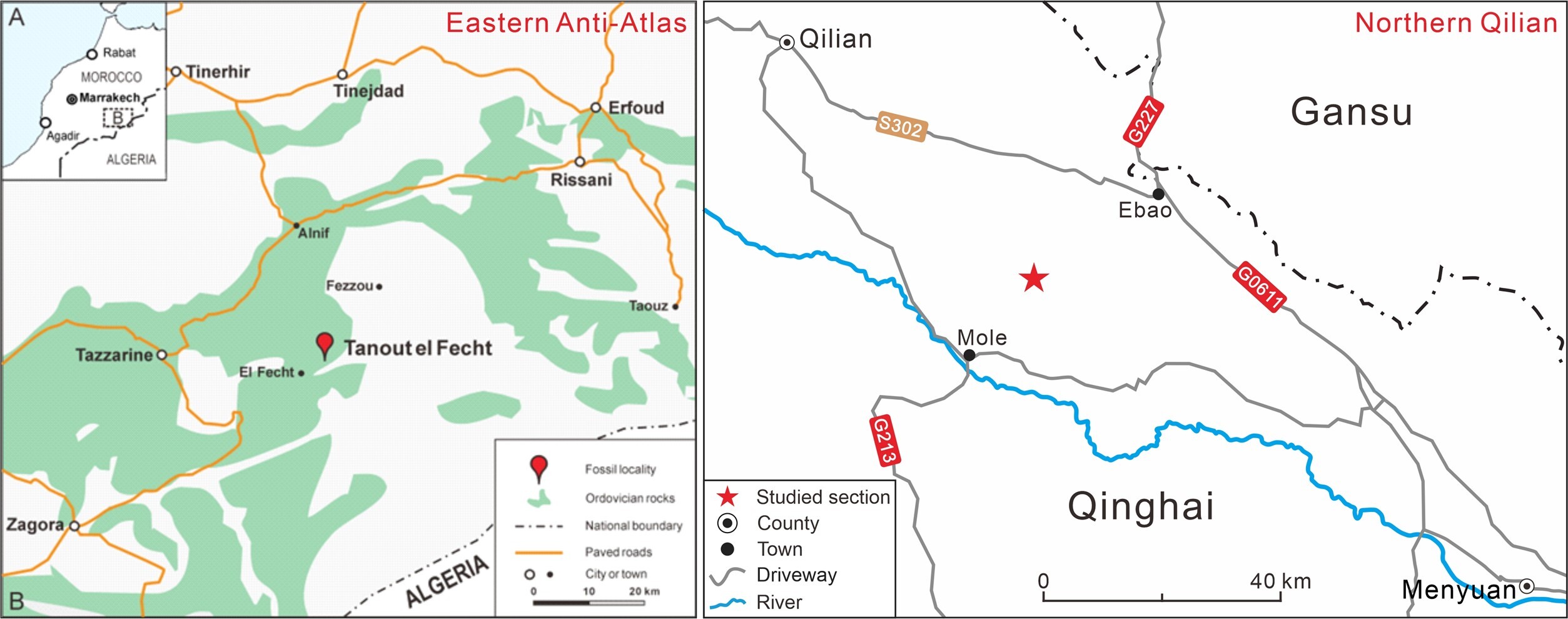
Geographical location of study areas and sections (Left: Anti-Atlas; Right: Qilian)
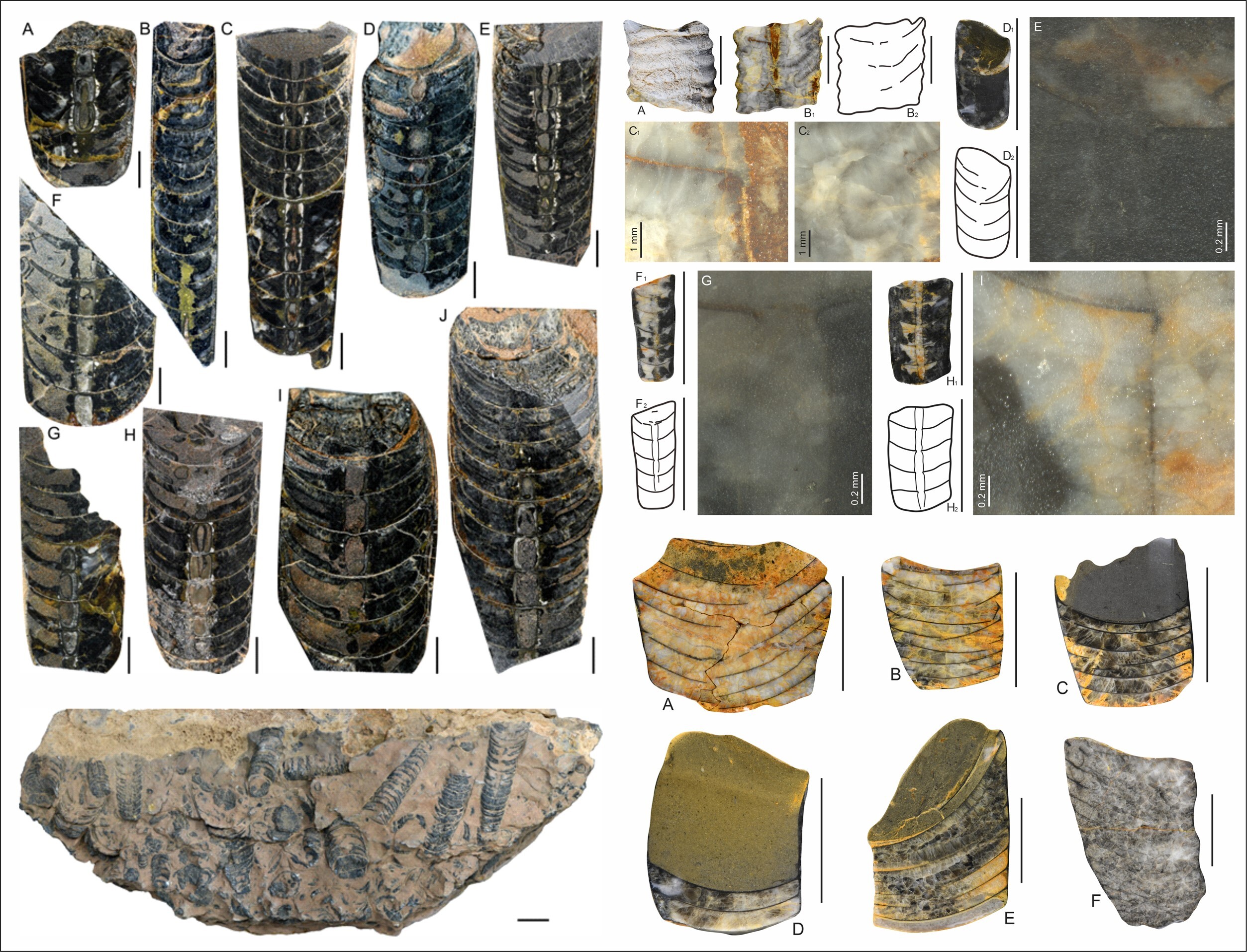
Middle Katian cephalopod collections from the Anti-Atlas and Qilian Mountains
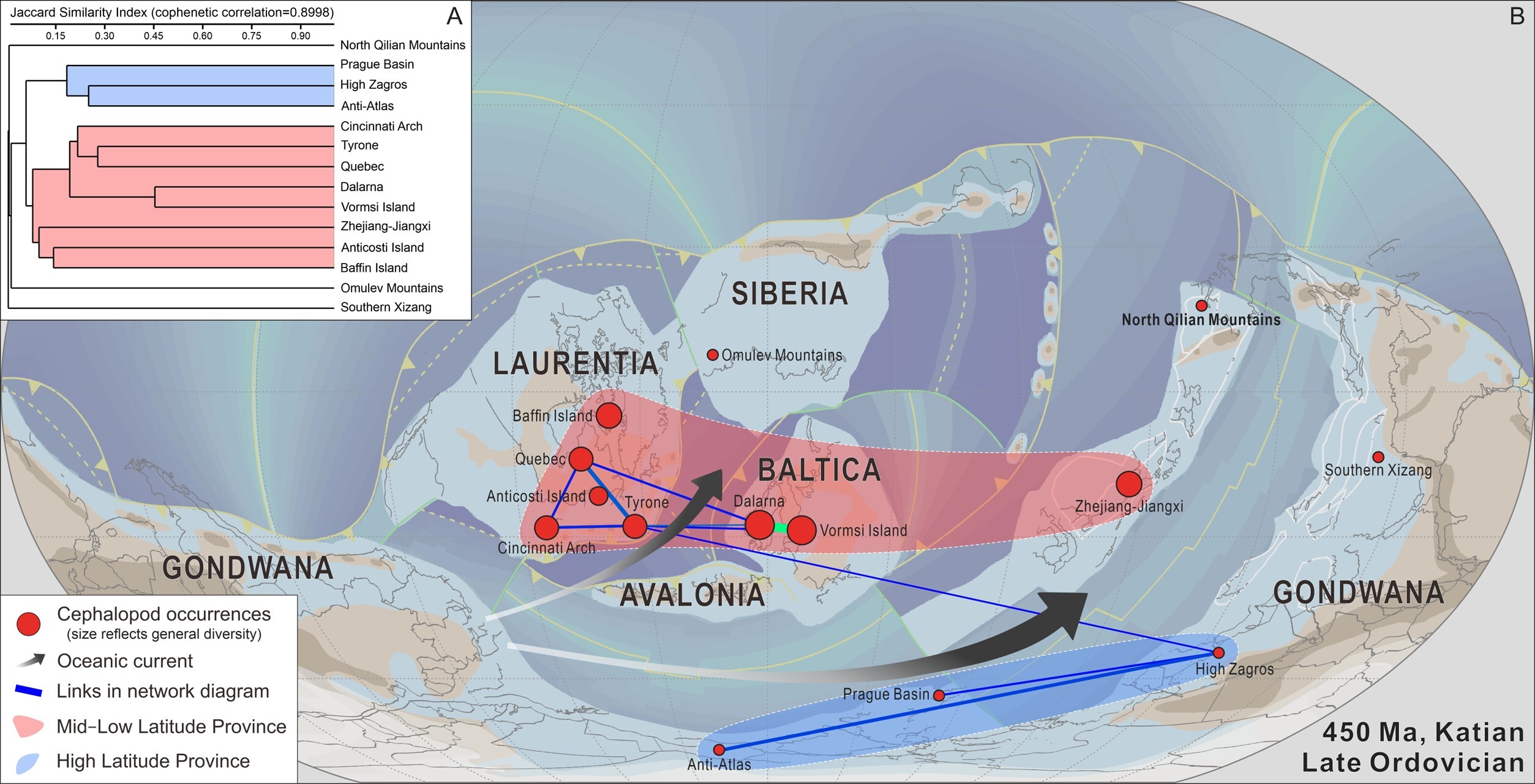
Results of quantitative analyses based on the middle Katian cephalopod occurrences
Download: