
Earth system box models are essential tools for reconstructing long-term climatic and environmental evolution and for uncovering the Earth system mechanisms. To break through the spatial and temporal resolution limits of current deep-time models, Dr. ZHANG Yinggang from the team of Prof. ZHU Maoyan at the Nanjing Institute of Geology and Palaeontology, Chinese Academy of Sciences (NIGPAS), collaborated with Prof. HU Yongyunand Dr. YUAN Shuai from Peking University, Prof. Benjamin Mills from the University of Leeds, and Dr. Andrew Merdith from the University of Adelaide. Together, they developed CESM-SCION, a new generation high-resolution climate-biogeochemistry coupled model. This model increases the spatiotemporal resolution of long-term Earth system simulations to a new level and identifies marine regression as a key driver for the onset of the Late Paleozoic Ice Age. The findings were recently published in the journal Geophysical Research Letters.
Since the establishment of the classic GEOCARB carbon cycle model by Berner and colleagues in the 1980s, Earth system box models have evolved from early zero-dimensional biogeochemical models (e.g., GEOCARB, COPSE) to climate-biogeochemistry coupled models like SCION, which can dynamically represent terrestrial climate and silicate weathering across space and time. Although SCION achieved three-dimensional dynamic expression of terrestrial silicate weathering, its built-in climate emulator (or climate datasets) was limited by low spatial resolution. This low resolution made it difficult to accurately capture complex and heterogeneous weathering processes on the deep-time Earth surface, often overlooking small-area weathering “hotspots”. This limitation became a technical bottleneck in further revealing terrestrial silicate weathering and temperature variations throughout Earth’s history.
Addressing the deficiencies of the original SCION model, which relied on low-resolution (20–40 Myr, 7.5°×4.5°) climate data from the Fast Ocean and Atmosphere Model (FOAM), the research team utilized high-resolution climate datasets from the Community Earth System Model (CESM). By increasing the spatiotemporal resolution to 3.75°×3.75° and 10 Myr, they replaced the original low-resolution climate emulator to construct CESM-SCION. This advancement allows for the high-resolution dynamic capturing of terrestrial silicate weathering processes, bringing deep-time Earth system modeling into a new frontier of spatiotemporal precision.
To verify the reliability of the new model, the team selected the Late Paleozoic Ice Age, the longest-lasting icehouse event of the Phanerozoic, as a probative case study. Previous studies using low-resolution versions of SCION, despite considering mechanisms such as the expansion of vascular plants and the assembly of Pangea, failed to reproduce the transition from a greenhouse to an icehouse climate during the mid-to-late Devonian. Using CESM-SCION, the team successfully captured a key driving mechanism previously overlooked: the critical control of tectonically driven land area changes over Earth's “weatherability” and surface albedo.
Modeling results show that during the mid-to-late Devonian, the assembly of Pangea was accompanied by a long-term global sea-level fall (marine regression). With the improved resolution, the CESM-SCION model quantified the “dual cooling effect” of this process. The increased global continental exposure caused by marine regression acted in two ways: first, it induced physical cooling by increasing global surface albedo; second, it vastly expanded the regions available for silicate weathering, thereby enhancing the global silicate weathering flux. This accelerated the consumption of atmospheric CO2, driving global cooling. This result not only replicates the critical transition from greenhouse to icehouse conditions in the mid-to-late Devonian but also proposes a new perspective: “Tectonically driven marine regression preceded and drove the Late Paleozoic Ice Age”.
This study emphasizes the importance of increasing the resolution of deep-time Earth system simulations. It not only resolves long-standing controversies regarding the initiation of the Late Paleozoic Ice Age but also highlights the significant potential of high-resolution climate-biogeochemistry coupled models in deep-time paleoclimate research.
The research was jointly funded by the National Key R&D Program of China, the National Natural Science Foundation of China (NSFC), the Jiangsu Province Excellent Postdoctoral Program, and the UK Natural Environment Research Council (NERC). Dr. Yinggang Zhang (NIGPAS) and Dr. Shuai Yuan (Peking University) are the co-first authors; Prof. Maoyan Zhu (NIGPAS) and Prof. Yongyun Hu (Peking University) are the co-corresponding authors.
Reference: Zhang, Y.#, Yuan, S.#, Mills, B. J. W., Merdith, A. S., Hu, Y.*, and Zhu, M*. (2025). Increased continental exposure as a driver of carbon drawdown and initiation of the Late Paleozoic Ice Age. Geophysical Research Letters, 52, https://doi.org/10.1029/2025GL119356.

Fig.1 Climatic impacts of paleogeographic evolution from 400–320 Ma (CESM simulation results under 2800 ppm atmospheric CO2 forcing).
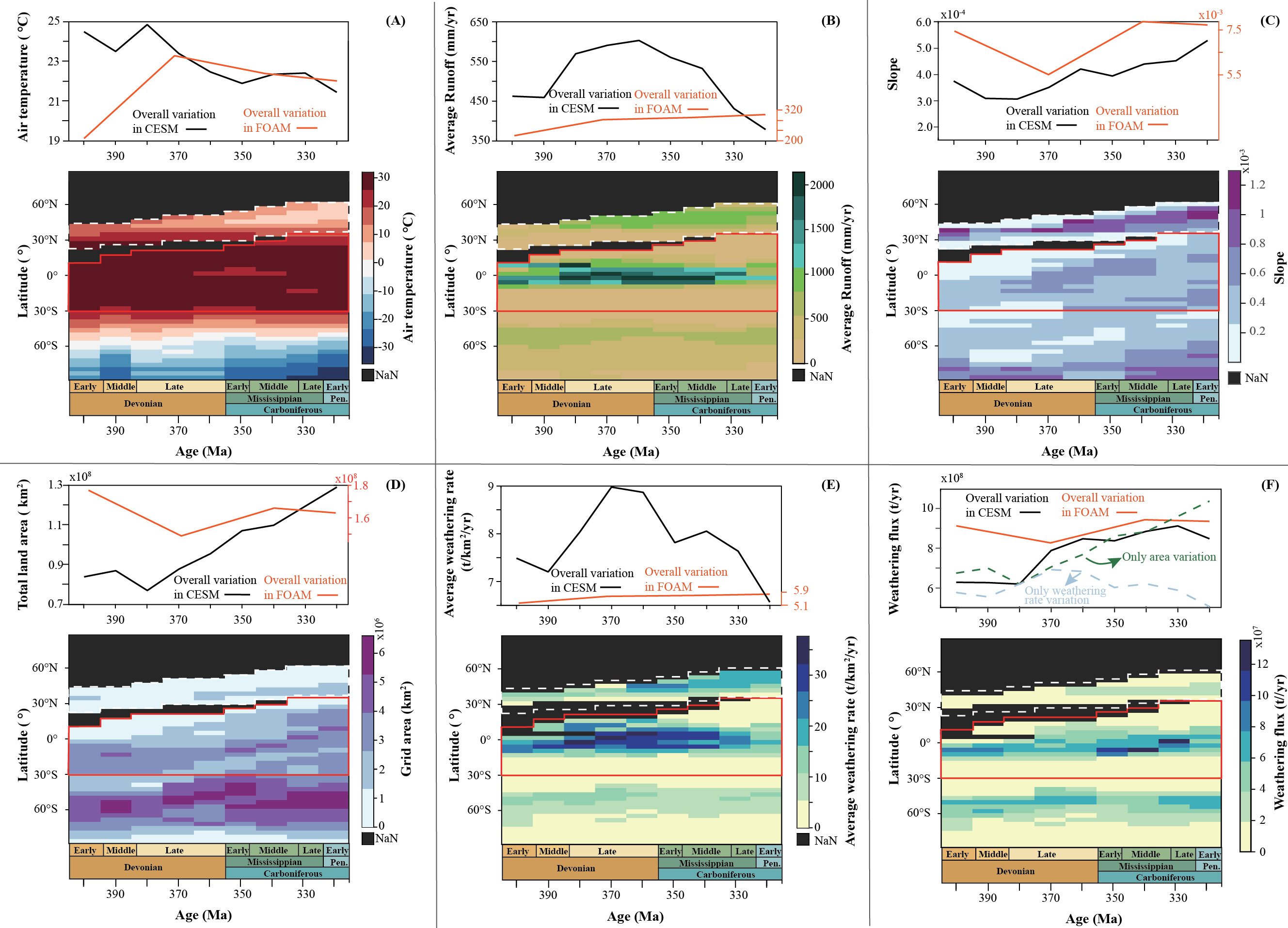
Fig.2 The dual cooling effect driven by increased continental exposure. CESM climate datasets based on fixed CO2 forcing (2800 ppm) show that as land area expands, temperatures decrease due to enhanced surface albedo (physical cooling), while global silicate weathering flux significantly increases (chemical cooling), revealing the weathering enhancement mechanism driven by marine regression.

Fig.3 Atmospheric CO2 levels and ice-line latitude variations reproduced by the CESM-SCION model.
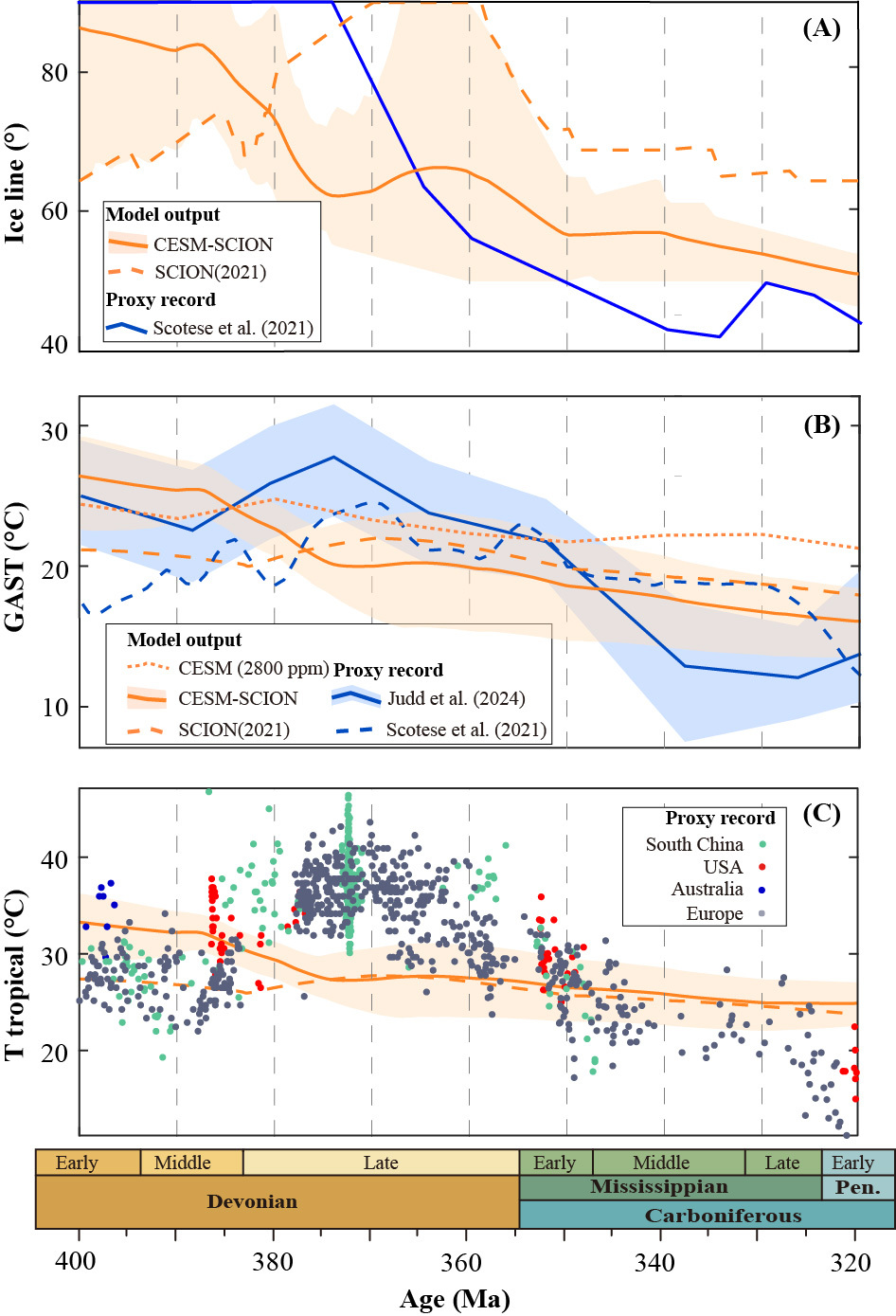
Fig.4 Ice-line latitude variations and changes in global mean and tropical temperatures simulated by the CESM-SCION model.
Download: