
The Cambrian Period was marked by several significant biotic extinctions and environmental perturbations. Among these, the Redlichiid-Olenellid Extinction Carbon Isotope Excursion (ROECE) occurring near the Cambrian Series 2–3 boundary is of particular interest, as it coincides with the turnover of trilobite evolution. This event is considered an important window for understanding the co-evolution of life and environment during the Cambrian Explosion. However, the driving mechanisms behind the ROECE event have long remained a subject of intense debate in the geosciences.
Recently, Dr. ZHANG Yinggang, a postdoctoral researcher in Professor ZHU Maoyan’s group at the Nanjing Institute of Geology and Palaeontology, Chinese Academy of Sciences (NIGPAS), in collaboration with Prof. YANG Tao (Nanjing University), Prof. HE Tianchen (Hohai University), and Profs. Benjamin Mills and Robert Newton (University of Leeds, UK), has identified the shoaling of deep anoxic waters as the primary driver of the ROECE event and its associated biological turnover. The findings were recently published in the international journal Global and Planetary Change.
Previous research on the ROECE focused primarily on its prominent negative carbon isotope excursion, proposing hypotheses such as the release of light carbon from the Kalkarindji Large Igneous Provinces (LIPs) or the oxidation of deep-sea dissolved organic carbon (DOC). However, due to a lack of high-resolution seawater sulfur isotope constraints, the feasibility of these hypotheses remained difficult to test.
In this study, the researchers conducted systematic carbonate sampling at the Xiaoerbrak section in the Tarim Basin, generating new seawater sulfur isotope data from carbonate-associated sulfate (δ34SCAS) across the ROECE interval. Their results revealed a striking pattern: while seawater carbon and sulfur isotopes exhibited a positive correlation (coupling) prior to the ROECE, they became significantly “decoupled” during the event, characterized by a sharp negative excursion in carbon isotopes (δ13C) and a concurrent positive shift in sulfur isotopes (δ34SCAS) (Fig. 1).
To quantitatively evaluate the cause of this anomaly, the researchers utilized the COPSE biogeochemical box model. The simulations demonstrated that external light carbon inputs (from LIPs), changes in primary productivity, or carbonate weathering alone could not simultaneously account for the observed negative carbon and positive sulfur isotope excursions. In contrast, the “anoxic water shoaling” model successfully reproduced the isotopic behaviours. In this scenario, deep anoxic waters, probably enriched in DOC, shoaled into the shallow shelf. Upon contact with oxygen, the DOC was oxidized, contributing a massive flux of light carbon to the system. Simultaneously, increased anoxia stimulated microbial sulfate reduction and pyrite burial, driving the remaining seawater sulfate toward heavier sulfur isotope values (Fig. 2).
The study further highlights that this large-scale shoaling of anoxic water led to a drastic reduction in oxygen levels (deoxygenation) in marine environments. This environmental stress severely restricted the living space of trilobites, triggering the rapid faunal turnover observed during the ROECE event.
This research was supported by the National Key Research and Development Program of China, the National Natural Science Foundation of China (NSFC), the Jiangsu Excellence Postdoctoral Program, and the UK Natural Environment Research Council (NERC).
Reference: Zhang, Y., Yang, T., He, T., Mills, B. J. W., Newton, R. J., Zhao, M., Yang, L., Zhu, M. (2026). Shoaling of anoxic water as a driver of the Cambrian ROECE event: new sulfur isotope evidence from the Tarim Basin. Global and Planetary Change, 261, 105403. https://doi.org/10.1016/j.gloplacha.2026.105403.
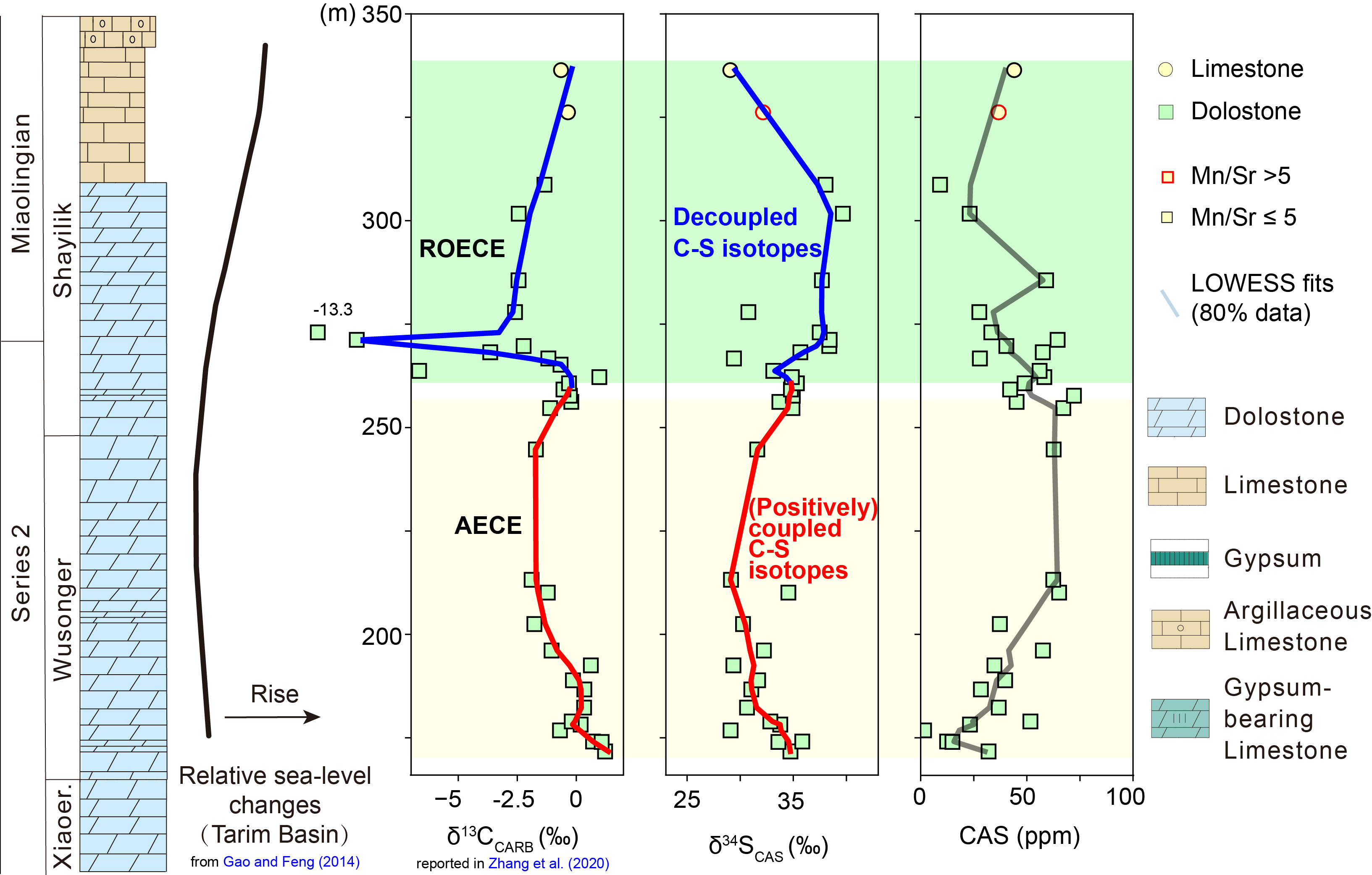
Variations in carbon and sulfur isotopes from the Wusonger to Shayilik formations at the Xiaoerbrak section, Tarim Basin. The data highlights the transition from coupled to decoupled isotopic behaviour during the ROECE.
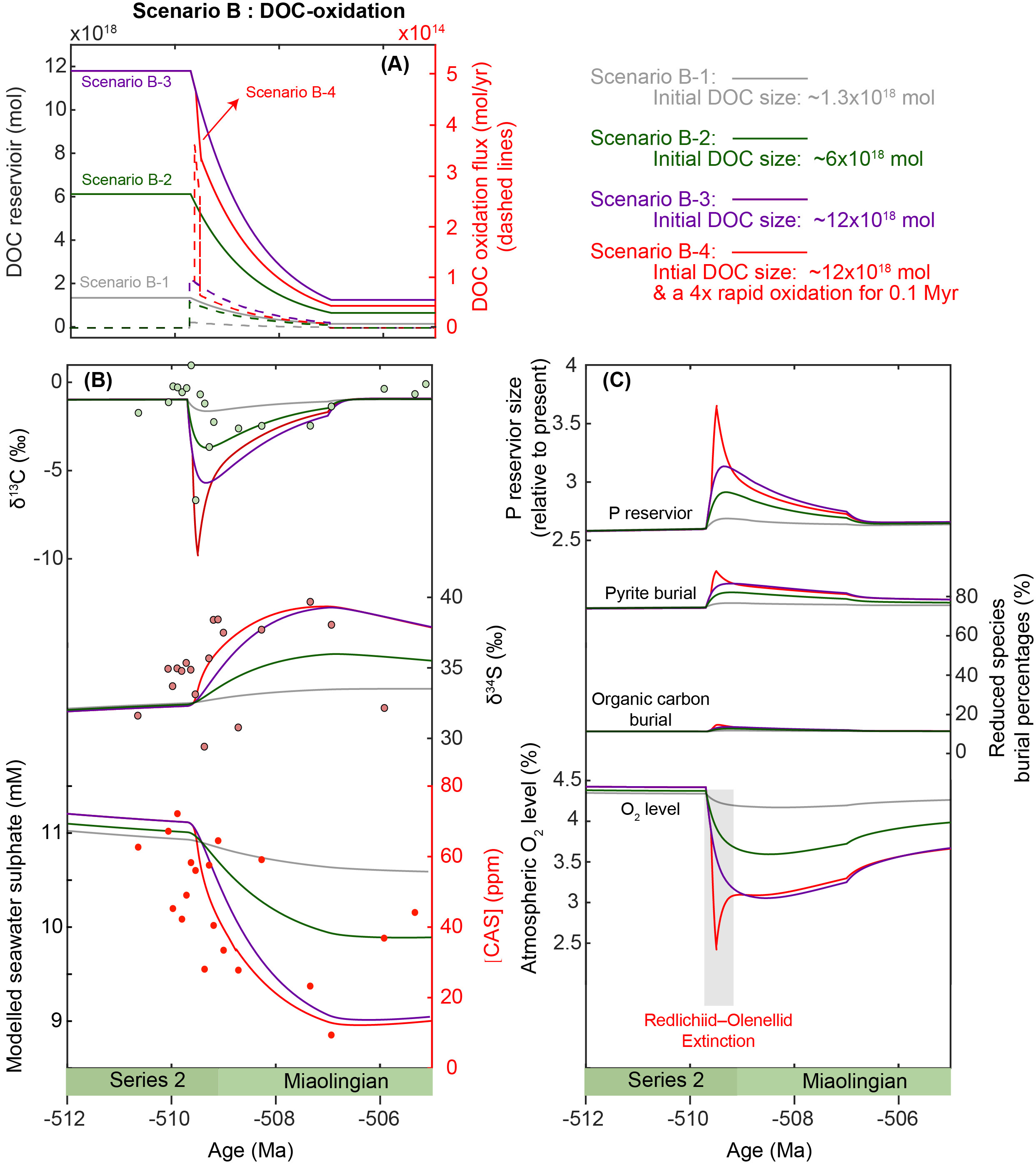
Biogeochemical modeling results for the DOC-oxidation (Anoxic Shoaling) scenario. The scenario is divided into four sub-scenarios based on DOC reservoir sizes (1.3–12×1018 mol) and oxidation rates. Panel A shows the DOC reservoir sizes and oxidation rates; Panels B and C display the simulated trends for seawater carbon and sulfur isotopes, as well as oxygen levels, illustrating the impact of anoxia on the marine environment.
Download: