
Fungi are vital components of modern terrestrial ecosystems, playing a pivotal role in sustaining material cycling, energy flow, and the structural stability of these systems as a whole. Furthermore, they have forged complex ecological relationships with terrestrial plants through diverse strategies, including saprophytism, parasitism, and symbiosis. However, in comparison to the abundant fossil records of plants and animals throughout geological history, fungal fossils, particularly those of parasitic fungi, remain relatively scarce.
The Early Cretaceous "Jehol Biota" of western Liaoning is a world-renowned fossil lagerstaett, celebrated for yielding exquisitely preserved fossils across a wide range of taxa. It provides critical fossil evidence for investigating major evolutionary events, such as the origin of early angiosperms, birds and mammals, thus serving as a key window into the origin and evolution of modern terrestrial ecosystems. Despite this, there have long been no research reports documenting fungal fossils within the Jehol Biota.
Recently, a joint research team led by Prof. WANG Yongdong from the Nanjing Institute of Geology and Palaeontology, Chinese Academy of Sciences (NIGPAS), and Prof. TIAN Ning from the College of Palaeontology, Shenyang Normal University, reported the discovery of fossil evidence for fungal parasitism and host defense in the Cretaceous Jehol Biota of western Liaoning, China. This marks the first documented record of fungal fossils within the Jehol Biota. The findings of this study were published online in Science Bulletin, an international comprehensive science journal, under the title "A 120-million-year-old fungal parasite from the Cretaceous Jehol Biota".
The research team uncovered well-preserved coniferous wood wood fossil, Protopodocarpoxylon jingangshanense Ding, from the Lower Cretaceous Yixian Formation in the Heichengzi Basin, Beipiao, western Liaoning. Their anatomical features, including Araucaria-type radial pits and Podocarpaceae-type cross-field pits, resemble those of extant Podocarpaceae species. Within these wood fossils, numerous exquisitely preserved characteristic hyphal structures bearing septa and clamp-connections were identified (Figs. 2–3), indicating their phylogenetic affiliation with Basidiomycota fungi. These hyphae colonized host tissues via two mechanisms: first, by penetrating tracheid walls to form apertures; second, by establishing complex branching networks within tracheid lumens through radial and cross-field pits. Additionally, spherical structures like chlamydospores, specialized asexual reproductive propagules, were observed attached to the hyphae. Notably, abundant tyloses were also detected in the infected host wood (Figs. 2–3). Studies of modern plant-fungal interactions have demonstrated that tyloses are physiological defense structures produced by hosts to counteract parasitic fungal invasions. On this basis, the fossil fungus is inferred to have been ecologically parasitic.
This marks another significant advancement in the field of Mesozoic wood-inhabiting fungal fossils by the research team, building on their earlier discovery this year of the oldest fossil blue-stain fungi in Jurassic wood from western Liaoning, which was recently published in National Science Review. The fossil evidence of Basidiomycota fungi parasitizing Podocarpaceae plants uncovered in this study reveals that this parasitic association existed 120 million years ago. It provides direct empirical support for investigating plant-fungal interactions of that period and facilitates insights into the evolution of plant defense mechanisms and fungal parasitic strategies.
Beyond being the first documented fungal fossil record from the Jehol Biota, this discovery also represents the earliest Cretaceous evidence of fungal fossils co-occurring with tyloses, bridging the gap in relevant records between the Jurassic and Cenozoic. Furthermore, this study demonstrates that fungi played a key role in Cretaceous terrestrial ecosystems, furnishes robust evidence of physiological defense responses by Cretaceous wood to parasitic fungi, and deepens our understanding of plant-fungal symbioses in Early Cretaceous terrestrial ecosystems.
TIAN Ning serves as the first author and co-corresponding author of the paper, with WANG Yongdong acting as a co-corresponding author. Additionally, Dr. XIE Aowei from the Senckenberg Natural History Museum (Germany), Prof. JIANG Zikun and PhD candidate HAO Ruiying from the Chinese Academy of Geological Sciences, and PhD candidate LI Fangyu from Guizhou University contributed to the study.
This study was supported by the National Natural Science Foundation of China and the Liaoning Revitalization Talents Program.
Reference: Tian Ning*, Xie Aowei, Wang Yongdong*, Jiang Zikun, Li Fangyu, Hao Ruiying, 2025. A 120-million-year-old fungal parasite from the Cretaceous Jehol Biota. Science Bulletin, 70(24): 4170-4172; 30 December 2025. https://doi.org/10.1016/j.scib.2025.08.014.
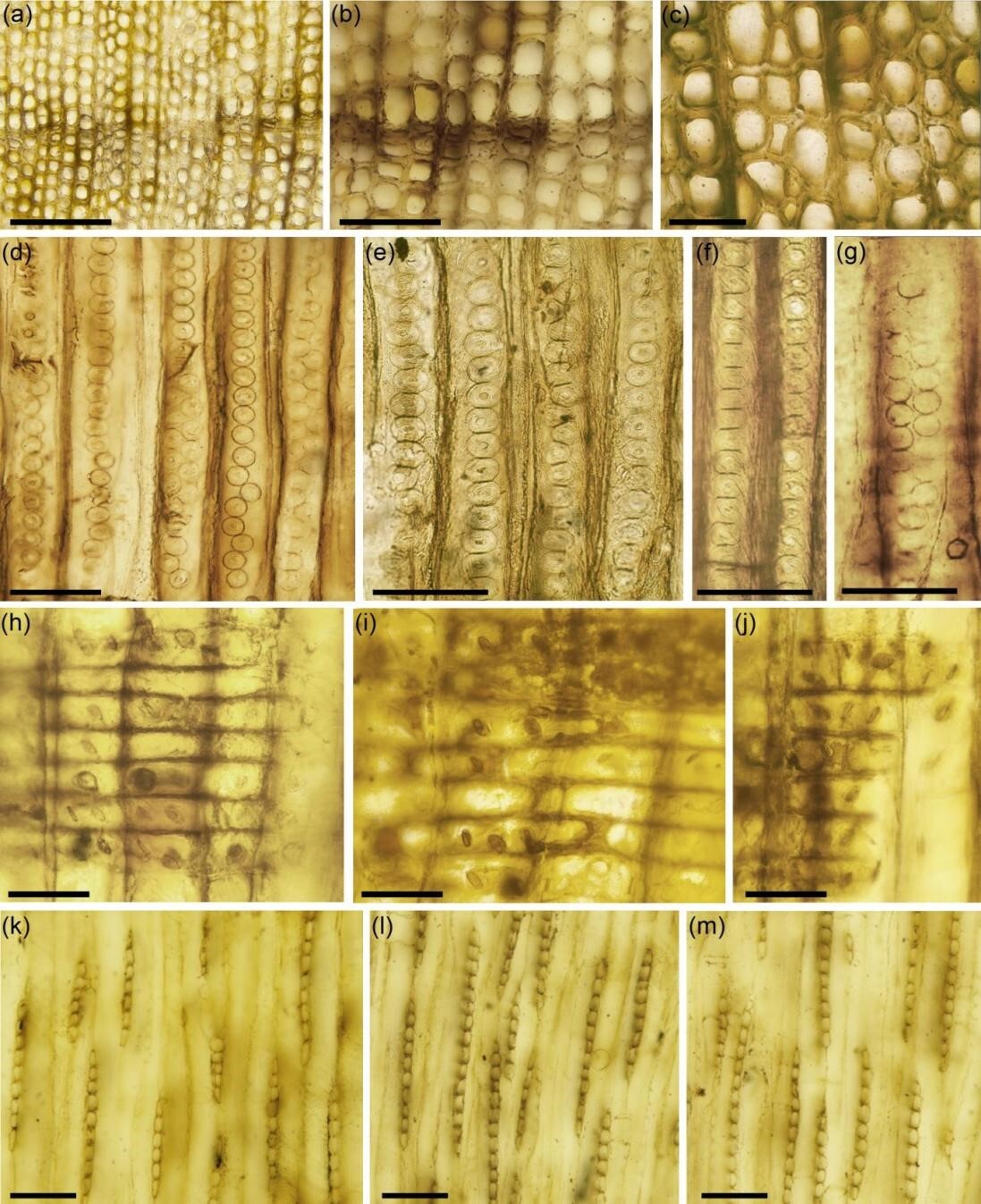
Fig.1 The anatomical features of fossil conifer wood, Protopodocarpoxylon jingangshanense Ding, from the Early Cretaceous Yixian Formation in western Liaoning, China. (a-c, cross sections; d-j, radial sections; k-m, tangential sections)
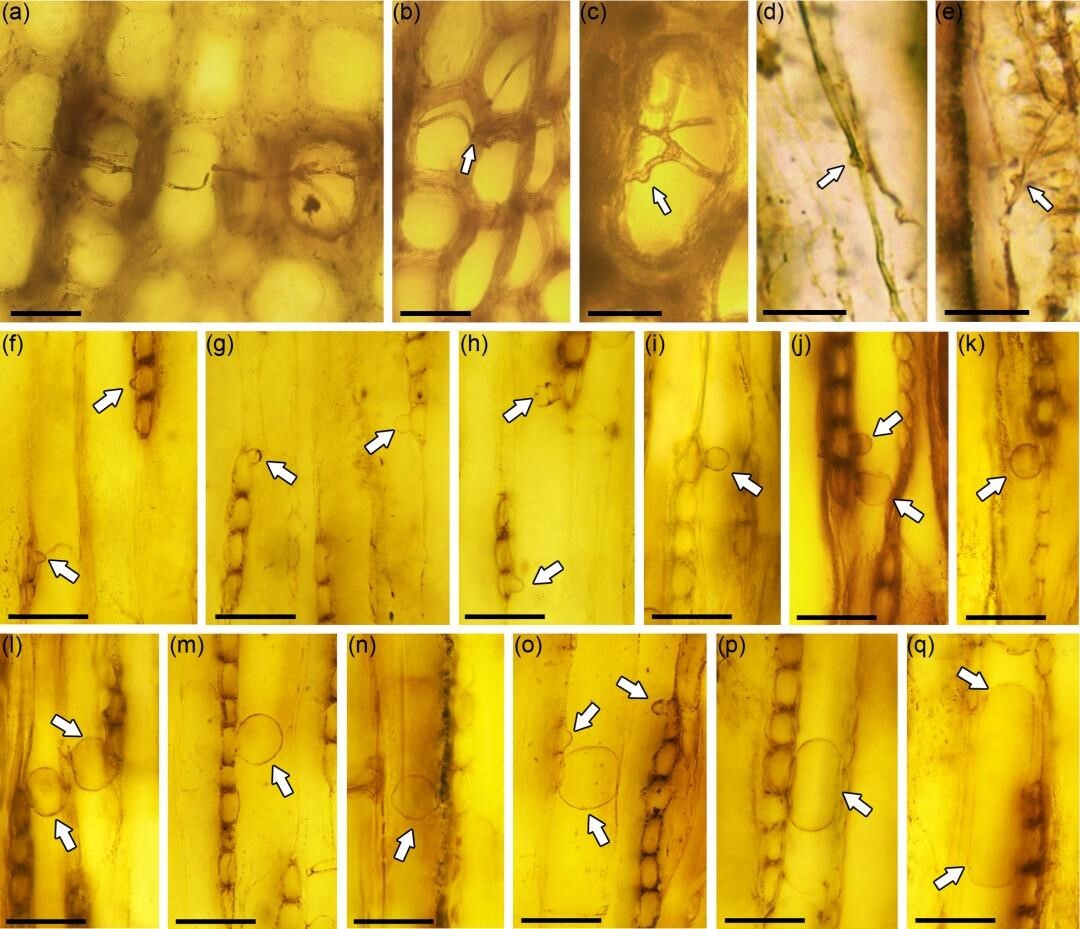
Fig.2 Fungal hyphae (a-e) and tyloses at different developmental stages (f-q) within the wood fossil
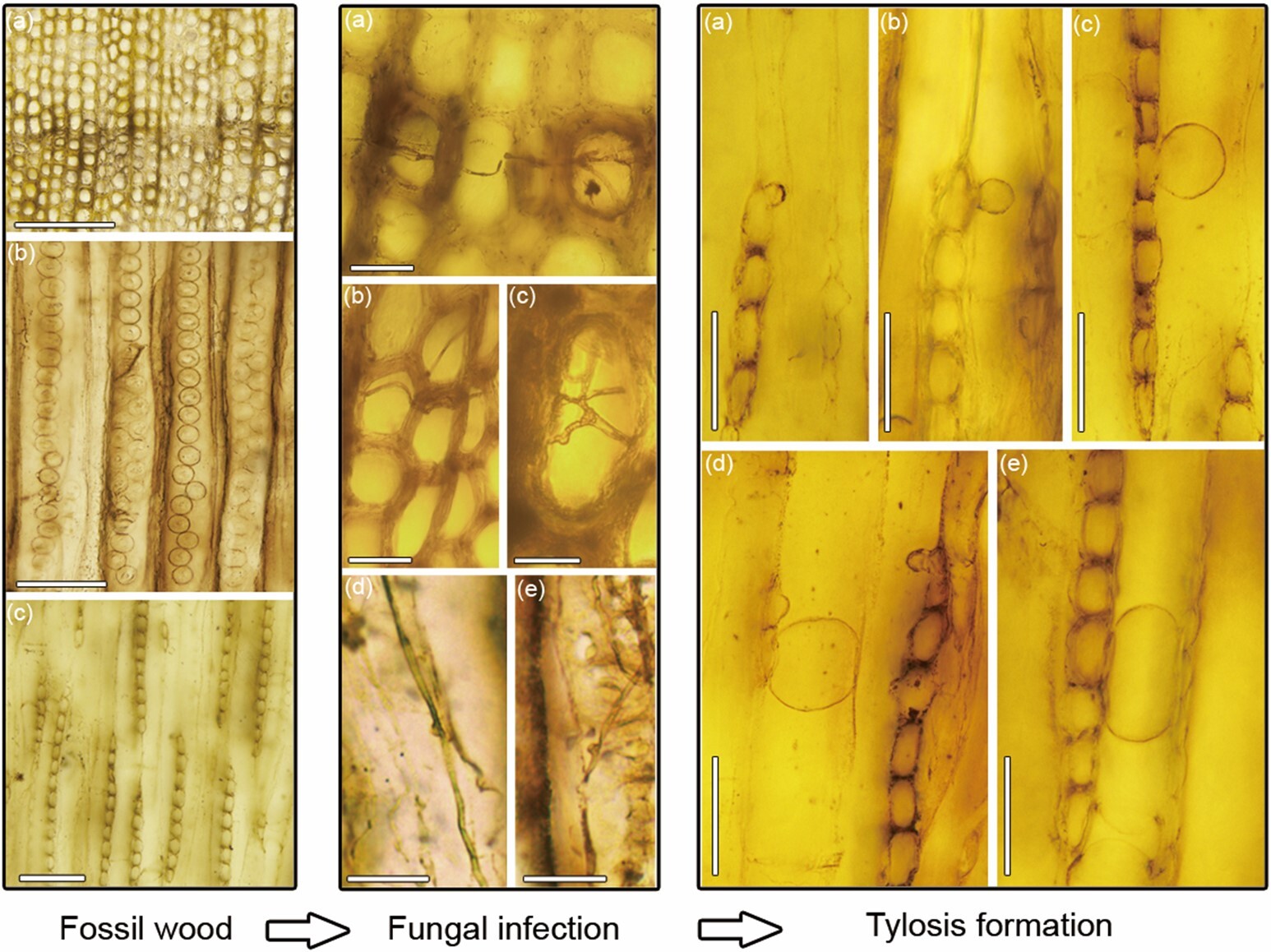
Fig.3 Anatomical structures, parasitic fungal hyphae, and tyloses from the fossil wood specimens in the Early Cretaceous of western Liaoning
Download: