
Cold-water coral ecosystems, recognized as biodiversity hotspots in the deep ocean, are currently facing dual threats from climate change and human activity. However, a critical lack of fundamental scientific knowledge has long hindered effective conservation and restoration efforts.
In a major step forward, Dr. LIU Qian, a postdoctoral researcher at the Nanjing Institute of Geology and Palaeontology, Chinese Academy of Sciences (NIGPAS), has joined forces with Dr. Michelle Taylor (University of Essex), Prof. Alex Rogers (National Oceanography Centre, UK), and Prof. Carlos Duarte (KAUST). Leading a consortium of 34 deep-sea experts from 13 nations, including the UK, USA, Canada, and Spain, the team published a landmark review in the journal Restoration Ecology. The study systematically identifies critical scientific bottlenecks and outlines a prioritized global action plan for the next decade.
Redefining the "Hidden" Coral World
Public perception of corals is often limited to the sun-drenched, reef-building species found in tropical shallow waters (warm-water corals). Unlike their tropical counterparts, cold-water corals (CWCs) have evolved a survival strategy completely independent of sunlight.
Detached from the reliance on photosynthesis, CWCs thrive beyond the photic zone, inhabiting a vast range of environments from polar shallows to abyssal depths of several thousand meters. As heterotrophs, they survive by capturing plankton and organic particles in the dark, cold depths.
While also referred to as "deep-sea corals," the study advocates for the standardized term "Cold-Water Coral" to better encompass their ecological diversity. The paper provides a unified definition: Cold-water corals refer to coral taxa that are azooxanthellate (do not rely on symbiotic algae for photosynthesis) or are only facultatively symbiotic.
Stemming from a specialist workshop held in Norway, the study underscores the irreplaceable ecological role of CWCs. The complex three-dimensional structures built by corals and sponges serve as essential nurseries, feeding grounds, and refugia for crustaceans, echinoderms, and deep-sea fish. Furthermore, they play a vital role in regulating the ocean carbon cycle.
Despite being designated by the UN as "Vulnerable Marine Ecosystems" (VMEs), effective protection is lack due to knowledge gaps in five key areas:
1.Biogeography: Distribution data is heavily biased towards the Northern Hemisphere, with severe gaps in the Southern Hemisphere, West Pacific, and Indian Ocean, limiting the accuracy of habitat suitability models.
2.Taxonomy & Community Assembly: High morphological plasticity leads to taxonomic confusion, hindering accurate assessments of biodiversity and succession.
3.Early Life History: Knowledge regarding gametogenesis, larval behavior, and settlement mechanisms is extremely limited, directly constraining the development of active restoration techniques.
4.Population Connectivity: A lack of quantified genetic flow data between populations makes it difficult to scientifically design networks of Marine Protected Areas (MPAs).
5.Growth & Trophic Dynamics: In the face of ocean acidification and warming, current understanding of biomineralization and energy budgets is insufficient to assess climate resilience.
To bridge these gaps, the 34-expert team proposed a strategic roadmap for the next decade, highlighting five priority actions:
1.Fill Geographic Blanks: Conduct systematic baseline surveys in unexplored deep-sea regions (West Pacific, South Pacific, Indian Ocean) to correct global distribution models.
2.Strengthen Fundamental Biology: Prioritize research on taxonomy, reproduction, connectivity, and metabolic dynamics to provide a theoretical foundation for science-based conservation.
3.Revolutionize Funding and Monitoring: Given the extremely slow growth rates of CWCs, the authors urge funding agencies to move beyond short-term project cycles and establish multi-decadal ecological monitoring systems (20–50 years) to objectively evaluate restoration success.
4.Promote Open Data: Establish standardized mechanisms for deep-sea data sharing, transforming "dark data" trapped in individual labs into global public assets for scientists and policymakers.
5.Bridge Science and Policy: Integrate CWC conservation into the agendas of the Convention on Biological Diversity (CBD) and the UN Framework Convention on Climate Change (UNFCCC) to drive the scientific designation of high-seas protected areas.
This work was supported by the National Key Research, Development Program of China and China Postdoctoral Science Foundation, and Coral Research and Development Acceleration Platform (CORDAP).
Reference: Liu, Q., Rogers, A.D., Roch, C., Gordon, J.D., Duarte, C.M., Robinson, L.F., Waller, R.G., Ferrier-Pagès, C., Brooke, S., Carreiro-Silva, M., Benson, K., Du Preez, C., Banks, S., Barry, J.P., Cordeiro, R.T.S., Cordes, E., Hennige, S., Hourigan, T.F., Kitahara, M.V., Kutti, T., Larsson, A.I., Lauretta, D.M., Matsumoto, A.K., Ross, R.E., Ramirez-Llodra, E., Yánez-Suárez, A.-B., Metaxas, A., Edinger, E., Filander, Z.N.P., Hendy, E., Montseny, M., Buglass, S., de Carvalho Ferreira, M.L., Taylor, M.L. 2025. Critical knowledge gaps in the conservation and restoration of cold-water corals. Restoration Ecology. e70286. https://doi.org/10.1111/rec.70286.
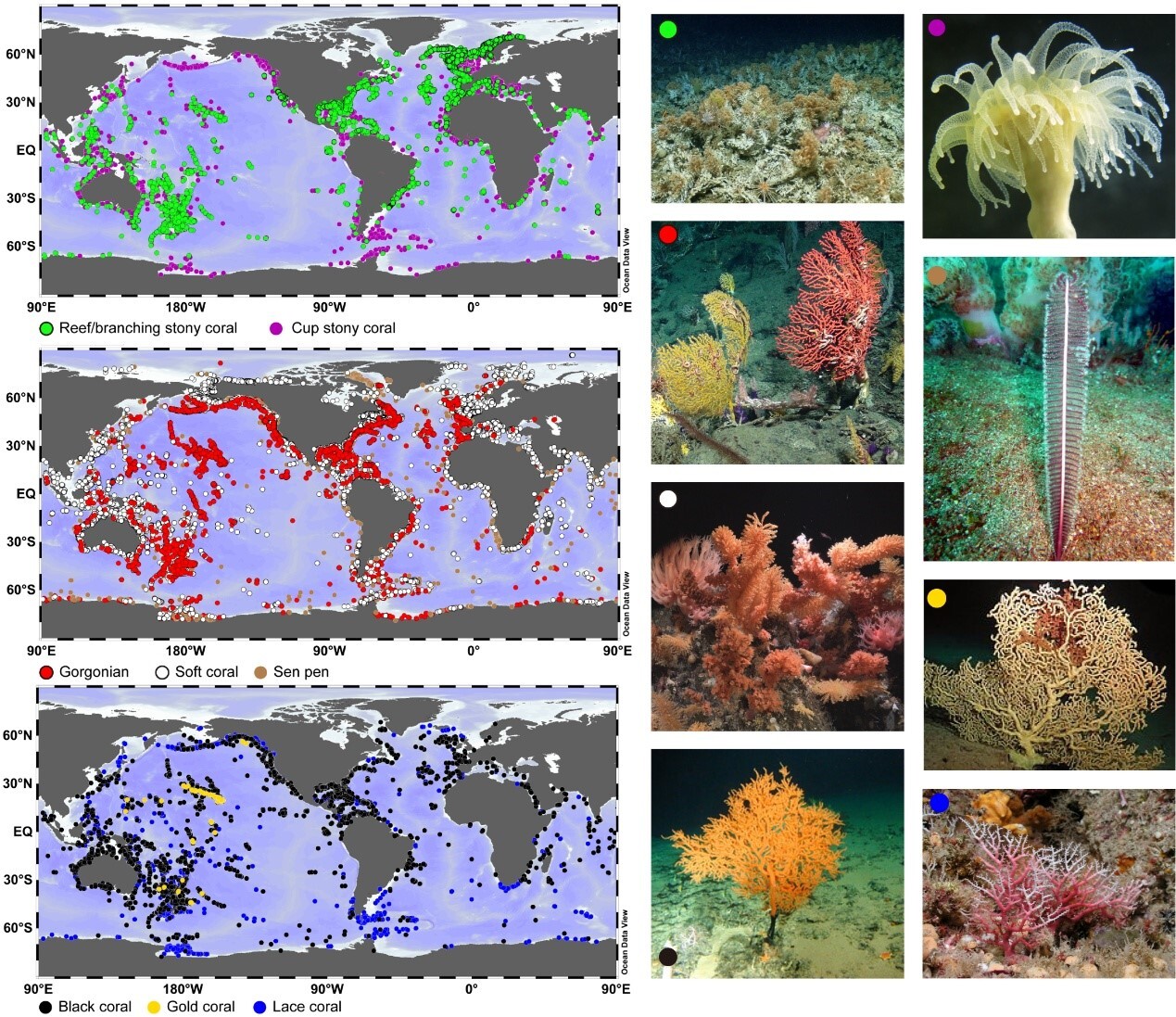
Cold-water coral distribution
Download: