
Stromatoporoid sponge communities from the early Silurian on the Tibetan Plateau has long been poorly represented in the fossil record, hindering the assessment of the region’s role in global Paleozoic marine evolution. Recent investigation by a research team from Nanjing Institute of Geology and Palaeontology, Chinese Academy of Sciences (NIGPAS), and Korea University on the early Silurian stromatoporoids from Baingoin, central Tibet have significantly improved this situation. The team has systematically documented an early Silurian (Aeronian) stromatoporoid assemblage from shallow-marine carbonate strata of the lower Dongka Group, with findings published in the Journal of Palaeogeography.
Three representative stromatoporoid species were identified in this study. The newly established species Cystostroma dongkaense sp. nov. is named after the Dongka locality where the material was collected. Another new species, Ecclimadictyon gejingae sp. nov., is dedicated to Ms. Ge Jing for her essential support during the field investigations in the high-altitude areas of Tibet. In addition, the known species Clathrodictyon shiqianense Dong and Yang, 1978 is also recorded from the same succession. The assemblage is dominated by clathrodictyid-type stromatoporoids, reflecting a characteristic post-extinction recovery community structure of the early Silurian.
Taxonomic comparison indicates notable affinities between the Baingoin assemblage and coeval stromatoporoid faunas from South China. This similarity suggests that during the early Silurian the Lhasa terrane occupied warm, shallow-marine latitudes favourable for hypercalcified sponge growth and that faunal exchange likely occurred between the two regions. Thus, the Baingoin stromatoporoids not only document reef ecosystem re-establishment folloowing the end-Ordovician mass extinction but also provide new constraints on early Silurian palaeogeography and the early evolution of the Tethyan realm.
Overall, this study advances the documentation of regional fossils, improves understanding of post-extinction reef recovery, and refines reconstruction of early Silurian palaeogeography. Future work integrating refined stratigraphic correlation and geochemical analyses is expected to further clarify environmental evolution and spatial dynamics of early Silurian reef ecosystems on the Tibetan Plateau.
Reference: Jeon, J., Chen, Z.Y., Wang, G.X., Zhang, Y.D., 2026. Middle Llandovery (Silurian) stromatoporoids from Baingoin, Xizang (Tibet), China. Journal of Palaeogeography, 15(2), 100336. https://doi.org/10.1016/j.jop.2026.100336.
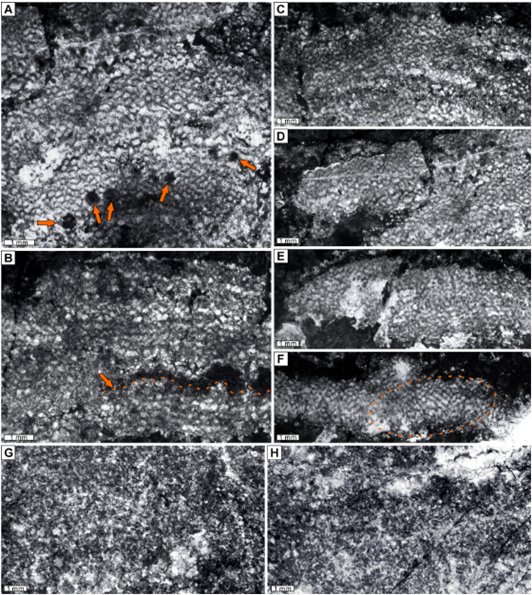
Ecclimadictyon gejingae sp. nov.
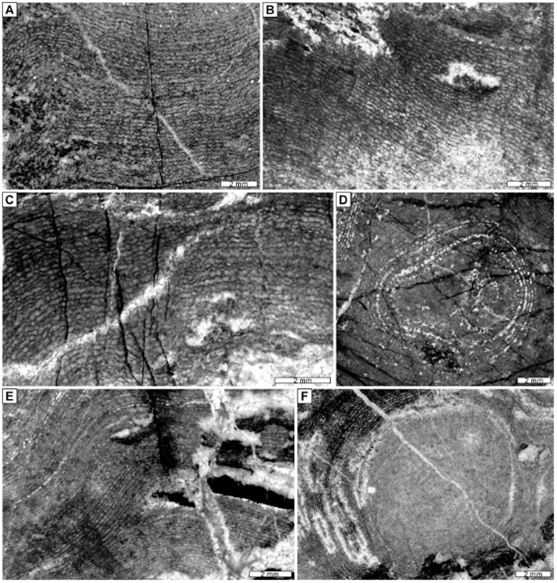
Clathrodictyon shiqianense
Download: