
The mid-Cretaceous (Albian–Turonian) interval was a time window characterized by extreme climatic conditions, marked by high production rates of oceanic crust and the formation of large igneous provinces (LIPs), which promoted CO2 emissions to the ocean-atmosphere system, leading to a pronounced greenhouse climate. Under these conditions, enhanced continental weathering and increased nutrient input to the oceans promoted widespread marine oxygen depletion, resulting in a series of globally significant Oceanic Anoxic Events (OAEs). Among them, the late Albian OAE 1d and OAE 2 spanning the Cenomanian/Turonian boundary (CTB) are characterized by the widespread deposition of organic-rich sediments and pronounced positive carbon isotope excursions, making them key time windows for investigating mid-Cretaceous carbon cycle perturbations and palaeoceanographic evolution.
Recently, an international research team consisting of Dr. HAN Meiling, Prof. LI Gang from the Nanjing Institute of Geology and Palaeontology, Chinese Academy of Sciences (NIGPAS), alongside Prof. Jörg Mutterlose from Ruhr University Bochum, Germany, Prof. Ulrich Heimhofer from Leibniz University Hannover, Germany, and Dr. Alexander Wheeler from Geological Institute, RWTH Aachen University, Germany, conducted a systematic investigation into mid-Cretaceous stable isotope records and diagenetic overprints in southern Tibet. Focusing on the Qiangdong section in the Gamba area, the team integrated carbon and oxygen isotope analyses with mineralogical data, Rock-Eval pyrolysis, and palynofacies analysis to evaluate the reliability of carbonate carbon isotope records and to assess how diagenetic processes constrain the identification of Oceanic Anoxic Events (OAEs). This study has been published in the international journal “Palaeogeography, Palaeoclimatology, Palaeoecology”.
In this study, the first continuous record of carbon and oxygen stable isotopes spanning the late Albian to early Turonian from the Qiangdong section in the Gamba area, southern Tibet, and systematically evaluates the impact of diagenesis on carbonate carbon isotope signals. A high-resolution δ13Ccarb record reveals an approximately 1.5‰ positive carbon isotope excursion within the calcareous nannofossil UC0 Zone, allowing the first identification of OAE 1d in this region and enabling detailed correlation with coeval records from multiple global oceanic realms.
This study presents the first continuous late Albian–early Turonian carbon and oxygen stable isotope record from the Qiangdong section (Gamba area, southern Tibet) and evaluates the effects of diagenesis on carbonate carbon isotope signals. An approximately 1.5‰ positive δ¹³Ccarb excursion within the calcareous nannofossil UC0 zone allows the first recognition of OAE 1d in this region and facilitates global chemostratigraphic correlation. Extremely low δ18Ocarb values, coupled with δ13Ccarb–δ18Ocarb covariation, illite-rich clay mineral assemblages, elevated Tmax values (432–560°C) and TAI indices, and selective dissolution of calcareous nannofossils collectively indicate that the Qiangdong section has undergone intense burial diagenesis and thermal alteration. These effects are particularly pronounced in intervals characterized by enhanced detrital input and reduced carbonate content, where δ13Ccarb signals are more susceptible to diagenetic modification.
This study provides critical new data and geochemical constraints for carbon isotope chemostratigraphic correlation across the late Albian to early Turonian in the eastern Tethys. The results demonstrate that, under conditions of strong diagenetic overprint and diminished carbonate content, the characteristic positive carbon isotope excursion of OAE 2 near the Cenomanian–Turonian boundary may be significantly attenuated or even obscured in the Qiangdong section. These findings highlight the necessity of rigorous diagenetic screening when interpreting δ13Ccarb records, to ensure the reliability of carbon isotope-based chemostratigraphic correlations.
This research was supported by the National Natural Science Foundation of China.
Reference: Han, M., Li, G.*, Wheeler, A., Heimhofer, U., Mutterlose, J., 2026. A mid-Cretaceous (Late Albian–Early Turonian) stable isotope record from southern Tibet–Pristine or diagenetically altered?. Palaeogeography, Palaeoclimatology, Palaeoecology, 113552. https://doi.org/10.1016/j.palaeo.2026.113552.
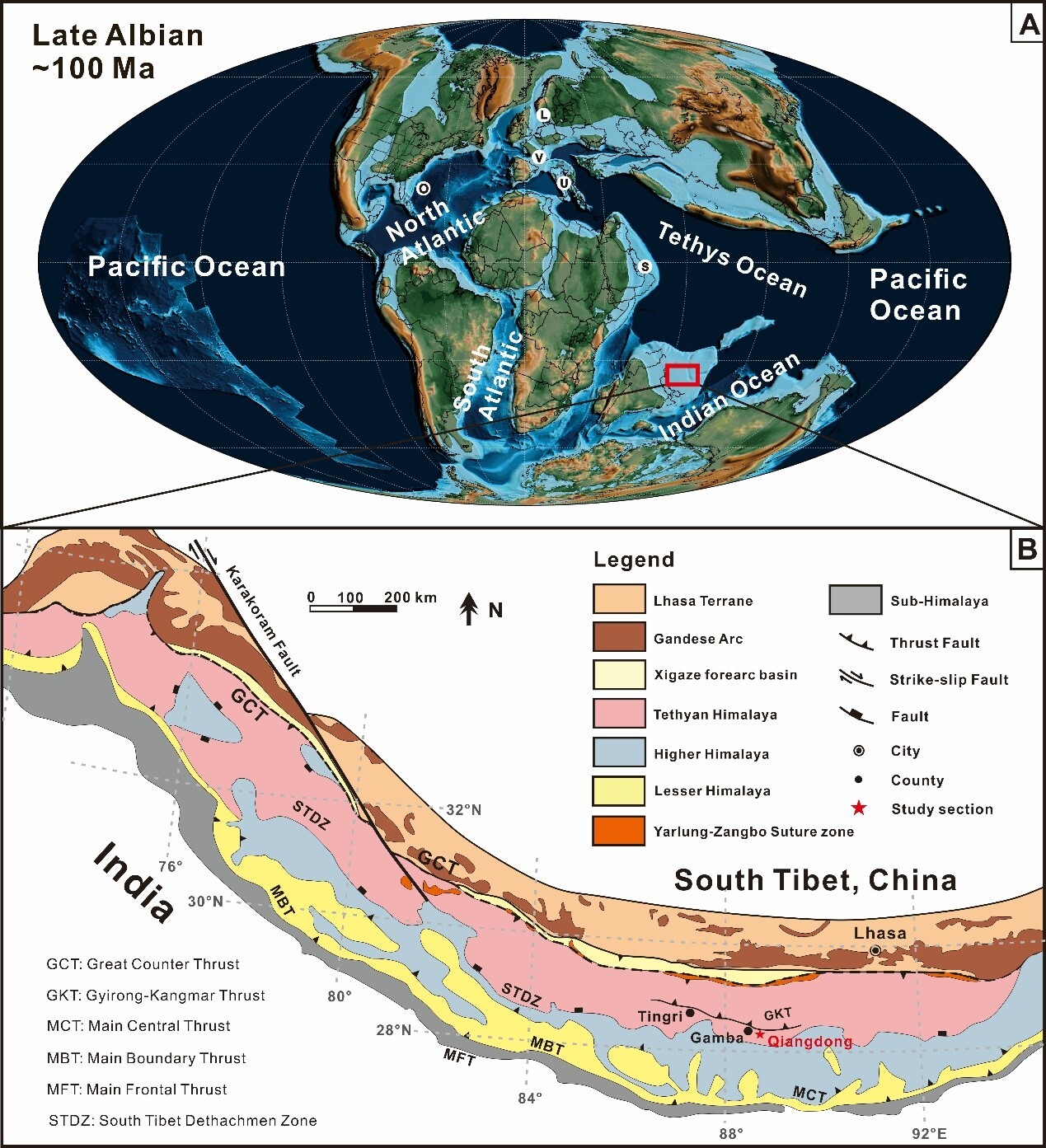
Fig.1 (A) Palaeogeographic map for the late Albian (~100 Ma); (B) Simplified geological map of South Tibet showing the Qiangdong section.
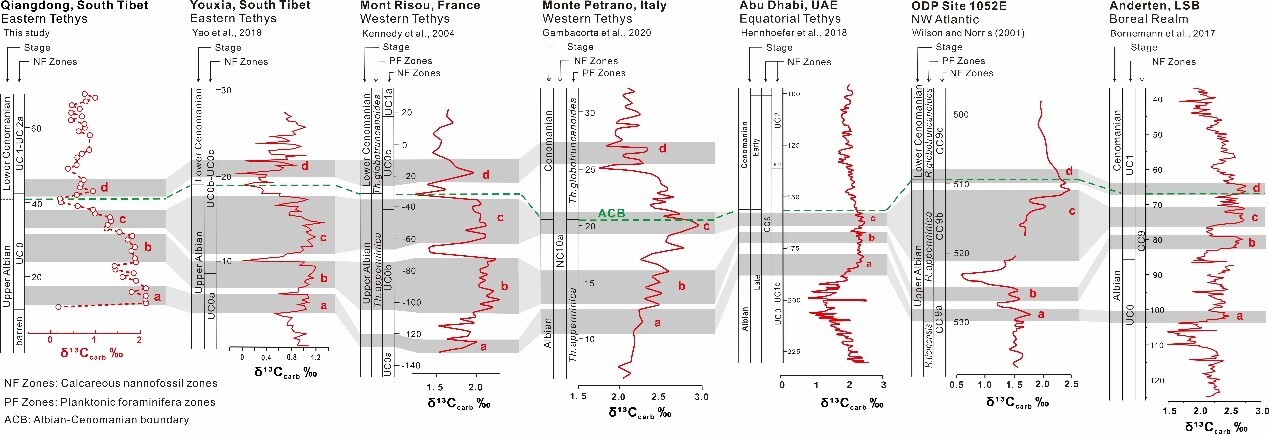
Fig.2 Correlation of δ13Ccarb records within the Albian/Cenomanian boundary interval, including the OAE 1d.
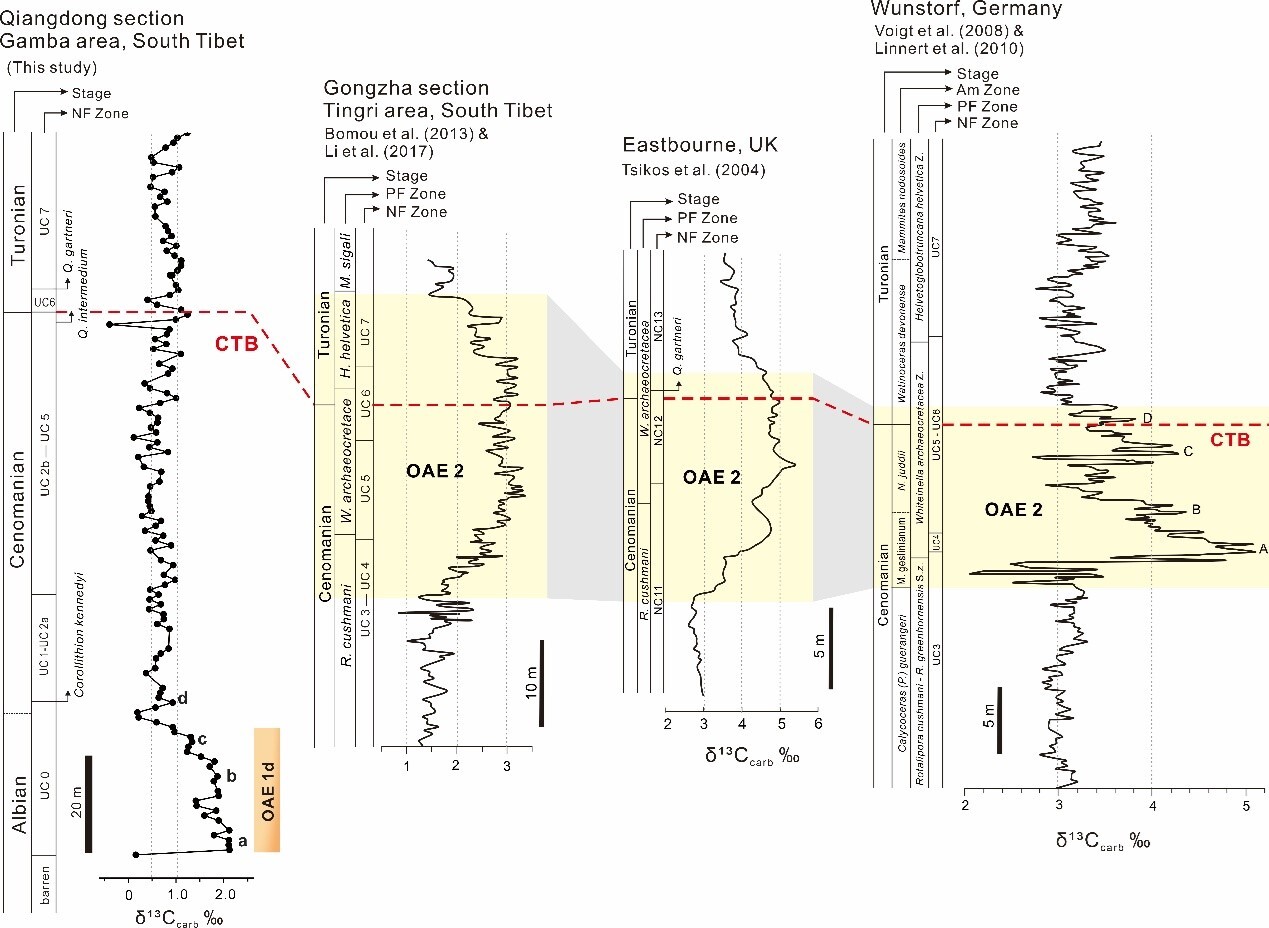
Fig.3 Correlation of the δ13Ccarb records in the Cenomanian/Turonian boundary interval.
Download: