
Recently, Prof. WANG Guangxu, from the Nanjing Institute of Geology and Palaeontology, Chinese Academy of Sciences (NIGPAS), published his English monograph Systematics and Evolution of Cyathophylloidid and Stauriid Rugose Corals (Late Ordovician–mid-Silurian) in Fossils and Strata. The volume, 195 pages in length and illustrated with 102 figures, provides a comprehensive synthesis of the taxonomy and evolutionary history of two major rugose coral families during the Late Ordovician to mid-Silurian interval. This work resolves long-standing taxonomic uncertainties and offers new insights into the evolution of Early Palaeozoic marine ecosystems.
For more than two centuries, Cyathophylloididae and Stauriidae have often been broadly grouped together under the Stauriidae sensu lato, ever since Linnaeus first described Stauria favosa in 1758. However, many taxa, especially those established since the mid-20th century, have remained inadequately described and illustrated, leaving their validity in doubt and hindering reliable analyses of their origin and evolutionary trajectory. To address this issue, Wang’s study re-examines a large number of published specimens, particularly type material housed in palaeontological institutions in China and Estonia, supplemented by newly collected fossils, and undertakes a systematic revision of these coral groups.
The research introduces a new framework for parricidal increase in rugose corals, distinguishing between septal parricidal increase (where new walls are formed from pre-existing septa) and aseptal parricidal increase (where septa are not involved). Wang argues that the traditional division into “peripheral” and “axial” increase, based solely on the position of new individuals, fails to capture the essential differences between typical stauriid rugose corals and other groups, and has led to considerable confusion. On this basis, the study redefines the scope of Cyathophylloididae and Stauriidae, and within the latter recognizes three subfamilies based on distinct septal increase modes (KLAC, KAC, and KA). Two new subfamilies, Paraceriasterinae and Heininae, are established, along with two new genera, Heina and Yuina. Furthermore, the monograph provides a detailed stratigraphic and geographic synthesis of the distribution of these corals within a high-resolution framework, tracing their origins, diversification, and extinction patterns.
This research was financially supported by the National Key Research and Development Program of China, the National Natural Science Foundation of China and the State Key Laboratory of Palaeobiology and Stratigraphy (LPS).
Reference: Wang, G.X. 2026. Systematics and evolution of cyathophylloidid and stauriid rugose corals (Late Ordovician–mid-Silurian). Fossils and Strata, 73, 1–195. https://www.scup.com/doi/book/10.18261/9788294167210-2026.
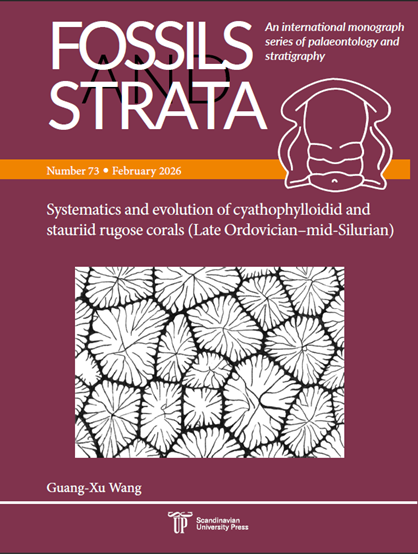
cover page of the monograph
Download: