
The Permian–Triassic (P–Tr) transition, approximately 252 million years ago, witnessed the most severe mass extinction event in Earth’s history, with more than 80% of marine species eliminated and ecosystems virtually collapsed. The crisis is widely attributed to large‑scale volcanic eruptions, including the Siberian Traps and acidic volcanism in the Tethyan realm, which injected massive CO2 and volatile substances into the atmosphere, triggering rapid global warming, ocean acidification, and intense carbon‑cycle perturbations. Rising temperatures further reduced oxygen solubility and enhanced water‑column stratification, weakening oceanic circulation and deep‑water ventilation, leading to widespread marine anoxia and even local euxinia.
However, a long‑standing question remains: did the severity of this global catastrophe vary among ocean basins due to differences in circulation intensity and connectivity? This issue is critical for understanding the spatiotemporal patterns of the extinction and the subsequent biotic recovery.
Recently, an international research team led by Professor ZHANG Hua of the Nanjing Institute of Geology and Palaeontology, Chinese Academy of Sciences (NIGPAS), published a study in Earth and Planetary Science Letters that employs magnesium isotopes (δ26Mg) as a novel tracer to constrain inter‑ocean connectivity during the P–Tr transition and its influence on ecosystem resilience. The first author is Associate Professor HU Zhongya of Tongji University, and the corresponding author is Professor ZHANG Hua.
Magnesium is a major constituent of seawater, second only to sodium, and has a long residence time of approximately 13 million years in the modern ocean. This vast marine Mg reservoir imparts a strong geochemical “inertia” to the open ocean – even under global environmental perturbations, the Mg isotope composition of the open ocean remains remarkably stable. In contrast, published records show that short‑term (<1 Myr) significant variations in seawater δ26Mg are almost exclusively associated with restricted basins. Therefore, Mg isotopes have recently emerged as a powerful proxy for identifying transient basin restriction.
During the P–Tr transition, the marine Mg cycle was highly dynamic, influenced by enhanced continental weathering, widespread dolomitization, and reverse weathering. These processes are all accompanied by significant Mg isotope fractionation, providing a theoretical basis for using δ26Mg to trace paleo‑ocean connectivity.
The research team systematically analysed Mg isotopes from three major paleo‑oceans – the Paleo‑Tethys, Neo‑Tethys, and Panthalassa. Sampling sections included the Saiq section in Oman and the Naluch Nala section in the Salt Range of Pakistan (Neo‑Tethys), as well as the Kamura and Taho sections in Japan (Panthalassa). All sections preserve complete P–Tr successions with well‑constrained conodont biostratigraphy and carbon isotope correlations.
The results reveal a fundamental divergence: seawater δ26Mg remained stable (−0.4‰ to −0.3‰) in the Neo‑Tethys and Panthalassa across the P–Tr transition, whereas it increased by more than 0.5‰ in the Paleo‑Tethys. Previous work by the same group (Hu et al., 2021) demonstrated that the pronounced δ26Mg rise in the Paleo‑Tethys reflects intensified dolomitization under global warming – light 24Mg was preferentially incorporated into dolomite, enriching the residual seawater in heavy 26Mg.
This stark inter‑basin contrast indicates that different ocean basins responded in fundamentally different ways to the same global climate perturbation. The Neo‑Tethys maintained effective water exchange with the Panthalassa, and its seawater chemistry was buffered by the vast Panthalassa reservoir. In contrast, the Paleo‑Tethys was relatively restricted, so the local dolomitization signal was amplified and clearly recorded in its Mg isotope composition.
To further quantify the buffering capacity of different basins, the team constructed a box model coupling the Mg cycle and water exchange. The model integrates Mg fluxes from riverine input, dolomitization, high‑temperature and low‑temperature alteration, and incorporates inter‑basin exchange parameters.
Simulations show that the residence time of Mg in seawater is the key parameter controlling the amplitude of δ26Mg variation. At Early Triassic seawater Mg concentrations of 10–50 mmol/kg, the residence time is estimated at 2–10 Myr. For a shorter residence time (~2 Myr), a roughly three‑fold reduction in exchange is sufficient to produce the observed isotope shift; for a longer residence time (~5 Myr), nearly two orders of magnitude of restriction are required to generate a similar change.
More importantly, the model quantitatively evaluates the buffering capacities of the different basins. In the relatively restricted Paleo‑Tethys, enhanced dolomitization over ~0.75 Myr consumed ~3.15 × 10¹⁸ mol of Mg, depleting the basin’s Mg reservoir by ~20%. In contrast, imposing the same relative increase in dolomitization flux on the vast Panthalassa/Neo‑Tethys system would result in a depletion of <5%, producing a δ26Mg change of <0.1‰ – consistent with the observed stability. These results demonstrate that the open ocean’s large Mg reservoir provides strong chemical buffering, whereas restricted basins are highly sensitive to environmental perturbations.
Stable seawater chemistry is crucial for the survival and recovery of marine organisms. Palaeoecological evidence indicates that shallow‑water carbonate platforms in the Neo‑Tethys maintained well‑oxygenated conditions after the extinction, hosting diverse benthic assemblages dominated by crinoids, bivalves, gastropods, brachiopods, and ostracods. These communities suggest that the Neo‑Tethys, being effectively connected to the Panthalassa, provided a relatively stable chemical environment that served as a refugium for surviving taxa.
In contrast, the restricted setting of the Paleo‑Tethys amplified multiple environmental stresses: enhanced dolomitization consumed alkalinity, potentially accelerating local ocean acidification; limited circulation further exacerbated anoxia; and elevated nutrient inputs from continental weathering accumulated in the semi‑closed basin, promoting eutrophication and widespread oxygen deficiency. The occurrence of pyrite in shallow‑water carbonates supports persistent suboxic to anoxic conditions in the Paleo‑Tethys.
This study provides the first inter‑basin geochemical evidence for oceanic differentiation during the P–Tr transition, revealing that the marine system did not respond homogeneously to the global crisis but instead exhibited a fundamental structural divergence. The findings deepen our understanding of the recovery mechanisms following the largest mass extinction in Earth’s history and introduce a new isotopic tool for paleo‑oceanographic circulation reconstruction.
This work was supported by the National Natural Science Foundation of China and the China Scholarship Council.
Reference: Zhongya Hu, Weiqiang Li, Robert J. Newton, Sylvain Richoz, Yasufumi Iryu, Satoshi Takahashi, Takumi Maekawa, Zhiguang Xia, Shouye Yang, Shu‑Zhong Shen, Hua Zhang*. 2026. Magnesium isotopes constrain connectivity and environmental resilience among ocean basins during the Early Triassic. Earth and Planetary Science Letters 690: 120191. https://doi.org/10.1016/j.epsl.2026.120191.
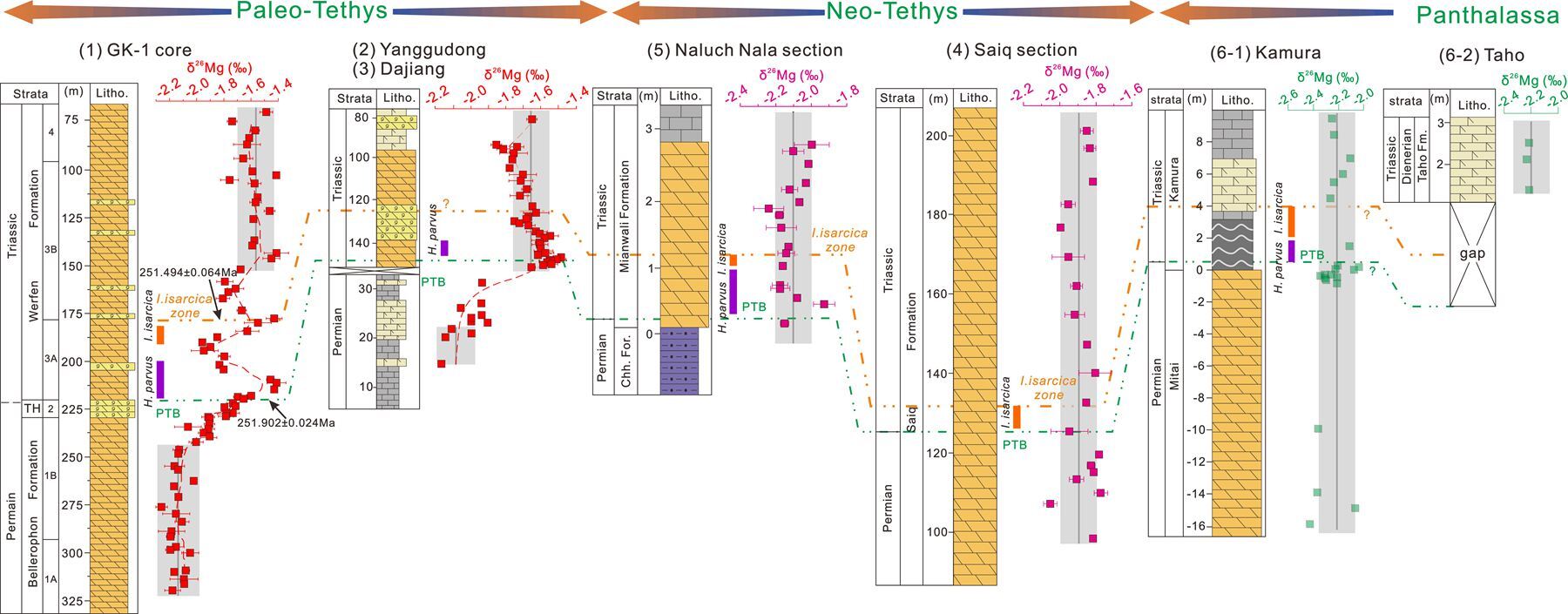
Fig.1 Comparison of δ²⁶Mg variations in typical dolomite sections from the Paleo‑Tethys, Neo‑Tethys and Panthalassa oceans

Fig.2 (A–C) Geochemical variations during the P–Tr transition (from literature); (D) Reconstructed seawater δ²⁶Mg from dolomite records (this study); (E–G) Element and isotope mass‑balance modeling testing the buffering capacity of Panthalassa vs. Paleo‑Tethys
Download: