
The Late Ordovician mass extinction (LOME), the first of the "Big Five" Phanerozoic mass extinctions, is generally considered to have occurred in two distinct pulses closely linked to the rapid growth and subsequent melting of the Gondwanan ice sheets. As a prominent component of Ordovician marine ecosystems, trilobites suffered catastrophic losses during this event, with extinction rates of approximately 49% at the family level and 70% at the genus level—far exceeding the average extinction intensity for contemporaneous marine life. It has long been assumed that the recovery of trilobites was delayed by global sea-level rise and widespread deep-water anoxia, with significant signs of recovery not appearing until the middle Llandovery (late Rhuddanian to Aeronian) or even later. However, some newly discovered trilobite fossils from the Ordovician–Silurian boundary interval across the globe have provided an unprecedented opportunity to reassess this scenario.
Recently, a research team led by Dr. WEI Xin, Professors ZHAN Renbin, RONG Jiayu, HUANG Bing, and Dr. YAN Guanzhou from the Nanjing Institute of Geology and Palaeontology, Chinese Academy of Sciences (NIGPAS), has made a major breakthrough in understanding the post-extinction recovery patterns of global trilobites. Their study reveals that trilobite recovery did not commence in the late Rhuddanian, as traditionally believed, but began shortly after the second pulse of the LOME—shifting the onset of recovery approximately 1.4 million years earlier than previously recognized. The findings were recently published in Earth-Science Reviews.
To investigate the recovery pattern of trilobites following the LOME, the research team compiled and systematically analyzed data from 26 trilobite faunas spanning the late Hirnantian to Rhuddanian across 10 major paleocontinental plates and terranes. Employing quantitative methods—including cluster analysis (CA), network analysis (NA), and principal coordinate analysis (PCoA)—within a high-resolution biostratigraphic framework, the team reached the following key conclusions:
1. An Earlier Recovery Onset
The study identified two distinct macroevolutionary phases: Ordovician-type faunas (typified by Mucronaspis) and Silurian-type faunas (typified by Acernaspis, Sinoencrinurus/Pepodes, and Trimerus). Silurian-type trilobite faunas appeared as early as the late Hirnantian (~442.92 million years ago), marking the true onset of recovery. This timing predates the previously thought late Rhuddanian (~441.54 million years ago) by approximately 1.4 million years.
2. A "Heterochronous + Dual-Center" Recovery Pattern
The recovery was not globally synchronous but rather heterochronous. The earliest recovery faunas emerged almost simultaneously in shallow-water settings on the low-latitude South China and Laurentia, subsequently expanding into deeper-water environments. The South China and adjacent regions (e.g., Tarim, Tasmania, East Qinling) gave rise to the distinctive Sinoencrinurus/Pepodes Fauna, which predominantly thrived in shallow-water and siliciclastic substrates. In contrast, Laurentia and adjacent regions (e.g., Baltica, Avalonia, Siberia) were characterized by the Acernaspis Fauna, which exhibited a broader ecological range across varying water depths and substrate types.
3. Rapid Recovery Driven by Multiple Factors
The vacant niches created by the mass extinction, coupled with the rapid recolonization and differentiation of shallow-water habitats, alleviated competitive pressures and facilitated adaptive radiation. Intrinsic evolutionary potentials of trilobites—such as heterochronic pattern, morphological conservatism, and "declining survivors" strategies—provided crucial new capacities for rapid recovery. Additionally, geographical isolation imposed by barriers such as the Paleo-Asian Ocean further accelerated the diversification process.
4. A New Post-Extinction Biogeographic Framework
There was a strong biogeographic differentiation in trilobites before the LOME. The cosmopolitan Mucronaspis Province during the early–middle Hirnantian was swiftly replaced after the second pulse of LOME by two distinct biogeographic provinces: the Acernaspis Province and the Sinoencrinurus/Pepodes Province. These two provinces were distributed on opposite sides of the Paleo-Asian Ocean at low latitudes and evolved independently in the early Silurian.
This work was supported by the National Key Research and Development Program of China, the Strategic Priority Research Program (B) of CAS, the Ministry of Science and Technology of the People's Republic of China, the National Science Foundation of China, the Fundamental Research Funds for Nanjing Institute of Geology and Palaeontology, CAS, the State Key Laboratory of Palaeobiology and Stratigraphy, and the Natural Science Foundation of Jiangsu Province.
Reference: Xin Wei*, Renbin Zhan, Jiayu Rong, Bing Huang, Guanzhou Yan. 2026. Rapid recovery of trilobites after the Late Ordovician mass extinction (LOME). Earth-Science Reviews 278, 105486. https://doi.org/10.1016/j.earscirev.2026.105486.
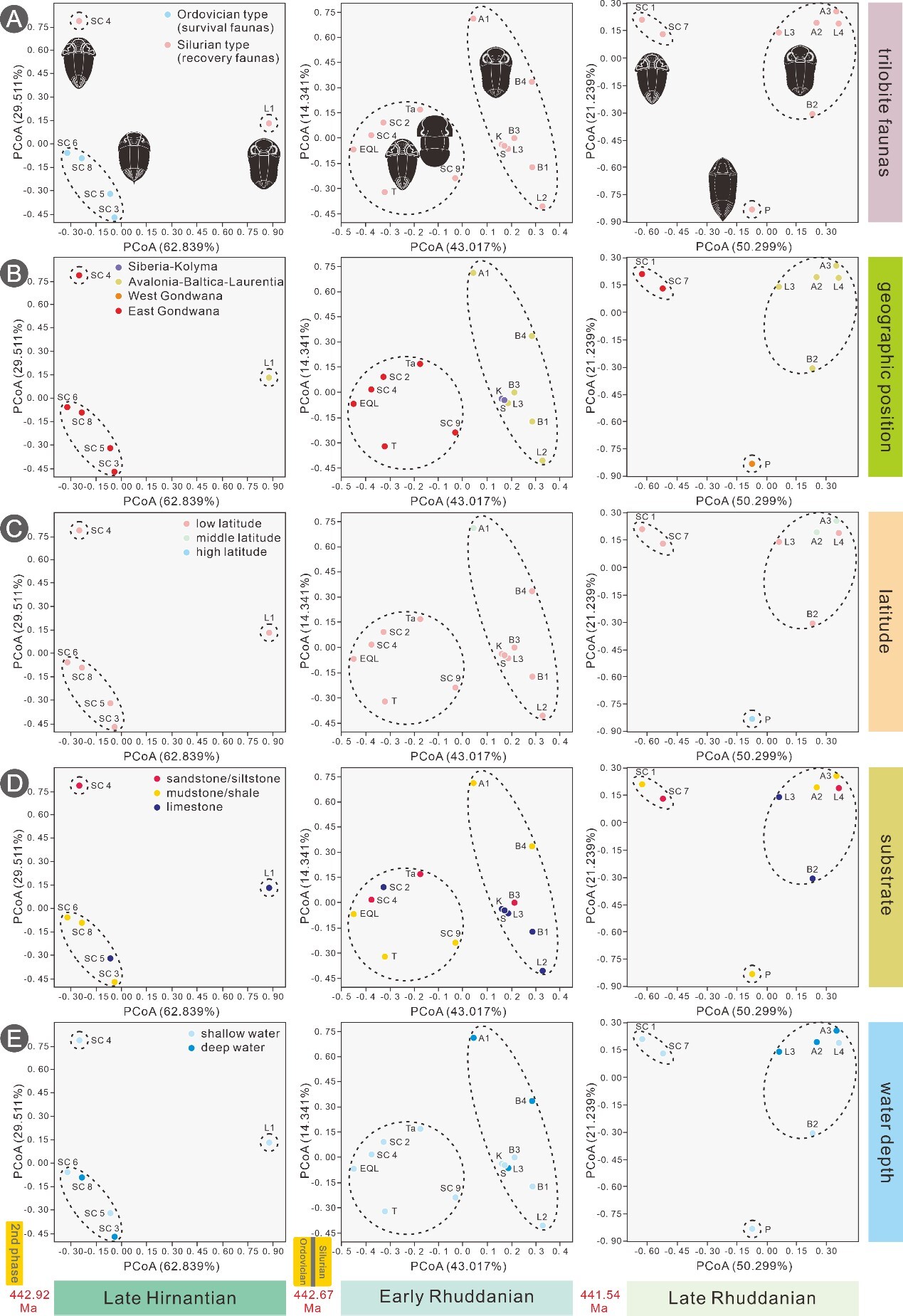
Principal Coordinate Analysis for 26 trilobite associations from the late Hirnantian to Rhuddanian, showing their distribution with different factors: (A) macroevolutionary feature; (B) geographic position; (C) latitude; (D) substrate; (E) water depth.
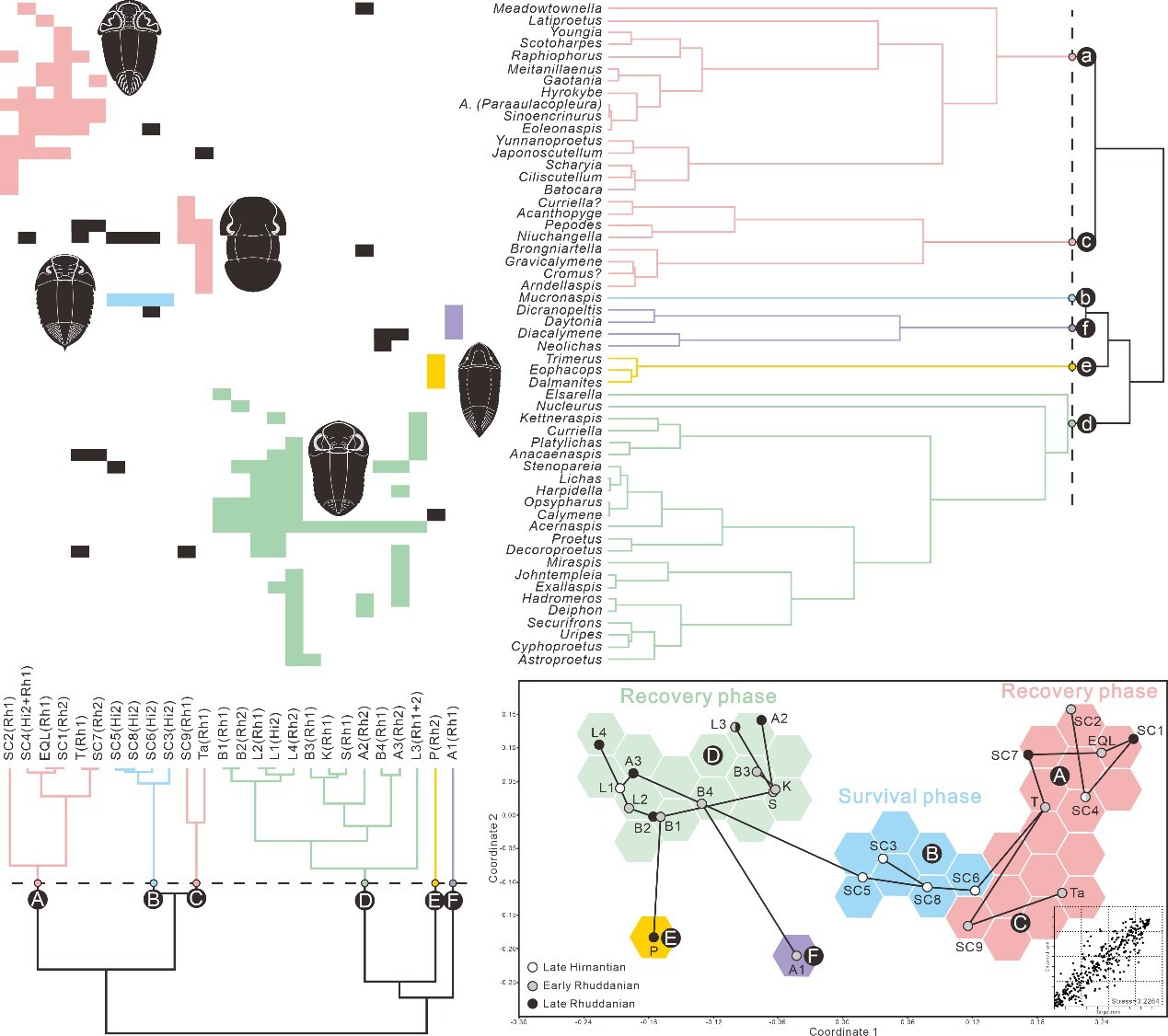
Cluster analysis (Q-mode at top right and R-mode at bottom left) and Nonmetric multidimensional scaling (NMDS) showing two macroevolutionary phases of trilobites and six distinct trilobite faunas from the late Hirnantian to Rhuddanian.
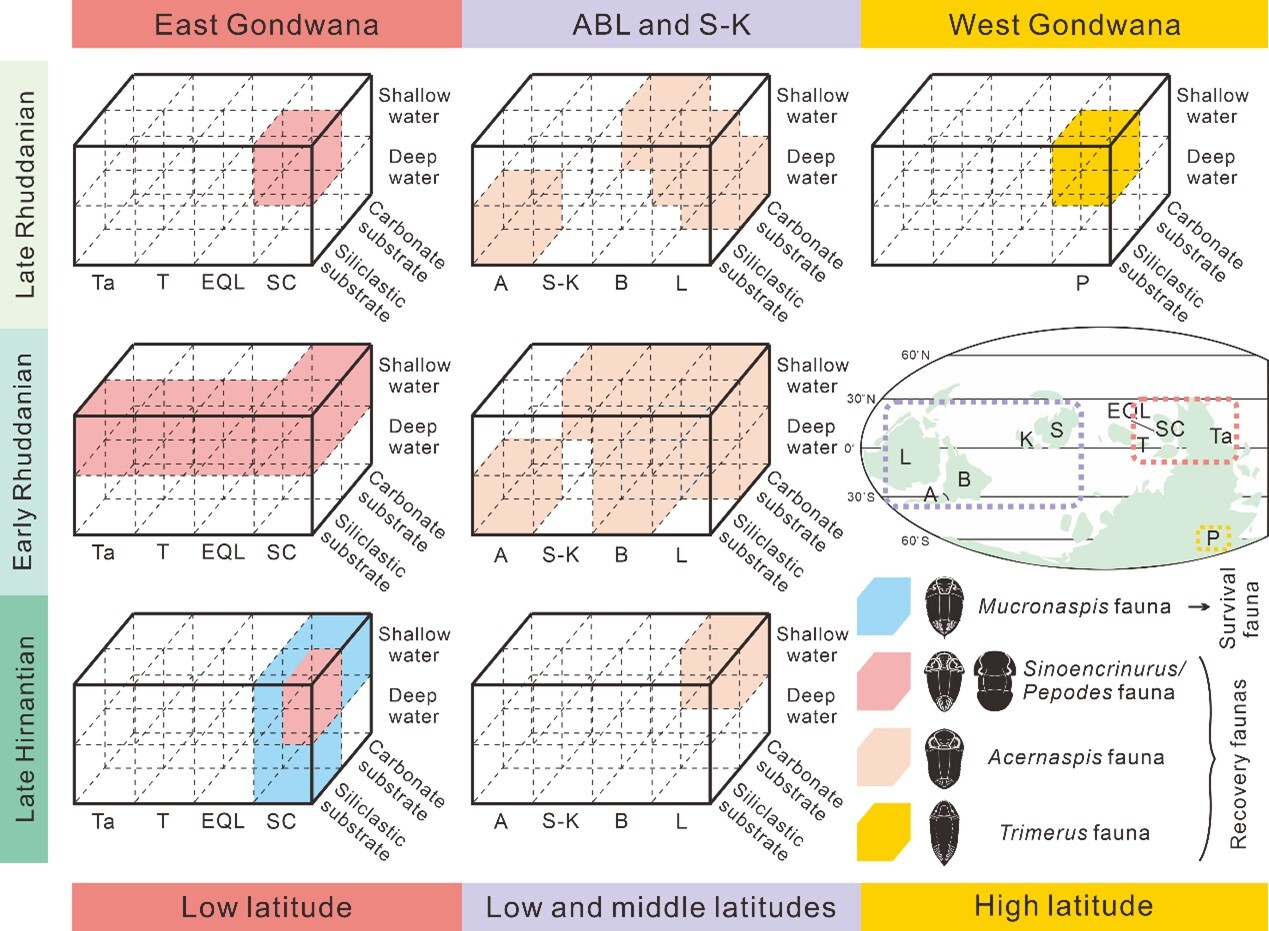
The spatiotemporal distribution of trilobites showing a heterochronous recovery pattern after the second episode of the LOME.
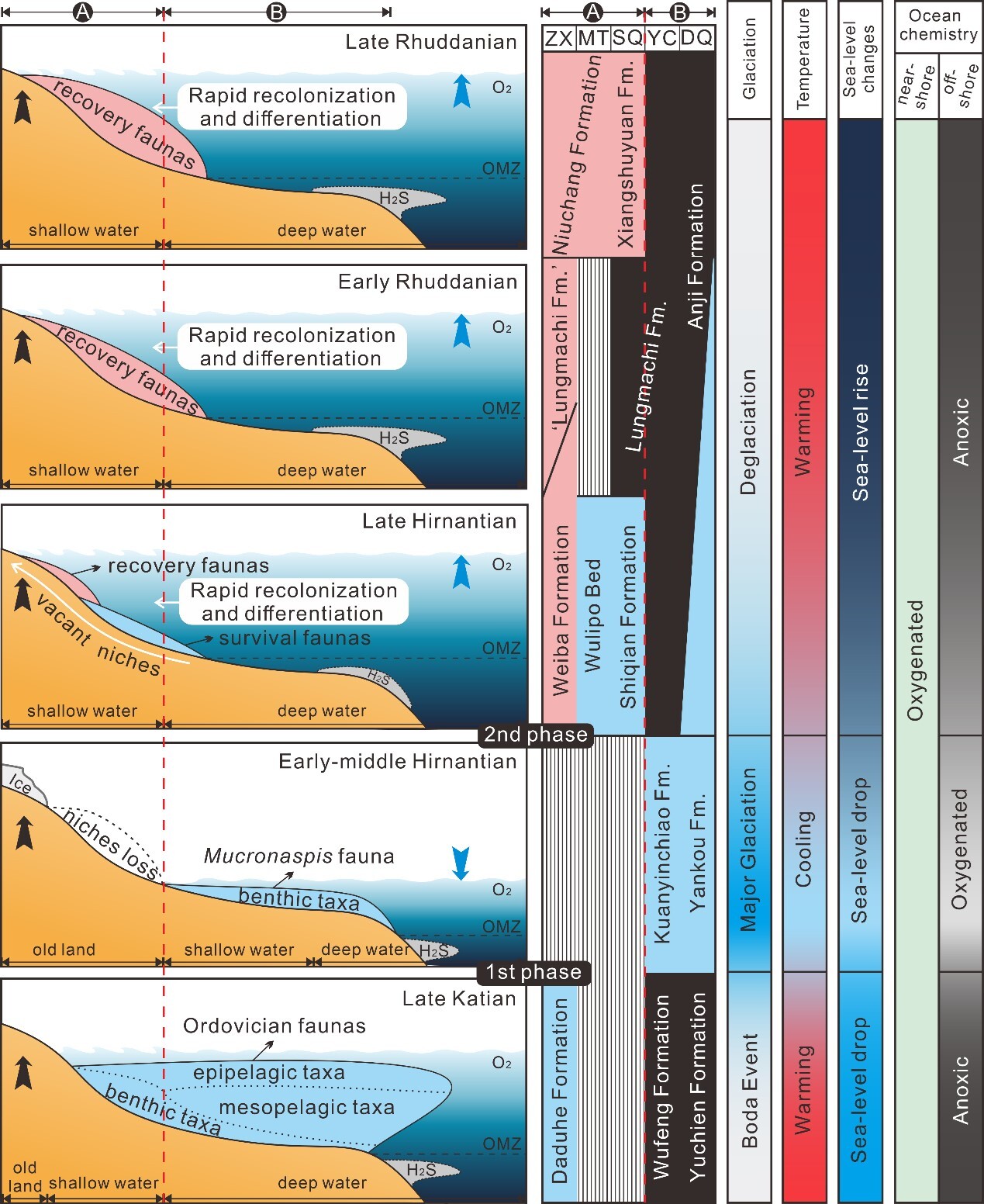
A conceptual model (left) showing vacant niches caused by the LOME, followed by rapid recolonization and differentiation of shallow-water habitats. Correlation chart of the Ordovician–Silurian boundary strata in South China (middle) and environmental changes (right), including the successions from shallow-water (A) to deep-water (B) environments and the faunal features (blue, the Ordovician-type trilobite faunas; red, the Silurian-type trilobite faunas; black, graptolite biofacies). Abbreviations: OMZ, oxygen minimum zone; Fm, Formation; ZX, Zhenxiong; MT, Meitan; SQ, Shiqian; YC, Yichang; DQ, Deqing.
Download: