
Following the Late Ordovician Mass Extinction (LOME), global climate warmed and sea levels rose, leading to the rapid recovery and re-radiation of benthic organisms such as brachiopods. Previous studies largely considered that the recovery of Early Silurian brachiopods post-LOME was mainly manifested as the restoration of diversity in shallow-marine environments. However, understanding remains relatively limited regarding key questions such as whether their ecospace expanded, how community structures turned over, and how paleobiogeographic patterns were reorganized.
Recently, Prof. HUANG Bing and his team from the Nanjing Institute of Geology and Palaeontology, Chinese Academy of Sciences (NIGPAS) have conducted a series of studies focusing on the recovery and re-radiation of brachiopods post-LOME. The relevant results indicate that post-LOME brachiopod radiation was not merely a simple rebound in diversity, but was accompanied by ecospace expansion, global paleogeographic distribution expansion, asynchronous replacement of dominant taxa, and community succession under the control of regional environments. These insights provide new evidence for understanding the mechanisms of ecosystem reconstruction following mass extinctions.
The related findings have been published in journals such as Journal of Paleontology, Palaeogeography, Palaeoclimatology, Palaeoecology, and Alcheringa.
(1) First Discovery of a Deep-Water Brachiopod Fauna in the Telychian of South China
The Early Silurian Telychian brachiopod record in South China is abundant, among which the Xiushan brachiopod Fauna has long been considered to be distributed in shallow-water environments. Researchers conducted a systematic study on the brachiopod fauna from the lower–middle Telychian Ningqiang Formation at the Bifengguan section in Guangyuan, Sichuan. A total of 21 species and 20 genera of brachiopods were identified. Using methods including NMDS, network analysis, and abundance heatmaps, three continuously succeeding brachiopod assemblages were delineated. Among them, the lowermost Aegiria–Epitomyonia assemblage is characterized by the relative abundance of the deep-water indicator genus Epitomyonia, representing the first explicitly discovered Benthic Assemblage 4 (BA4) deep-water community within the Xiushan brachiopod Fauna in South China. The subsequent Aegiria–Megaspinochonetes assemblage and Fardenia–Striispirifer assemblage indicate a gradual shallowing of the environment from BA4 to lower–upper BA3, forming a complete shallowing-upward sequence.
This discovery indicates that the ecological range of post-LOME brachiopod radiation in South China is broader than previously recognized, and the Xiushan brachiopod Fauna was not restricted to shallow-water environments but had expanded into deeper-water ecospaces. The study further points out that this section is located on the northern margin of the Yangtze Platform, and its unique paleogeographic position may have provided a relatively stable habitat for the deep-water brachiopod fauna. This result not only supplements the record of Telychian deep-water benthic communities in South China, but also reveals the important role of local paleogeographic conditions in post-LOME ecosystem reconstruction.
(2) Revealing Paleobiogeographic and Taxonomic Reorganization of Post-LOME Brachiopod Radiation at a Global Scale
To understand the recovery and re-radiation of post-LOME brachiopods at a macroevolutionary scale, researchers compiled global generic level occurrence data of brachiopods across 6 time intervals spanning the Rhuddanian, Aeronian, and Telychian (with each stage subdivided into early and late). Methods including bootstrap diversity estimation, piecewise regression, Generalized Additive Models (GAM), NMDS, and network analysis were utilized to systematically analyze the changes in diversity, spatial distribution, and community structure of Early Silurian brachiopods. The study found that brachiopod diversity rose rapidly from the Rhuddanian to the Aeronian, reaching a relatively high level in the late Aeronian, after which it remained generally stable with slight fluctuations during the Telychian. More importantly, the brachiopod radiation process was reflected not only in increased diversity, but also in significant geographic expansion, weakened paleobiogeographic provincialism, and asynchronous replacement of dominant brachiopod taxa across different paleoplates. Overall, the composition of brachiopod faunas gradually transitioned from types with more Ordovician characteristics to more typical Silurian-type assemblages. This result emphasizes that relying solely on diversity curves is insufficient to fully reveal the macroevolutionary processes following a mass extinction. Geographic distribution expansion, community structure changes, and dominant taxa turnover are the key indicators for understanding the re-radiation of brachiopods post-LOME.
(3) Telychian Brachiopod Community Turnover in South China Reveals the Controlling Role of Regional Environments
Researchers also conducted systematic sampling and quantitative analysis of the brachiopod fauna from the Daluzhai Formation at the Wuke section in the Butuo area of southern Sichuan. The fauna, collected from 14 fossil horizons, comprises 18 species and 17 genera, consisting mainly of atrypides, strophomenides, rhynchonellides, and spiriferides, displaying typical characteristics of a Silurian brachiopod fauna. The study identified two brachiopod assemblages: the lower Nalivkinia elongata–Megaspinochonetes subrectangularis assemblage, and the upper Nalivkinia magna–Howellella shiqianensis assemblage. This community turnover reflects a gradual shallowing of the local marine environment, which is likely related to the regional uplift of the Yangtze Platform. The research demonstrates that post-LOME brachiopod radiation exhibits obvious heterogeneity at the regional scale, where tectonic setting, sea-level changes, and local water depth jointly influenced the composition and succession of benthic communities.
The series of studies described above collectively demonstrate from both global and regional scales that the recovery and re-radiation of brachiopods post-LOME was a complex process: at the global scale, it manifested as geographic expansion and taxonomic reorganization; at the regional scale, it manifested as deep-water ecospace expansion and community turnover controlled by the paleogeographic setting. These results deepen the understanding of ecosystem reconstruction mechanisms following mass extinctions and provide new fossil evidence for understanding the recovery process of Early Silurian marine ecosystems.
The research was supported by the National Natural Science Foundation of China and the National Key Research and Development Program of China.
References:
Huang B, Chen D, Pan F, Shi K. 2026. First record of a deep-water brachiopod fauna in the Telychian of South China and its paleoecological implications. Journal of Paleontology. 99(6):1293-1302. https://doi.org/10.1017/jpa.2025.10200.
Huang, B., Chen, D., & Shi, K. 2025. Characterizing the biogeographic and taxonomic patterns of post-LOME (early Silurian) diversification of brachiopods. Palaeogeography, Palaeoclimatology, Palaeoecology, 675, 113105. https://doi.org/10.1016/j.palaeo.2025.113105.
Huang, B., Chen, D., & Candela, Y. 2025. A new brachiopod fauna from the Telychian (early Silurian) of Southwest China and its palaeoecological significance. Alcheringa: An Australasian Journal of Palaeontology, 49(1), 30–39. https://doi.org/10.1080/03115518.2024.2431912.
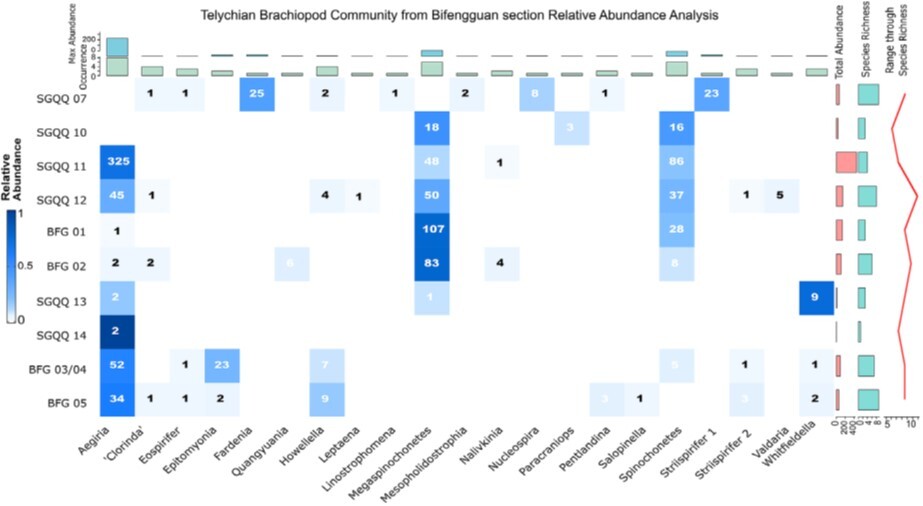
Fig1. Succession of brachiopod assemblages and diversity changes in the Ningqiang Formation at the Bifengguan section, Guangyuan, Sichuan.
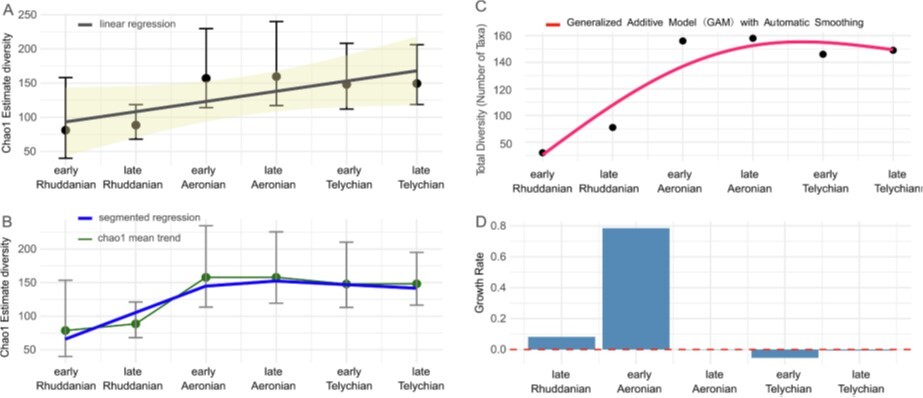
Fig2. Piecewise regression and Generalized Additive Models (GAM) reveal that the global brachiopod diversification process began to stagnate during the Telychian.
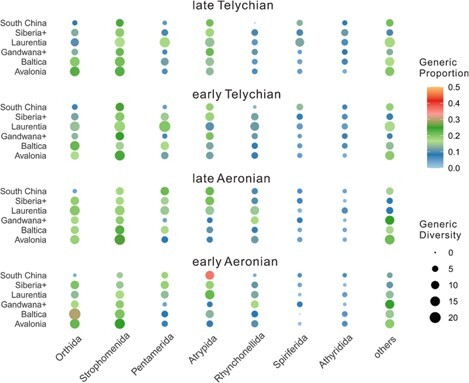
Fig3. Genus-level bubble charts of brachiopods across several major global paleoplates during the post-LOME radiation period showing the asynchronous replacement of dominant brachiopod taxa.
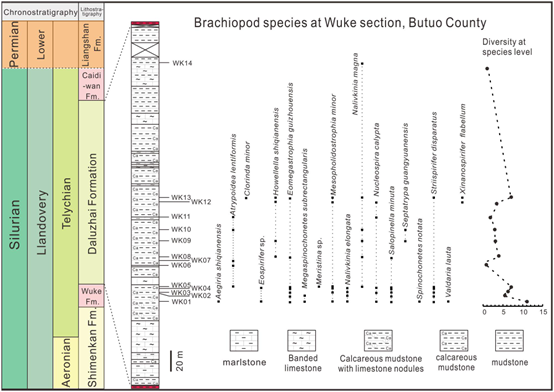
Fig4. Brachiopod assemblages and diversity changes in the Daluzhai Formation at the Wuke section.
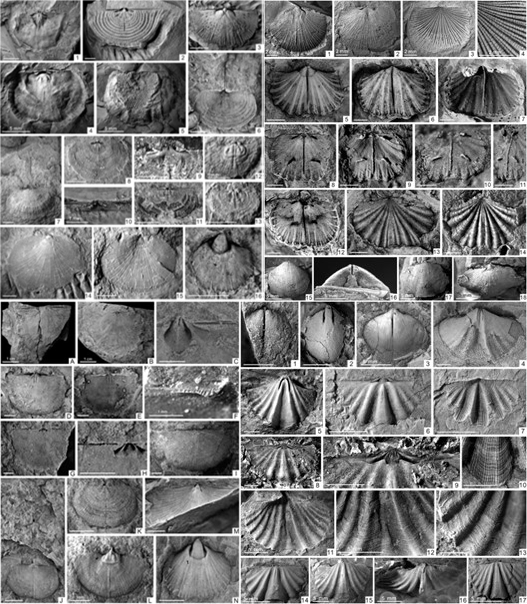
Fig5. Representative brachiopods from the Bifengguan and Wuke sections and photographs of their latex casts.
Download: