
Volcanism is a primary driver of long-term climate change, but its net climatic effect—warming or cooling—remains debated. The Guadalupian–Lopingian (G–L) transition (~260 million years ago) witnessed the final demise of the Late Paleozoic Ice Age, concurrent with eruptions from both the Emeishan Large Igneous Province (ELIP) and the South China continental arc. This unique confluence provides a natural laboratory for investigating the climatic impacts of different volcanic types.
A recent study led by Dr. CHENG Cheng and Prof. ZHANG Hua at the Nanjing Institute of Geology and Palaeontology, Chinese Academy of Sciences (NIGPAS), in collaboration with researchers from Nantong University and Hefei University of Technology, has shed new light on this puzzle. Through an integrated, multi‑proxy investigation of the Yinpingshan section in South China, the team clearly documented a transition in volcanic source from arc‑dominated to LIP‑dominated volcanism and demonstrated their divergent climatic effects. The findings have been published in Earth and Planetary Science Letters.
The research team conducted high‑resolution analyses on the Yinpingshan section, including zircon U–Pb geochronology, elemental geochemistry, mercury (Hg) proxies, and organic carbon isotopes (Fig. 1). The results reveal two distinct phases of Hg anomalies. Early, intense Hg anomalies linked to continental arc volcanism show minimal concurrent carbon isotope excursions and low chemical weathering indices, indicating limited global climatic impact.
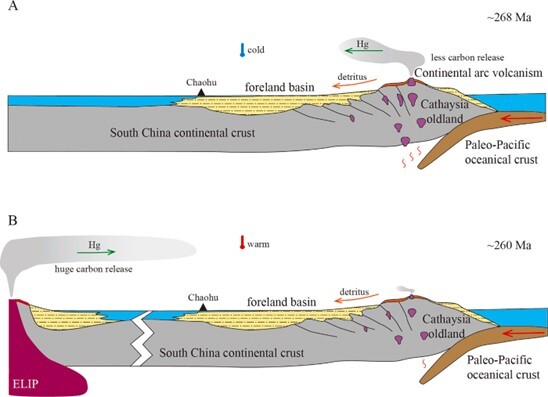
In stark contrast, later, weaker Hg anomalies associated with the ELIP coincide with significant negative carbon isotope excursions and evidence for enhanced chemical weathering, pointing to massive CO2 emissions that drove global warming. The study further shows that following peak volcanism, intensified silicate weathering and organic carbon burial facilitated atmospheric CO2 drawdown, leading to subsequent cooling.
This study provides compelling sedimentary evidence that a change in the dominant volcanic source—from arc to LIP—can itself drive a shift in climate state (Figs. 2, 3). It underscores that the scale, style, and type of volcanism, not merely its presence, are the decisive factors governing its climatic influence. This new framework refines our understanding of volcanic forcing mechanisms during critical climate transitions in Earth’s history and offers important insights for assessing the potential climatic effects of various geological processes in the context of modern global change.
This work was supported by the National Natural Science Foundation of China, the Nanjing Institute of Geology and Palaeontology, and the Natural Science Foundation of the Jiangsu Higher Education Institutions of China.
Reference: Cheng Cheng, Dan Wang, Shuangying Li, Hua Zhang. Volcanic source change triggers divergent climatic responses across the Guadalupian-Lopingian transition in eastern South China. Earth and Planetary Science Letters, 2026, 683, 119985. https://doi.org/10.1016/j.epsl.2026.119985.
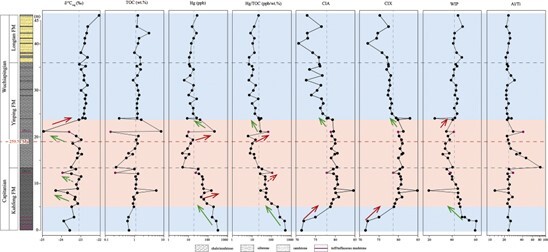
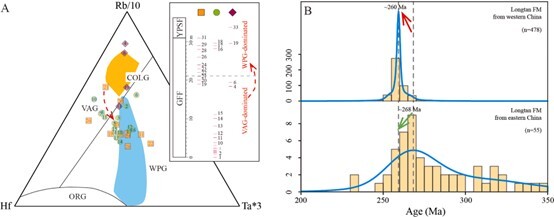
Fig. 2. (A) Tectonic discrimination diagrams of the Permian tuff or tuffaceous mudstone samples. (B) Comparison of the youngest detrital zircon age populations in the Longtan Formation between eastern and western China.
Download: