
The Sichuan Basin is one of the most representative large Mesozoic sedimentary basins in China, where the Cretaceous strata are dominated by red-bed deposits. Due to the scarcity of fossils and the lack of materials suitable for absolute age determination within these red beds, their precise chronology has long remained poorly constrained and subject to debate. Ostracods are the most common fossil group in the Cretaceous red beds of the Sichuan Basin and serve as key index fossils for non-marine biostratigraphic subdivision and correlation of the Cretaceous, thus providing critical clues for resolving this issue.
Recently, Associate Professor WAGN Yaqiong from the Nanjing Institute of Geology and Palaeontology, Chinese Academy of Sciences (NIGPAS), in collaboration with Senior Researcher Byung-Do Choi from the Daegu National Science Museum, conducted a systematic study of non-marine ostracods from the Lower Cretaceous Cangxi Formation in the Sichuan Basin. Through detailed ostracod biostratigraphic analysis, the research team precisely constrained the geological age of the Cangxi Formation, and identified the timing of the faunal transition from non-Cypridea assemblages to Cypridea-dominated assemblages in the Early Cretaceous of the basin for the first time. In addition, the study reveals that climatic zonation may have been a key factor controlling ostracod palaeobiogeographic distribution.
A total of 20 non-marine ostracod species belonging to 7 genera were identified from the Cangxi Formation, including one new species, Deyangia rhodopetra sp. nov. Notably, the genus Cypridea was discovered for the first time near the top of the formation (Fig. 1). Based on ostracod assemblages and biostratigraphic correlation, the age of the Cangxi Formation is constrained to the Valanginian–Hauterivian stages, providing an important chronological framework for stratigraphic subdivision and regional correlation of the Lower Cretaceous in the Sichuan Basin.
The study further demonstrates that ostracod faunas in northern and southern China followed broadly consistent evolutionary pathways during the early Early Cretaceous, both undergoing a transition from “non-Cypridea assemblages” to “Cypridea-dominated assemblages.” However, differences are evident in the dominant genera during the early stage of this transition. In South China (e.g., the Sichuan Basin and the Lanping-Simao Basin), assemblages are characterized by Jingguella and Deyangia, whereas in North China, Luanpingella is the characteristic genus (Fig. 2).
Extensive comparisons indicate that the ostracod assemblages dominated by Jingguella and Deyangia in the Sichuan Basin closely resemble those from several basins along the eastern Tethyan margin, including the Lanping-Simao Basin in Yunnan, the Xining-Lanzhou Basin in Qinghai and Gansu, and the Kuqa Basin in Xinjiang (Fig. 3). This suggests that these regions may have belonged to the same non-marine ostracod palaeobiogeographic province during the early Early Cretaceous, potentially extending westward to the Fergana Basin in Kyrgyzstan, although its exact extent requires further investigation.
Combined with previously published palynological palaeobiogeographic data, the study indicates that both non-marine ostracods and spore-pollen assemblages reveal the existence of a distinctive palaeobiogeographic province along the eastern Tethyan margin during the early Early Cretaceous (Fig. 3). This province likely corresponded to a relatively arid climatic regime, with Jingguella and Deyangia serving as potential indicators of arid conditions.
By integrating ostracod and palynological evidence, this study further supports the existence of an arid climatic belt along the Tethyan margin and highlights significant differences in vegetation and invertebrate assemblages compared to those in the Pacific coastal regions. This study also suggests that the Tethys Ocean may have played a key role in shaping the climatic pattern of East Asia during the Early Cretaceous. Similar to how modern oceans influence global climate through heat transport, ocean circulation, and ocean-atmosphere interactions, the Tethys Ocean may have regulated regional climatic zonation and biogeographic patterns through complex ocean–atmosphere–land interactions.
This work not only provides new palaeontological evidence for reconstructing the Early Cretaceous palaeoclimate of East Asia, but also offers important insights into the role of oceans in regulating climate systems under greenhouse conditions. With the development of high-resolution palaeoclimate models, future studies are expected to further elucidate the mechanisms by which the Tethys Ocean influenced the palaeoclimate of East Asia.
The result was published in “Papers in Palaeontology”. This research was supported by the National Key Research and Development Program of China and the National Natural Science Foundation of China.
Reference: Byung-Do Choi#, Yaqiong Wang#*, 2026. Ostracod fauna from the Lower Cretaceous Cangxi Formation of the Sichuan Basin, southwestern China: Taxonomy, biostratigraphy and palaeobiogeography. Papers in Palaeontology, 12(2): e70083. https://doi.org/10.1002/spp2.70083.
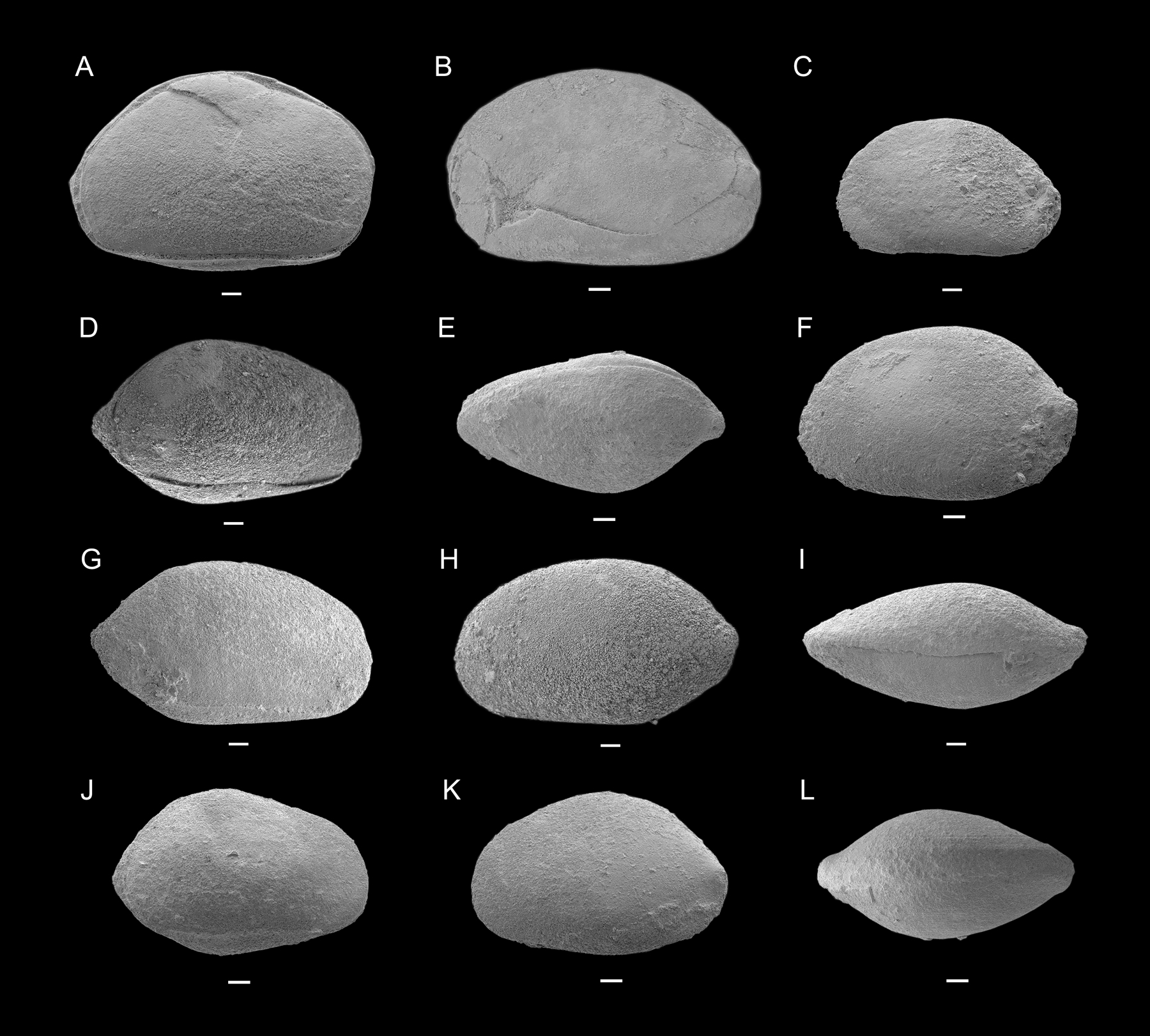
Fig.1 Selected ostracods from the Cangxi Formation, A–C, Deyangia deyangensis Li 1984b; D–L, Deyangia rhodopetra sp. nov. All scale bars represent 100 μm.
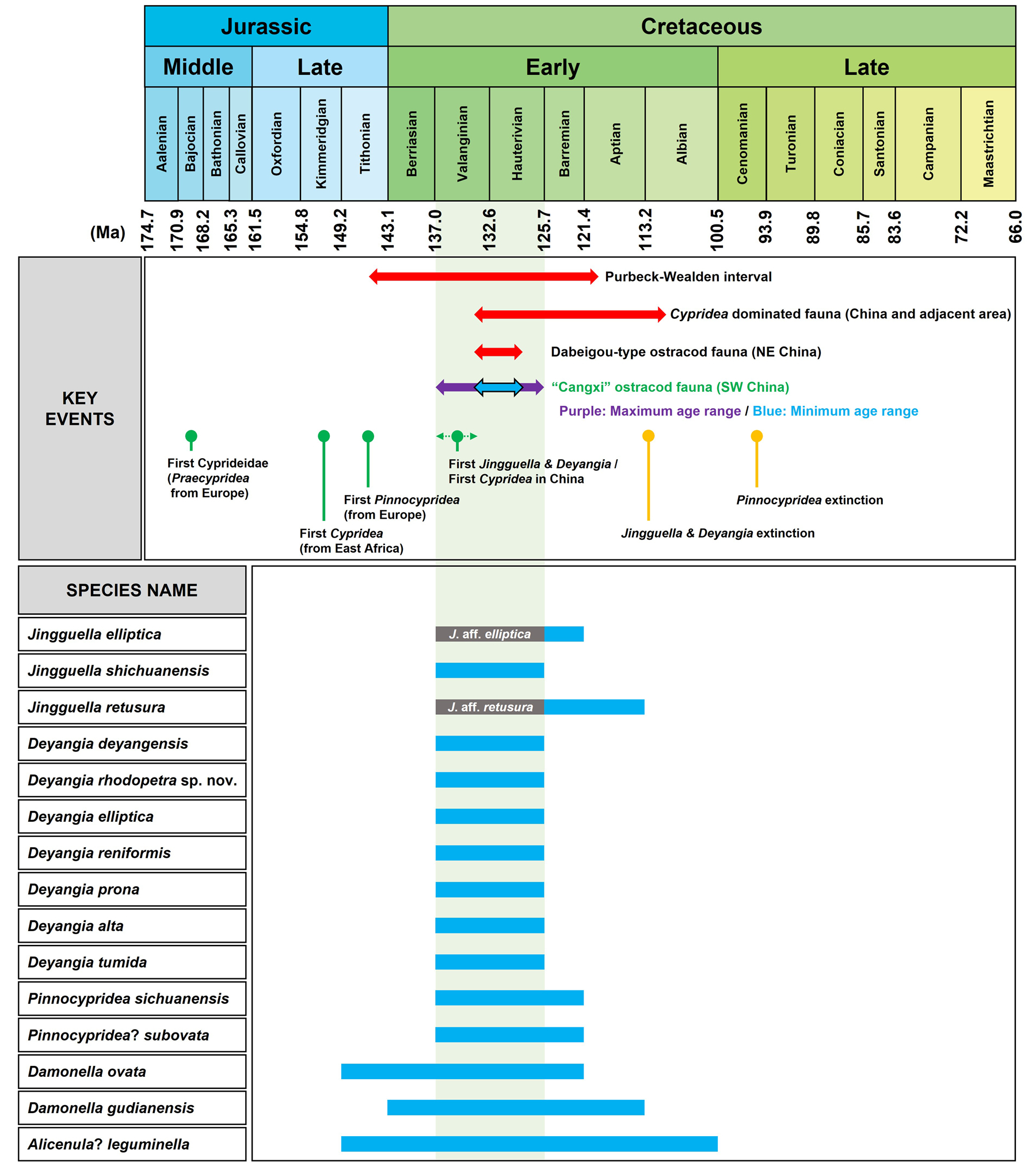
Fig.2 Stratigraphic ranges of the ostracod species present in our samples from the Cangxi Formation, and some key events of the non-marine ostracod evolution timeline during the Middle Jurassic to Cretaceous interval.
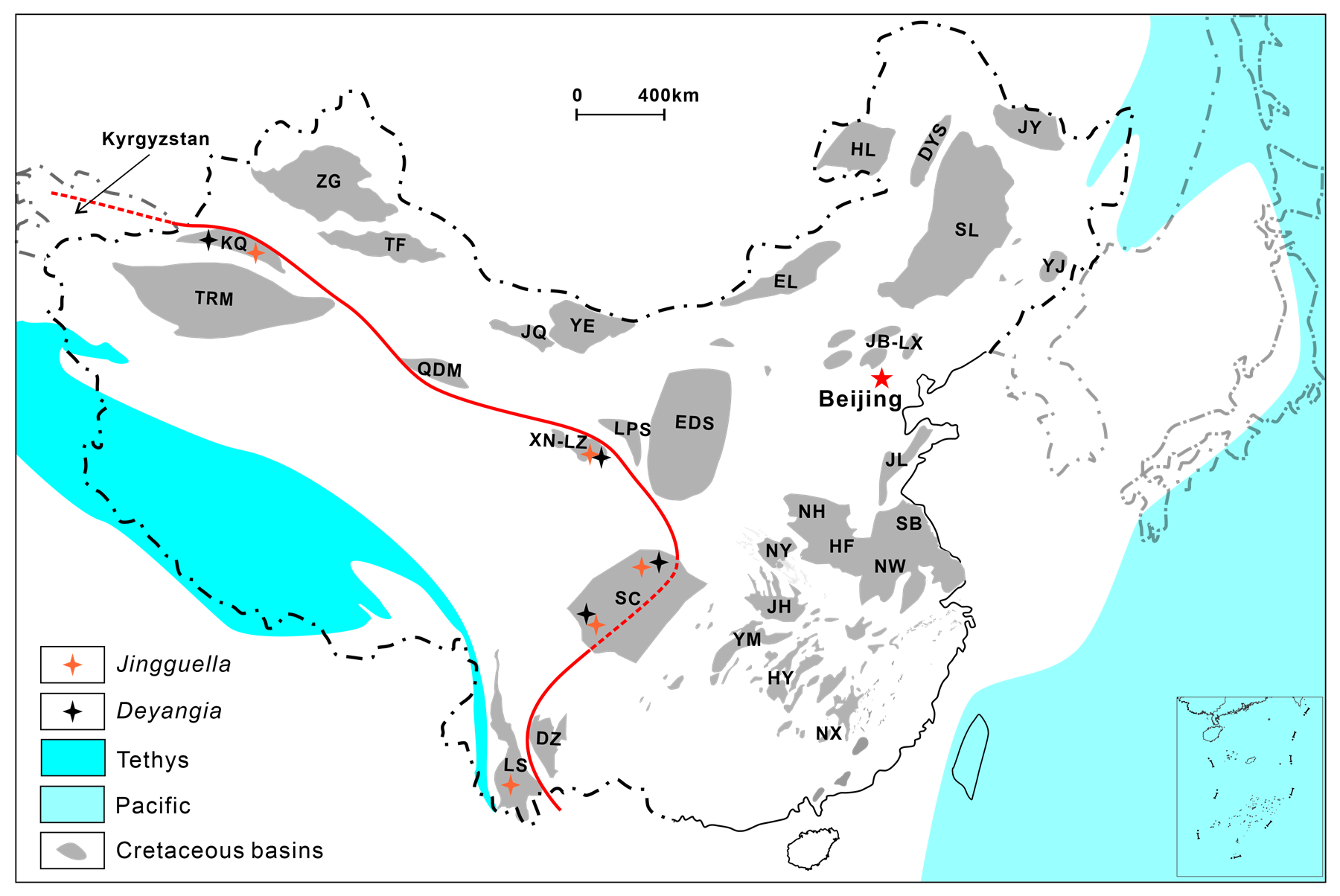
Fig.3 The distribution pattern of the genera Jingguella and Deyangia during the Early Cretaceous. Red solid line indicates the non-marine ostracod palaeo-province boundary around the Tethys Ocean and the dashed line indicates the possible palaeo-province boundary.
Download: