
The radiation of angiosperms (flowering plants) from the mid-Cretaceous to the early Paleogene drove major ecological transitions in Mesozoic terrestrial ecosystems. As one of the most important and abundant ecological interactions in nature, the insect-plant pollination relationship is believed to have played a crucial role in this evolutionary process. However, direct fossil evidence of Cretaceous insect pollination remains highly scarce.
Recently, Professor CAI Chenyang from the Center for Mesozoic Terrestrial Ecosystems at the Nanjing Institute of Geology and Palaeontology, Chinese Academy of Sciences (NIGPAS), collaborating with colleagues from the United States, the United Kingdom, Australia, and Spain, discovered multiple amber specimens demonstrating insect pollination from mid-Cretaceous Burmese amber dating back approximately 100 million years. This discovery reveals direct evidence of multiple insect groups participating in pollination, including beetles pollinating extinct gymnosperms, as well as behaviors suggesting that beetles and thrips may have pollinated early angiosperms and gymnosperms, respectively. These findings uncover a complex and diverse pollination ecological network during the mid-Cretaceous. The related results were recently published in international journals, including Proceedings of the Royal Society B, BMC Biology, Insect Systematics and Diversity, and Annals of the Entomological Society of America.
Through precise sectioning and ultrastructural observations of pollen grain fossils within the mid-Cretaceous Burmese amber, researchers discovered large quantities of Eucommiidites pollen directly coating and adhering to the body surfaces of two beetles belonging to the superfamily Nitiduloidea. These beetles were identified as a new short-winged flower beetle species, Furcalabratum pollinitaferum (family Kateretidae), and an undetermined species of sap beetle (family Nitidulidae). As a type of pollen widely distributed during the Mesozoic but extinct by the Late Cretaceous, Eucommiidites has been extensively reported within the reproductive structures of the extinct gymnosperm order Erdtmanithecales. Combining the ecological habits of modern related taxa with the exceptional preservation state of numerous pollen grains directly attached to the insect bodies, these specimens constitute rare and textbook direct evidence of insect pollination. Furthermore, based on the distinct boundary between a pollen clump located near the abdomen of the short-winged flower beetle and the surrounding scattered pollen, alongside the deformed and consistently oriented pollen within the clump, researchers suggest that this pollen mass may be a beetle coprolite (fossilized feces), implying that the beetle likely had pollen-feeding habits. Notably, a thrips belonging to the genus Aspistothrips was also preserved near the short-winged flower beetle, with Eucommiidites pollen similarly scattered around and on its body. This reveals that Cretaceous thrips may not have been restricted to pollinating cycads but might have also pollinated Erdtmanithecales plants, while preliminarily reflecting that a certain pollination ecological commonality between thrips and beetles may have already formed during the Cretaceous.
The researchers also re-evaluated the taxonomic status of the tumbling flower beetle (family Mordellidae) Angimordella burmitina, which was previously considered a "specialized pollinator of early angiosperms." They shifted its placement from the crown-group subfamily Mordellinae to the stem-group subfamily Apotomourinae. More importantly, plant pollen was also found adhering to the body surface of a thrips co-occurring with this pollinating tumbling flower beetle. This pollen matched the type found on and around the beetle, marking the first reported association between thrips and putative angiosperm pollen. This phenomenon of co-occurrence among tumbling flower beetles, thrips, and pollen suggests that the ecological niche of primitive Cretaceous tumbling flower beetles leaned toward a generalized or transitional type rather than that of highly specialized plant pollinators.
Extant short-winged flower beetles with specialized antennal structures are quite rare, yet this type exhibited high diversity within Cretaceous amber biota. Through comparative observations of the morphology of the antennal scape and principal component analysis, the researchers concluded that this specialized structure carries high taxonomic significance, preliminarily suggesting its function may relate to bisexual communication. Concurrently, a large volume of Asteropollis pollen, likely belonging to the angiosperm family Chloranthaceae, along with closely associated plant residual structures, was discovered around the beetle fossil Protokateretes ensifer, which possesses a specialized antennal scape. This suggests that the species may have already established a pollination relationship with early angiosperms.
In addition, the identification of pollen associated with the Cretaceous pollinating beetle Pelretes vivificus was revised. Near a male specimen of Pelretes bicolor, which features a specialized mandible, researchers discovered a thrips belonging to the genus Parallelothrips, with pollen adhering to its body surface that was previously thought to be dispersed by P. vivificus. Through comparative observations of pollen morphology across new and old specimens, combined with the similarity in ecological habits among species of the same genus, the researchers revised the pollen type associated with P. vivificus from the angiosperm pollen genus Tricolpopollenites to the gymnosperm pollen Eucommiidites. This redefines the pollination target of this beetle and further enriches the fossil record of thrips pollination and joint pollination by beetles and thrips.
Integrating the available fossil evidence, these studies indicate that a generalized pollination system between insects and plants may have already formed during the Cretaceous period: a single insect species could pollinate multiple plant groups, while the same plant species could be co-pollinated by multiple insect groups. Furthermore, the phenomenon of joint pollination by beetles and thrips, common in modern ecosystems, may have emerged as early as 100 million years ago. Meanwhile, our understanding of plant hosts within Cretaceous pollination networks has been further expanded. In addition to cycads, plants of the order Erdtmanithecales were very likely key insect-pollinated gymnosperm hosts during the Cretaceous. Regarding angiosperms, besides Nymphaeaceae (water lilies), Chloranthaceae may also represent a crucial component of early insect-pollinated flowering plants. These key lines of evidence preserved in amber fossils provide an invaluable window into understanding the diversity of Cretaceous insect pollination modes and the evolution of early terrestrial ecosystems.
This research was funded by the National Key R&D Program of China and the National Natural Science Foundation of China.
Reference:
1. Zhao, Q., Liu, J., Wang, Y., Engel, M.S., Myint, T.A., Huang, D., Cai, C.*, 2026. Beetle pollination of Erdtmanithecales, an extinct lineage of Mesozoic gymnosperms. Proceedings of the Royal Society B: Biological Sciences 293, 20260060.
2. Li, Y.D.*, Peris, D., Peña-Kairath, C., Zhao, Q., Huang, D., Cai, C.*, 2026. Revisiting early angiosperm pollination: a reassessment of Angimordella beetle and co-occurring thrips from mid-Cretaceous amber. BMC Biology 4, 11.
3. Zhao, Q., Sun, Y., Liu, J., Slipinski, A., Fu, Y., Huang, D., Engel, M.S., Emlen, D.J., Cai, C.*, 2026. Antennal extremes in amber: possible beetle pollination of Chloranthaceae in the Cretaceous. Insect Systematics and Diversity 10(1), ixaf059.
4. Zhao, Q., Huang, D., Cai, C.*, 2026. Dual pollination of Cretaceous Erdtmanithecales by thrips and beetles. Annals of the Entomological Society of America, saag017. https://doi.org/10.1093/aesa/saag017.
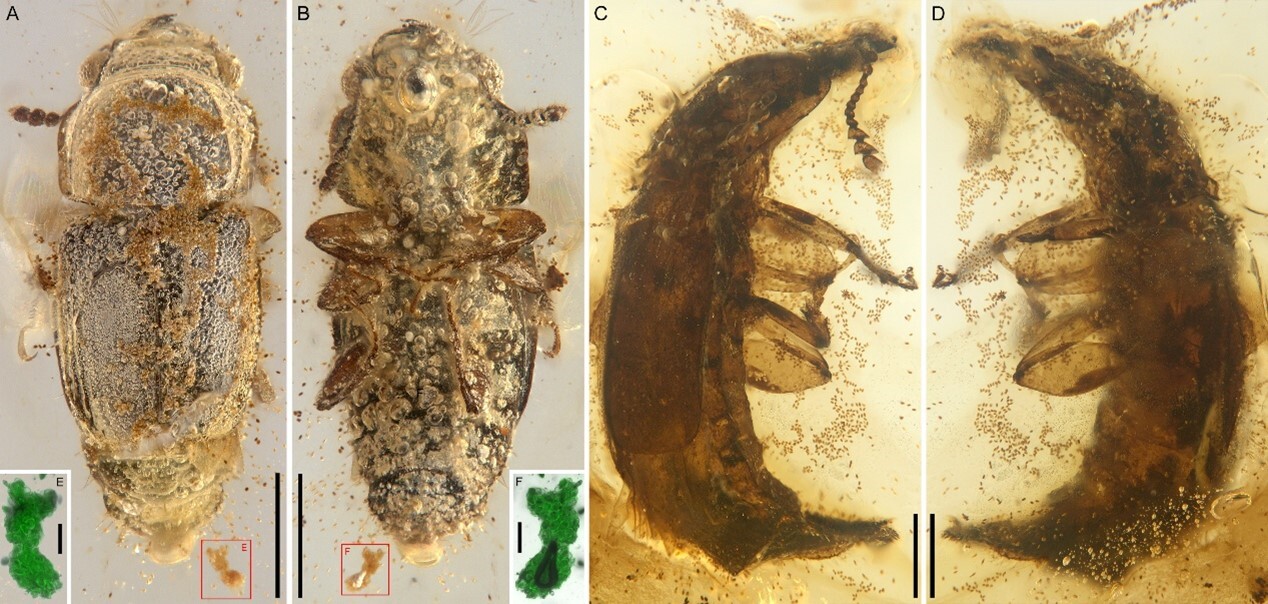
Fig.1 Two Nitiduloidea specimens covered withEucommiiditespollen. A and B show the new fossil species of short-winged flower beetle, Furcalabratum pollinitaferum; C and D show an undetermined species of the family Nitidulidae; E and F show putative coprolites.
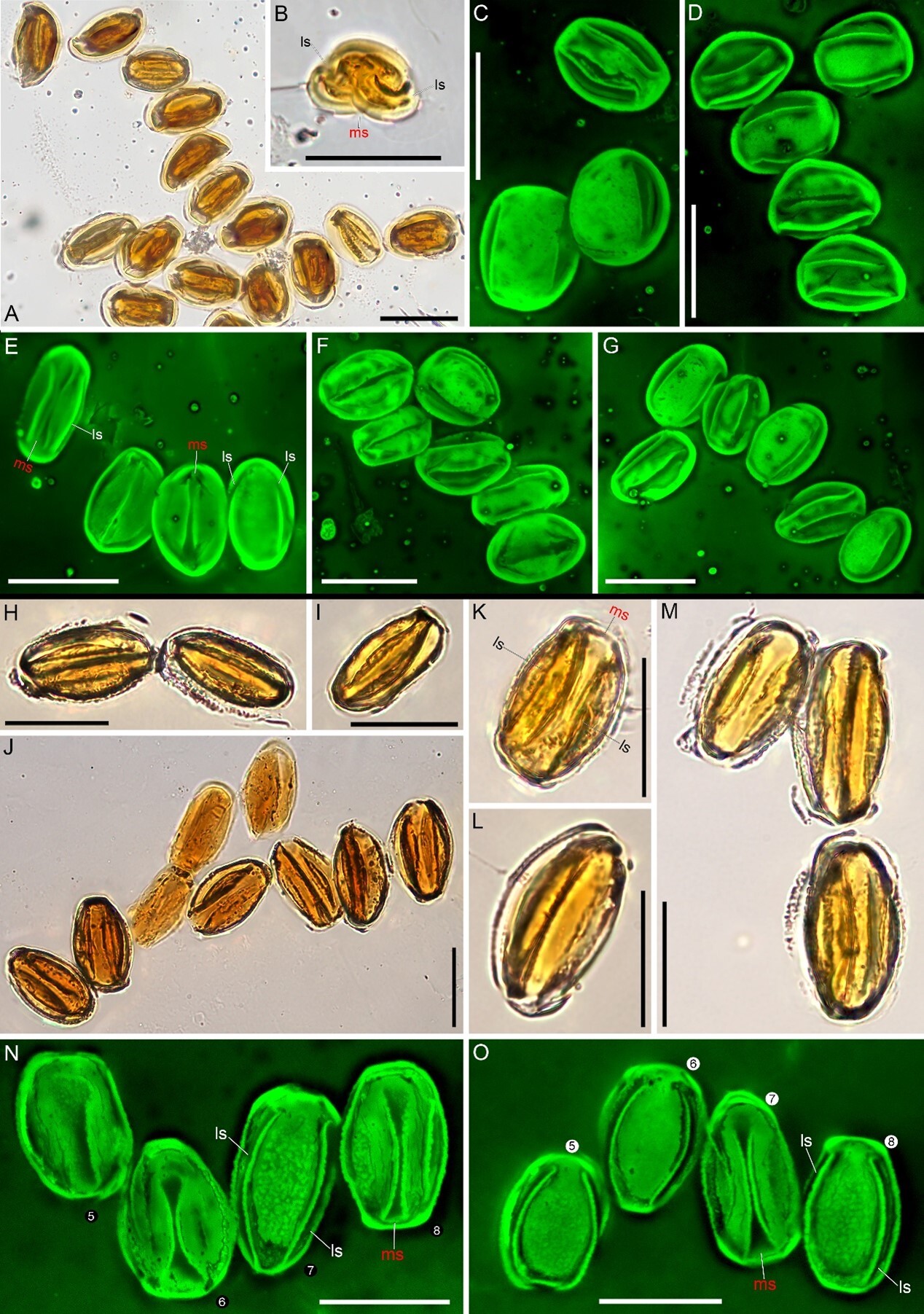
Fig.2 Eucommiidites pollen preserved in co-occurrence with pollinating beetles in Burmese amber. A–G show pollen co-occurring with Furcalabratum pollinitaferum; H–O show pollen co-occurring with the undetermined Nitidulidae species.
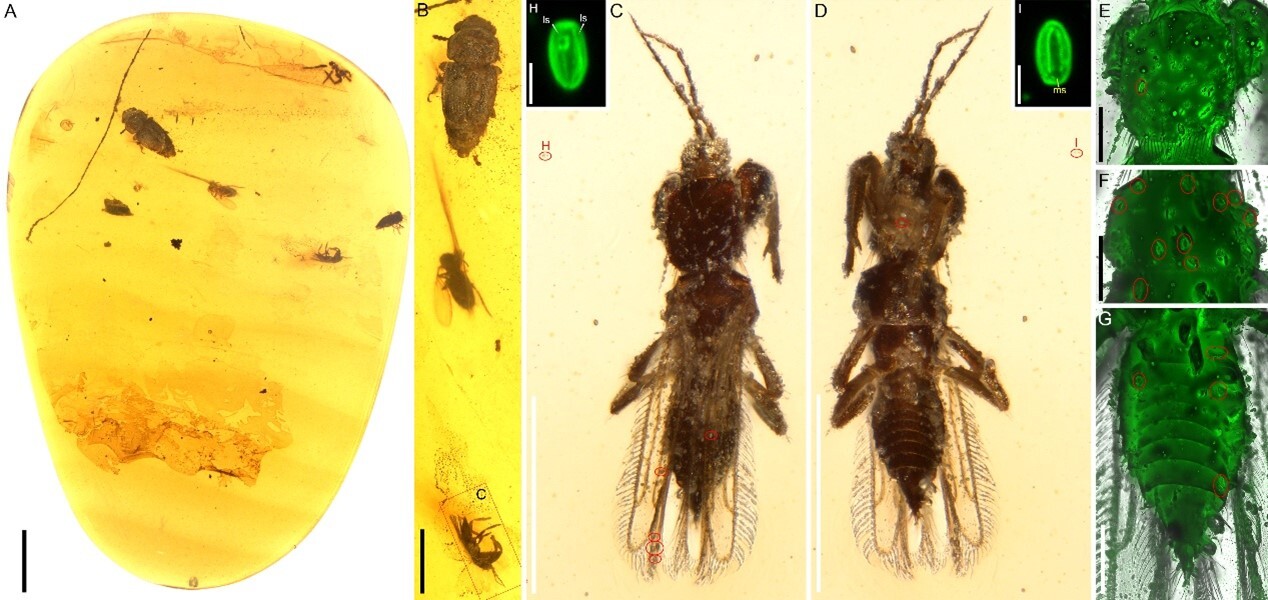
Fig.3 Aspistothrips thrips co-occurring with Furcalabratum pollinitaferum. C and D provide general dorsal and ventral views of the new Aspistothrips specimen; red circles in E–G indicate scattered pollen grains.
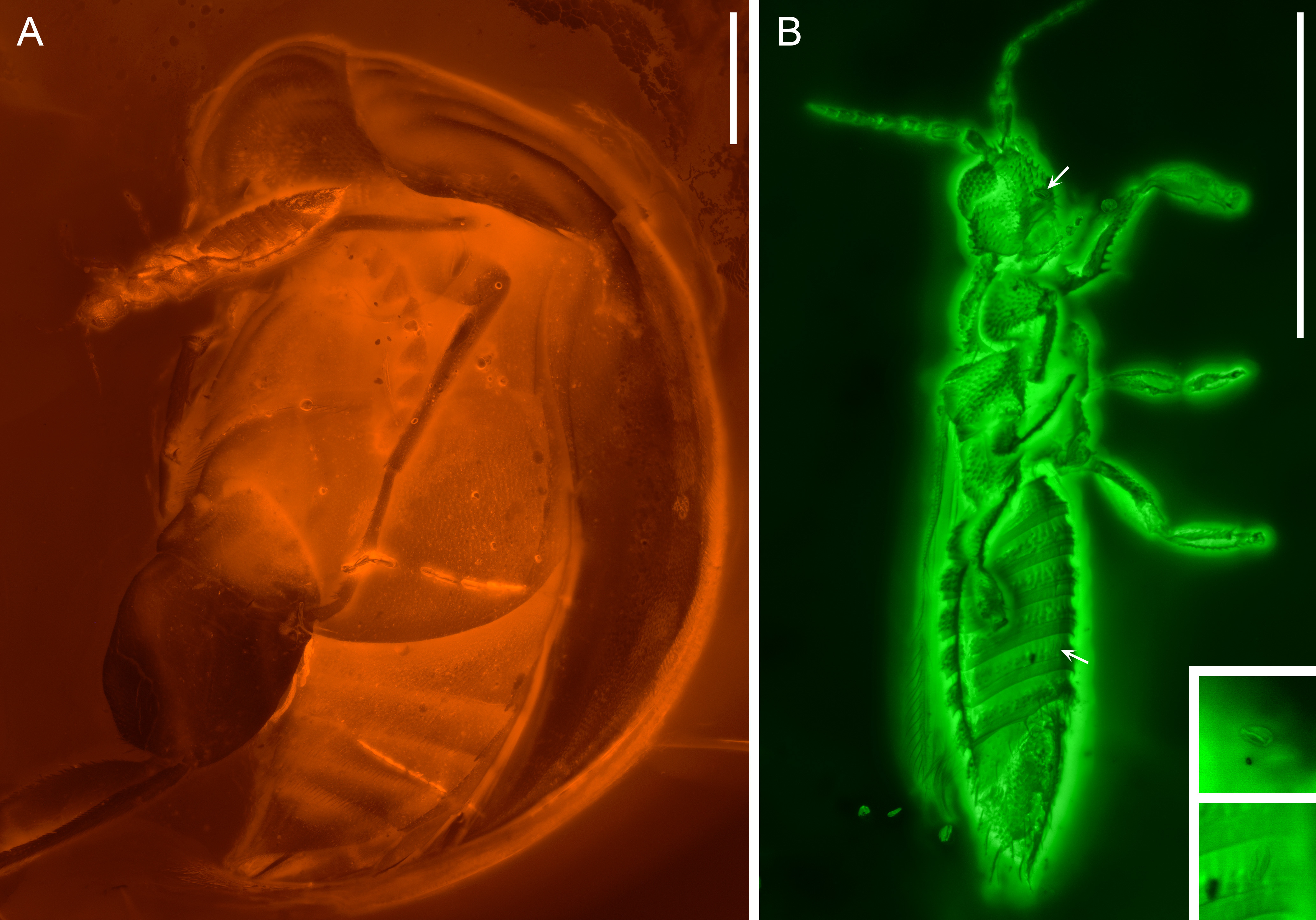
Fig.4 A thrips co-occurring with the primitive tumbling flower beetle Angimordella burmitina, along with putative angiosperm pollen adhering to its body surface. A illustrates the co-occurrence of the tumbling flower beetle and the thrips; B provides a magnified view of the thrips and the pollen on its body, with arrows indicating the sampling positions for the close-up pollen images.
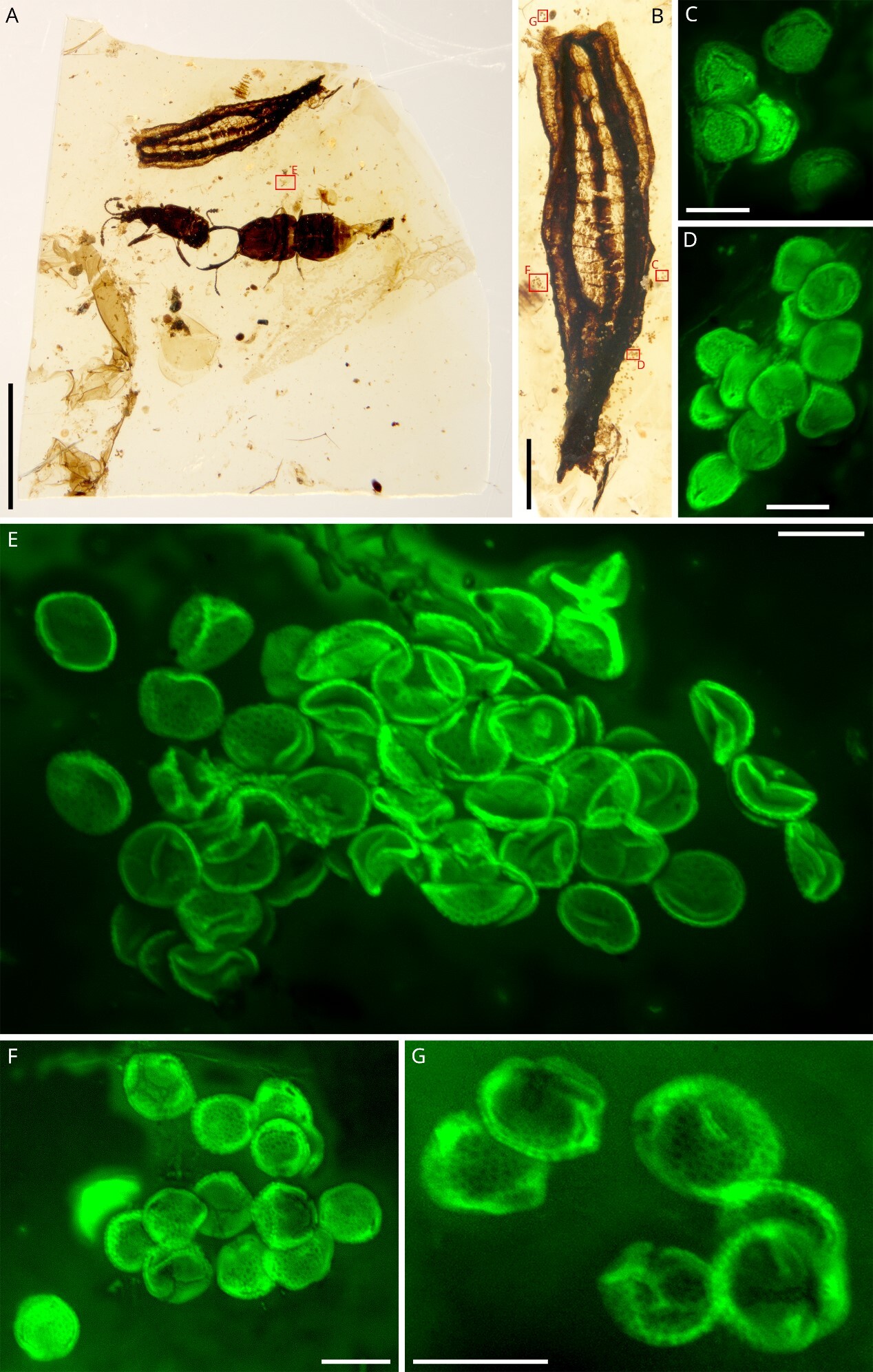
Fig.5 Asteropollis pollen co-occurring with Protokateretes ensifer. A shows the overall view of the amber specimen; B displays plant residual structures that potentially produced the pollen; C–G provide close-up, magnified views of the Asteropollis pollen.
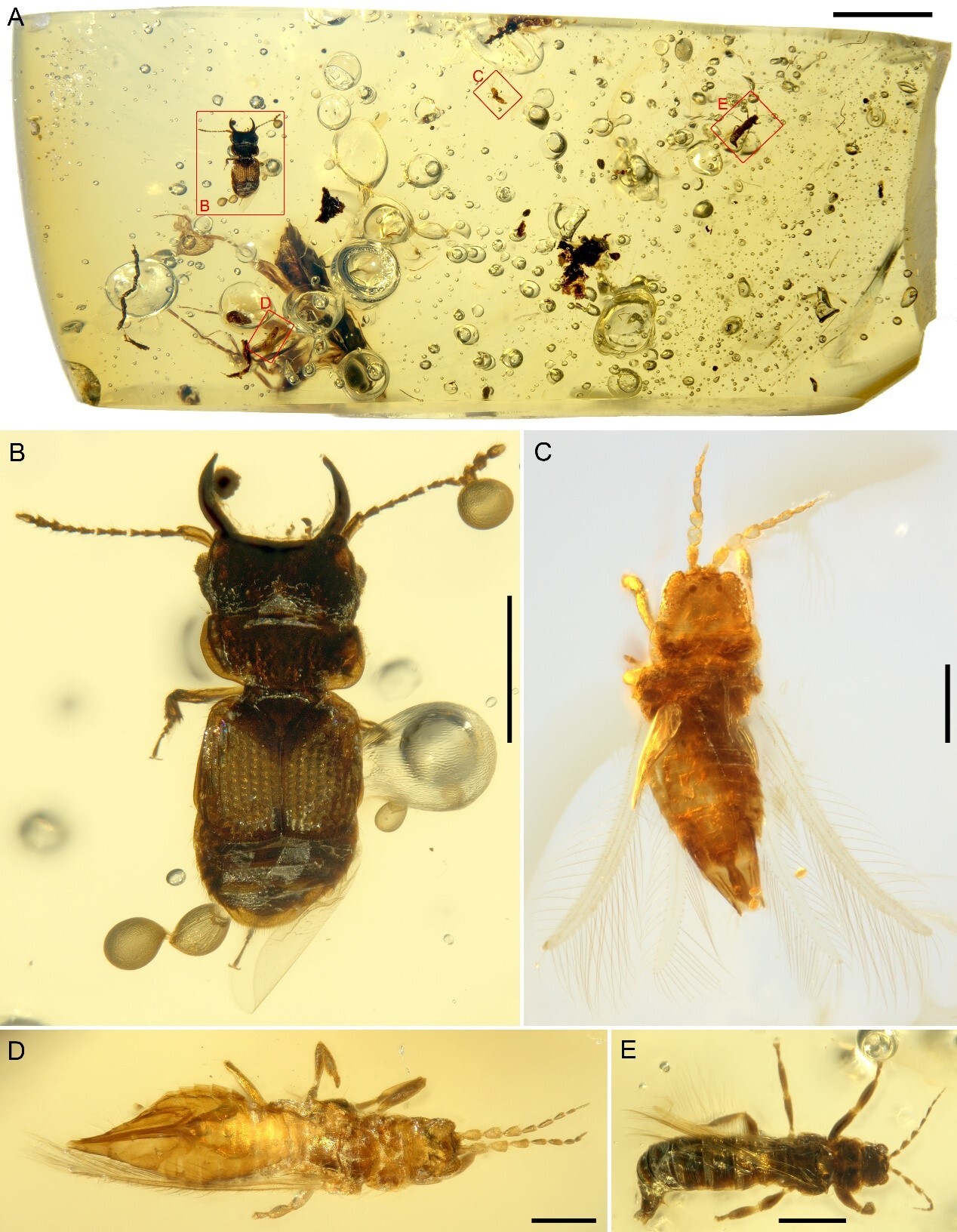
Fig.6 Parallelothrips specimens co-occurring with a male specimen of Pelretes bicolor. B shows the newly discovered male specimen of Pelretes bicolor; C highlights a Parallelothrips individual with three pollen grains directly adhering to its fringed wing; D and E show two additional Parallelothrips specimens.
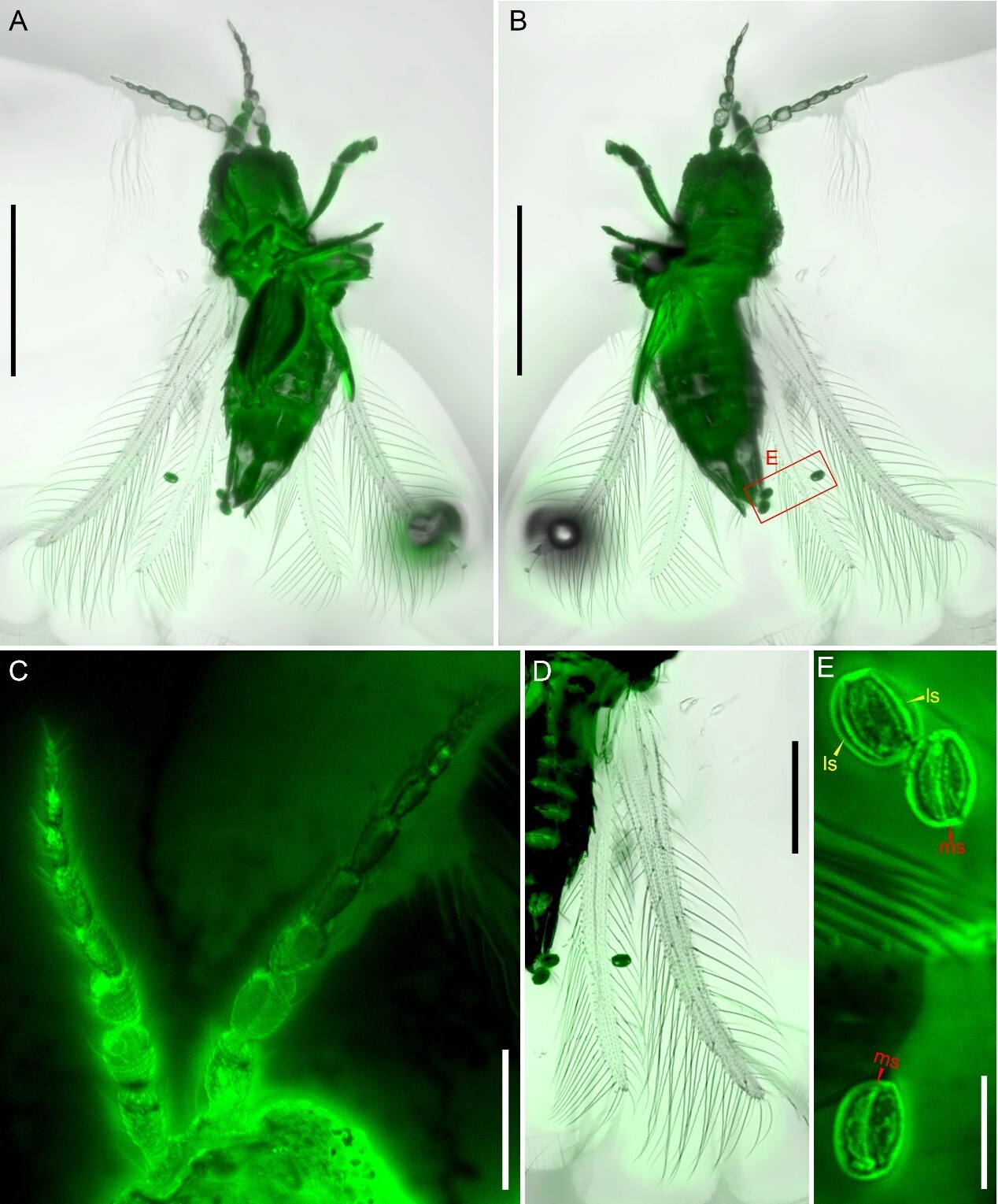
Fig.7 Parallelothrips and the Eucommiidites pollen attached to its body surface. A and B provide magnified general views of the Parallelothrips with adhering pollen; C illustrates the key diagnostic features of the thrips’ antennae; D shows a fringed wing with attached pollen; E presents close-up details of three pollen grains.
Download: