
The North China Craton (NCC) is a key geological unit in East Asia. Its large-scale destruction during the Late Mesozoic, characterized by lithospheric thinning, large-scale magmatism and structural deformation, is widely considered to be closely related to the subduction of the Paleo-Pacific Plate. This deep geodynamic process not only triggered widespread magmatic activity and rifting but also profoundly influenced the evolution of terrestrial ecosystem.
Recently, Associate Professor WANG Yaqiong from Nanjing Institute of Geology and Palaeontology, Chinese Academy of Sciences (NIGPAS), and Associate Professor ZHONG Yuting from Guangzhou Institute of Geochemistry, Chinese Academy of Sciences, together with collaborators from Liupanshui Normal University and Nanjing University, conducted zircon SIMS U–Pb dating of tuff layers from the Lower Cretaceous succession in the Liuhe Basin, Jilin Province. High-precision ages were obtained for the Lamenzi, Dashatan, and Baodaqiao formations, yielding ages of 127.1 ± 0.9 Ma, 124.6 ± 1.2 Ma, and 122.1 ± 1.4 Ma, respectively. The result was published in Cretaceous Research.
These results establish, for the first time, a robust chronostratigraphic framework for the Lower Cretaceous strata of the Liuhe Basin, providing new temporal constraints for dating fossil-bearing horizons of the Jehol Biota sensu lato and for understanding the evolution of Early Cretaceous rift basins in East Asia.
The Liuhe Basin is a small rift basin located in the northeastern part of the North China Craton (NCC), preserving fossil assemblages of the Jehol Biota sensu lato (including gastropods, bivalves, fishes, and turtles). However, the depositional ages of these fossil-bearing strata have long remained poorly constrained because of the lack of reliable geochronological data, limiting our understanding of basin evolution and regional tectonic-ecological interactions.
In this study, zircon SIMS U–Pb dating was performed on tuff layers interbedded within sedimentary successions of the Lamenzi, Dashatan, and Baodaqiao formations. The results indicate that the Lamenzi Formation was deposited during late Hauterivian, the Dashatan Formation during early Barremian, and the Baodaqiao Formation during the late Barremian to early Aptian. Combined with previously published ostracod biostratigraphic data, the study further constrains the ages of the Xiahuapi Dianzi and Hengtongshan formations to Aptian, while the Heiwaizi Formation may extend into early Albian.
This study also documents that the sedimentary evolution of the Liuhe Basin records a transition from volcanic-dominated deposition to clastic sedimentation at ~122 Ma, marking a shift from syn-rift magmatism to post-rift conditions. Regional comparison indicates that this transition exhibits an eastward-younging trend across rift basins along the northern NCC, consistent with progressive lithospheric extension driven by rollback of the paleo-Pacific plate.
The newly established geochronological framework not only refines the Lower Cretaceous stratigraphic timescale of East Asia but also provides important temporal constraints for investigating how deep Earth geodynamic processes influenced surface basin evolution and terrestrial ecosystem development. Furthermore, this study supports the hypothesis that the spatiotemporal evolution of the Jehol Biota sensu lato on the NCC may have been closely linked to the destruction of the craton, providing a new basis for understanding the coupling relationships among tectonic activity, environmental change, and biological evolution in East Asia during the Early Cretaceous.
This research was supported by the National Key Research and Development Program of China and the National Natural Science Foundation of China.
Reference: Yu-Ting Zhong, Ya-Qiong Wang*, Jia-Jun Mo, Huazheng Zhu, 2026. Chronostratigraphic constraints on the Lower Cretaceous volcano-sedimentary succession of the Liuhe Basin: implications for the Jehol Biota sensu lato and destruction of the North China Craton. Cretaceous Research, 186: 106429. https://doi.org/10.1016/j.cretres.2026.106429
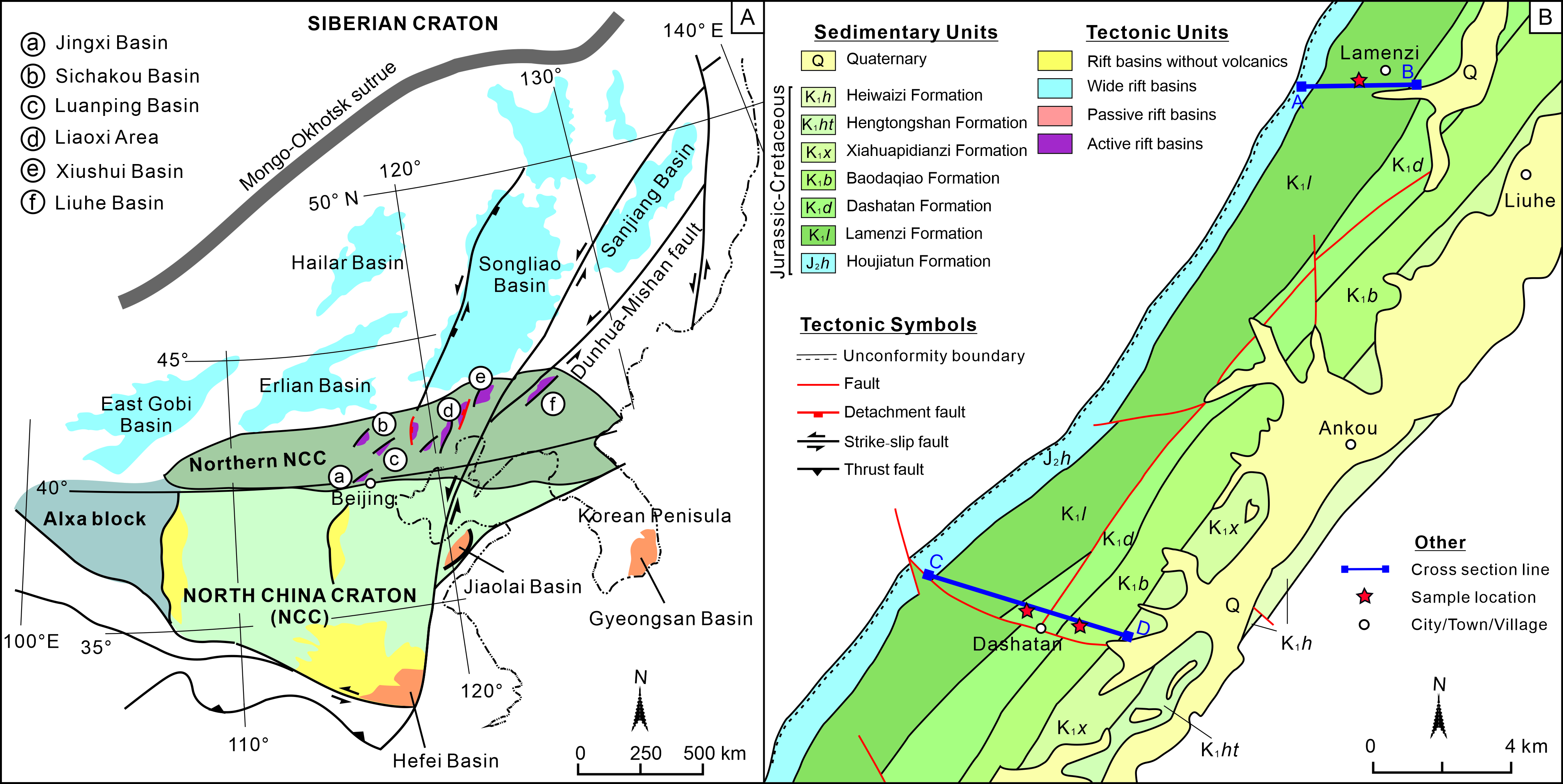
Fig. 1 A. Tectonic map showing distribution of Cretaceous basins in NE Asia; active rift basins distributed in northern NCC (modified from Meng et al., 2022, figure 1). B. Simplified geological map of the Liuhe Basin, showing the distribution of major stratigraphic units and sampling locations (modified from the 1: 250,000 geological map of the Hailong area).

Fig. 2 A–C. Overview photographs of the sampled sections; D–F. Field occurrences of tuff samples 2025TF-5, 2025TF-6, and 2025TF-7, respectively; G–H. Photomicrographs of sample 2025TF-5 under plane-polarized light and cross-polarized light, respectively; I. Photomicrograph of sample 2025TF-7 under plane-polarized light; J. Stratigraphic column showing lithology, thickness, and sampling horizons of individual formations (thickness based on Xu et al., 2019, table 1). Fsp: feldspar; Qtz: quartz.
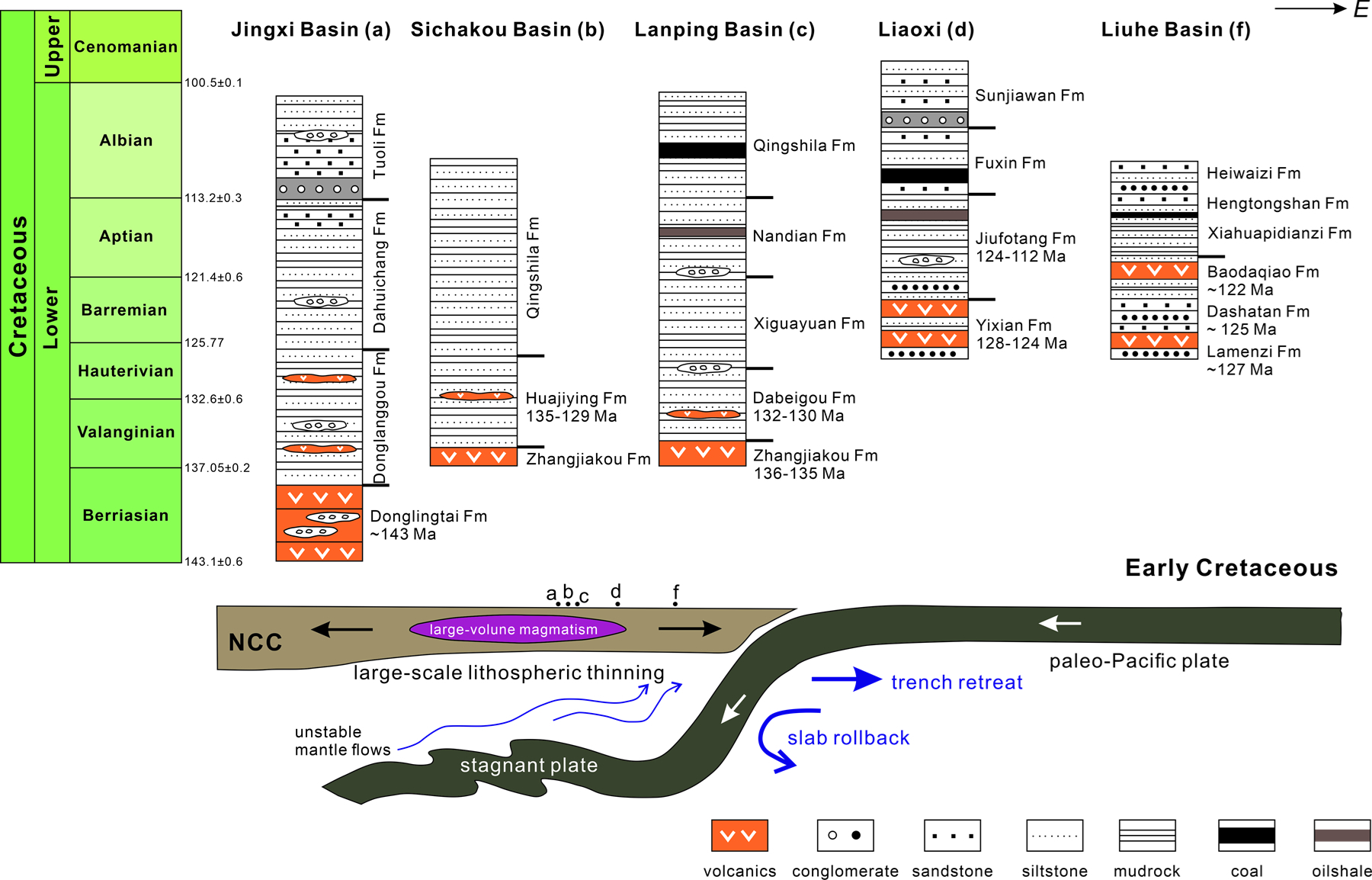
Fig. 3 Stratigraphic correlation of Lower Cretaceous sequences in northern NCC, showing volcanic and volcaniclastic rocks in the lower part and clastics in the upper (modified from Zhou et al., 2021, figure 4) (ages data based on Zhou et al., 2021; Meng et al., 2022; Zhong et al., 2025, references therein and this study); subduction process of paleo-Pacific plate during the Early Cretaceous, and its controls on destruction of the NCC (modified from Zhu et al., 2017, figure 5) (Geochronological chart based on International Chronostratigraphic Chart v 2024/12, Cohen et al., 2013).
Download: