
Zoraptera, commonly known as angel insects, represents one of the most enigmatic insect orders. These minute, soft-bodied insects exhibit both winged and apterous morphs and live gregariously. Distributed mainly across tropical regions worldwide, they dwell under bark, in decaying wood and leaf litter, with fewer than 50 extant species recorded globally. Discovered more than a century ago, the phylogenetic placement of Zoraptera has long remained a central contentious puzzle in insect evolutionary research. Over the past decade, morphological and molecular analyses have unanimously placed Zoraptera within Neoptera, yet conflicting evolutionary hypotheses persist regarding its relatedness to other polyneopteran lineages. This long-standing debate, dubbed the "century-old problem", highlights the immense challenge of resolving its evolutionary affinities.
Recently, a research team led by Professor CAI Chenyang from Nanjing Institute of Geology and Palaeontology, Chinese Academy of Sciences (NIGPAS), collaborated with research institutions across the United Kingdom, the United States, the Czech Republic, Spain, Italy and other countries. Leveraging large-scale genome sequencing, construction of an ultra-large molecular matrix and multi-dimensional statistical validation, the team assembled a phylogenomic dataset with broad taxonomic coverage for insect evolution, precisely resolving the evolutionary position of Zoraptera on the insect Tree of Life. The findings were published online in the international journal Proceedings of the Royal Society B.
The researchers sampled 89 extant species covering all major polyneopteran clades, alongside 23 distant outgroups. Highly conserved single-copy orthologous genes were filtered, assembled and concatenated to build an ultra-large polyneopteran phylogenetic matrix with the most comprehensive taxon sampling and balanced lineage representation to date. Based on this extensive gene dataset, the team systematically evaluated diverse molecular evolutionary models, quantified and corrected phylogenetic biases induced by across-site compositional heterogeneity, and compared topological perturbations arising from different partitioning schemes and heterogeneity-correcting models.
The results demonstrate that the widely accepted mainstream Haplocercata hypothesis—positing Zoraptera and Dermaptera as sister groups forming the basal polyneopteran lineage—only holds when compositional heterogeneity across sequence sites is ignored. Support for this hypothesis declines markedly once site-heterogeneous models capable of mitigating such systematic errors are applied. Under the optimal evolutionary model, Zoraptera consistently emerges as the earliest-diverging lineage at the root of Polyneoptera, while Dermaptera and Plecoptera form the clade Dermoplectopterida, the sister group to all remaining polyneopterans. Topology tests and cross-model comparisons jointly confirm the robustness of the polyneopteran phylogenetic framework proposed herein, laying a critical foundation for reconstructing the ancestral morphological and biological traits of polyneopterans and elucidating their early evolutionary radiation.
The team adopted a multi-layered independent validation framework to cross-verify the conclusions. First, multispecies coalescent models yielded an identical topology to the maximum-likelihood tree inferred from the ultra-large matrix. Second, the jackknife resampling test was systematically applied for the first time to an ultra-large insect genomic matrix, repeatedly confirming that the recovered evolutionary framework is robust to perturbations of the matrix and analytical approaches. The highly stable polyneopteran phylogeny established in this study provides a core quantitative analytical framework for reconstructing ancestral polyneopteran body plans and deciphering patterns of their early radiation.
This research was funded by the National Key R&D Program of China.
Reference: Yehao Wang, Erik Tihelka, Petr Kočárek, Michael S. Engel, Jesus Lozano-Fernandez, Zi-Wei Yin, Omar Rota-Stabelli, Diying Huang, Davide Pisani, Philip C.J. Donoghue and Chenyang Cai* (2026) Phylogenomics resolves the century-old ‘Zoraptera problem’: Zoraptera as the earliest diverging lineage of Polyneoptera. Proc. R. Soc. B 291: 2025.3174. https://doi.org/10.1098/rspb.2025.3174.
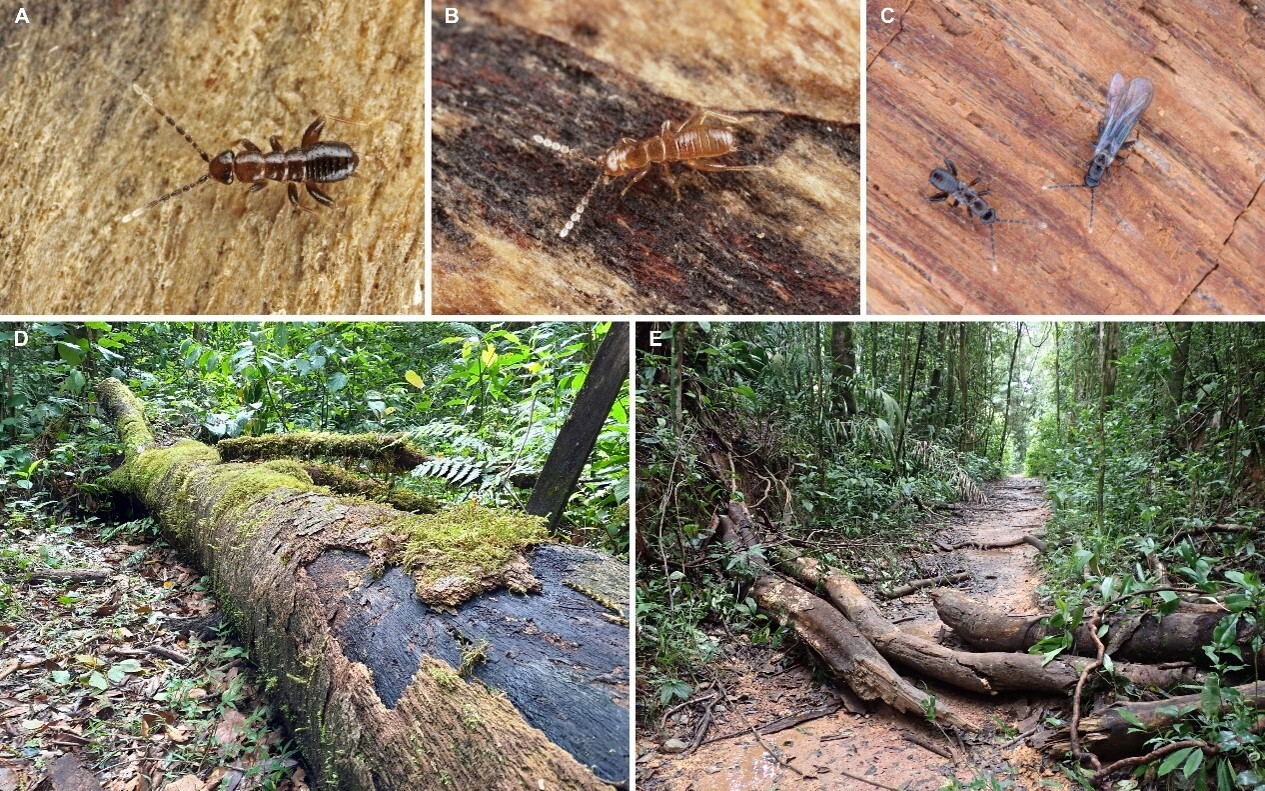
Fig.1 Zorapterans and their habitats
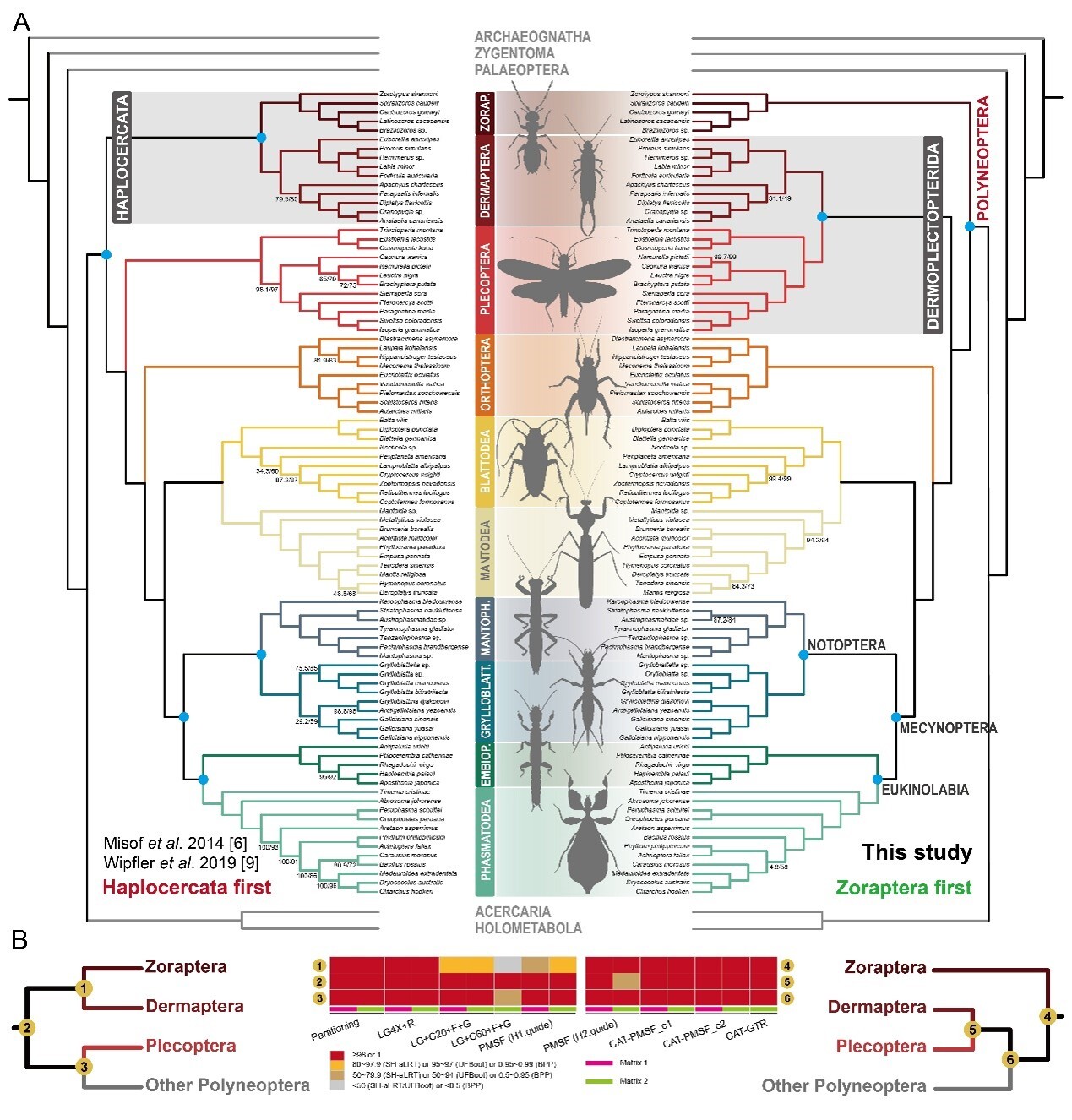
Fig.2 Impacts of across-site compositional heterogeneity on polyneopteran phylogeny; the left panel shows previous hypotheses, and the right panel presents the novel topology recovered in this study
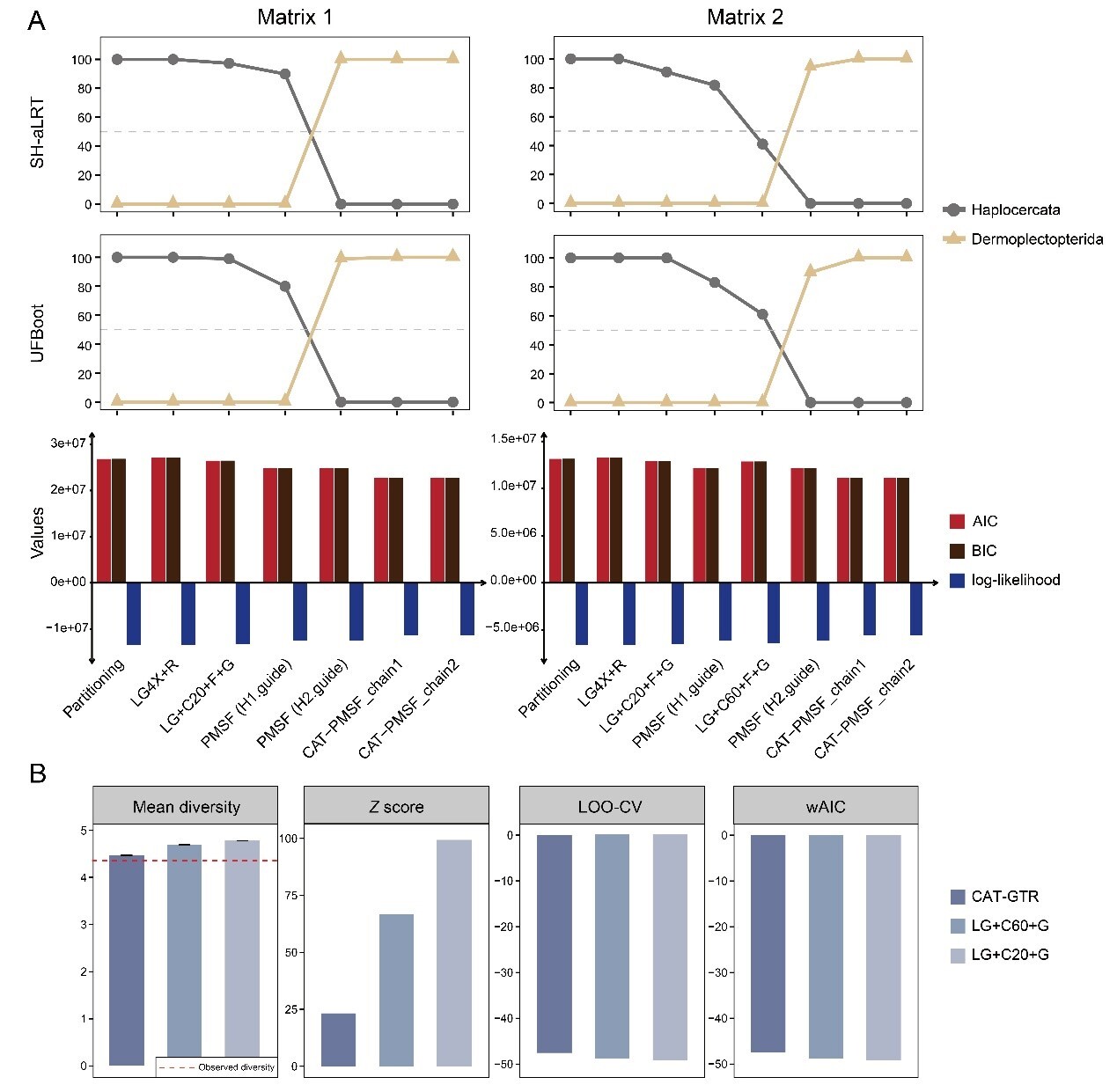
Fig.3 Shifts in statistical support for the two competing hypotheses and comparisons of model fit
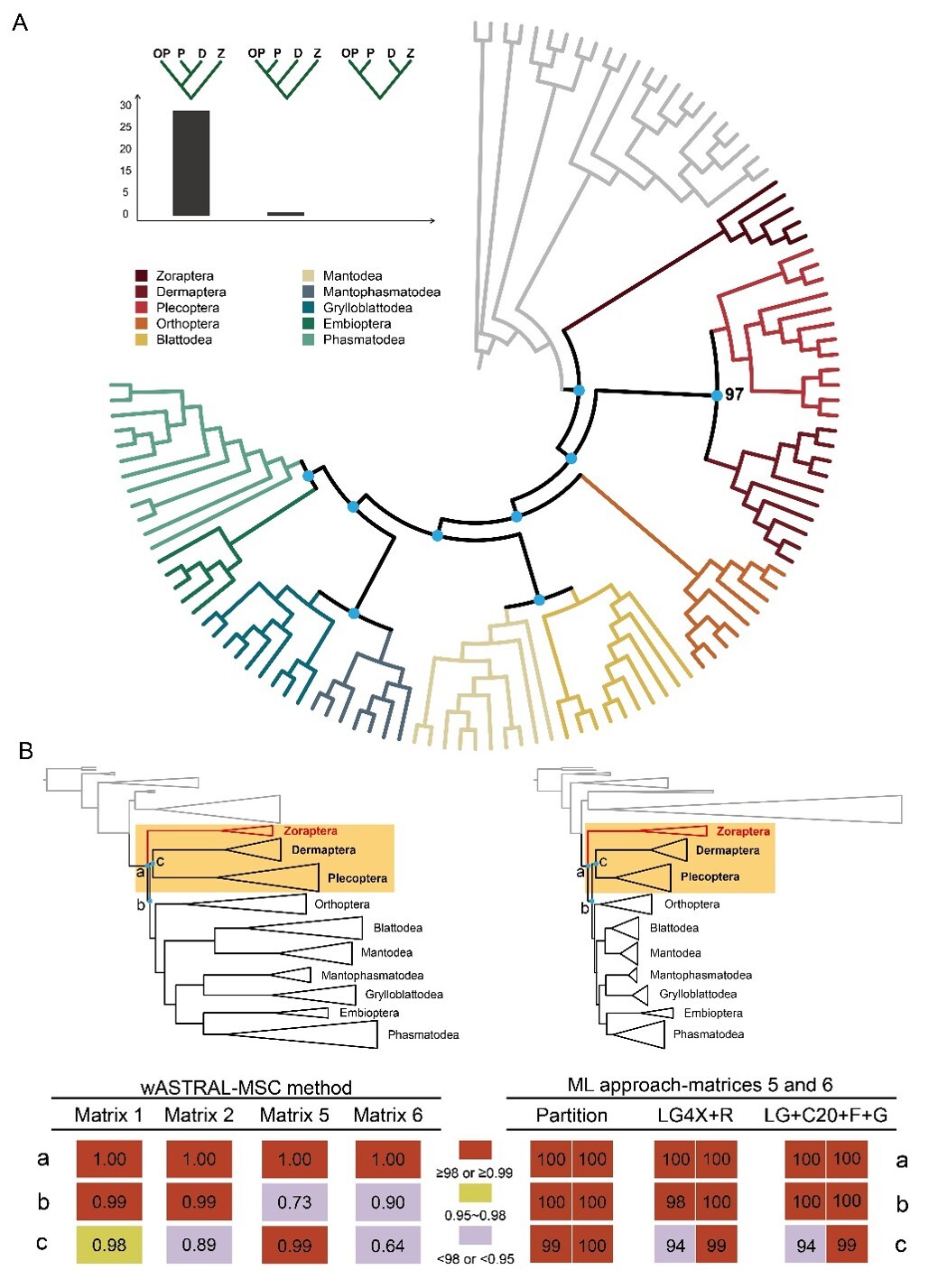
Fig.4 Systematic jackknife resampling tests applied to an ultra-large insect genomic matrix for the first time; congruent topological relationships within Polyneoptera recovered consistently via both coalescent and maximum-likelihood analyses
Download: