
The late Paleozoic witnessed intense tectonic activity, which played a major role in driving the evolution of Earth’s surface systems. Two major continent-continent collisional belts formed during the late Paleozoic, namely the Hercynian orogen and the Uralian orogen. In addition, a series of subduction-related orogenic belts formed around these continents during the late Paleozoic, including the Cordilleran orogenic belt, the Terra Australis orogenic belt, and the Central Asian orogenic belt. Meanwhile, the South China Craton was located to the northeast of the Paleo-Tethys Ocean, at the confluence of the Panthalassa Ocean to the east and the Paleo-Tethys Ocean to the west. However, the tectonic setting of South China during the late Paleozoic remains ambiguous due to the lack of sufficient magmatic and metamorphic records, in addition to the restricted siliciclastic sedimentary system, which hampers our understanding of the regional tectonic evolution and geodynamic processes.
As the first-order control on changes in paleogeography, different tectonic settings of continental margins would exert different influences. Therefore, reconstructing the paleogeographic evolution processes of South China can provide additional constraints on the tectonic setting of the South China Craton. Over the past decade, numerous late Paleozoic detrital zircons have been reported from Devonian to Triassic siliciclastic strata in South China, providing an opportunity to explore its tectonic setting and geodynamics. The occurrence of two late Paleozoic magmatic rocks, with ages of 334 Ma and 317 Ma, from the southeastern region of South China, confirms magmatic activity in southeastern South China. Most of these studies focused on the tectonic setting of southeastern South China, and different models have been proposed to account for those magmatic activities. By contrast, the northwestern margin of South China was claimed to be a passive continental margin, although its tectonic setting has received limited attention. Therefore, reconstructing the paleogeographic evolution of South China is critical for elucidating its late Paleozoic tectonic setting, which remains poorly understood.
Here, Prof. CHEN Jitao and QIE Wenkun from the Nanjing Institute of Geology and Palaeontology, Chinese Academy of Sciences (NIGPAS), leading a team including assistant researchers GAO Biao and ZHONG Yutian, and Master’ degree candidate GUAN Yifan, conducted heavy mineral assemblage analyses, detrital zircon cathodoluminescence (CL) imaging, geochronological analyses, and zircon geochemical analyses, to explore the provenance and paleogeographic evolution of South China during the late Paleozoic. The results of this study were recently published in the Journal of Asian Earth Sciences.
The three samples from the MLB section show relatively similar zircon U–Pb age spectra. Specifically, they consist of two major age clusters at 470–410 Ma and 860–800 Ma, with peaks at ca. 440 Ma and 830 Ma. Six subordinate age populations peak at 2.5 Ga, 1.8 Ga, 990 Ma, 910 Ma, 790 Ma, and 680 Ma. The remaining sporadic zircons fall within the age ranges of 3.1–2.6 Ga, 2.4–1.9 Ga, and 1.7–1.0 Ga. In conclusion, the siliciclastic sandstones in the MLB section have broadly similar provenance compositions, including the early Paleozoic Kwangsian orogenic rocks from the Cathaysia Block, detritus from the eastern Yangtze Block, and material from the central Jiangnan orogenic belt.
Although the above provenance analysis indicates a relatively stable source-to-sink system for the MLB section, a provenance shift can still be recognized. The proportion of zircons aged 470–410 Ma, derived from the Kwangsian orogenic belt in the Cathaysia region, decreases from 24% in sample MLB-0 to 16% in MLB-71.8, and finally to 8% in MLB-129. In contrast, the proportion of zircons peaking at ca. 830 Ma (860–800 Ma), derived from the central Jiangnan fold belt in the eastern Yangtze Block, increases from 15% in sample MLB-0 to 32% in MLB-71.8, and then decreased slightly to 26% in MLB-129.
A Monte Carlo test was used to assess the error ranges of the detrital contributions from the Cathaysia Block for the three MLB sandstone samples. Considering their error ranges, the probability of a strict decreasing trend in the percentage of the 470–410 Ma zircon cluster is about 64.34%, and the probability of MLB-0 > MLB-129 is about 99.91%. To reveal the long-term paleogeographic evolution of South China, a compilation of detrital zircon ages from late Paleozoic sedimentary rocks was conducted. Correspondingly, a decreasing contribution of detrital zircons aged 470–410 Ma can also be observed in the compiled detrital zircon age spectra of late Paleozoic strata in the Cathaysia Block, further supporting the gradual topographic flattening of the Cathaysia landmass during the late Paleozoic. By contrast, the age spectra of the Yangtze region remain similar over ~120 Myr (from the Early Devonian to the Early Permian), indicating a stable provenance system, which is consistent with a passive continental margin setting. In addition, the tectonic settings of the Yangtze and Cathaysia regions can also be distinguished on the CA–DA diagram.
This study was supported by the National Natural Science Foundation of China.
Reference: Biao Gao*, Yutian Zhong, Yifan Guan, Wenkun Qie, Jitao Chen*. Provenance analysis of latest Devonian to early Carboniferous siliciclastic deposits in central South China: Implications for paleogeographic change and tectonic setting of the South China Craton. Journal of Asian Earth Sciences, 310:107202. https://doi.org/ 10.1016/j.jseaes.2026.107202.
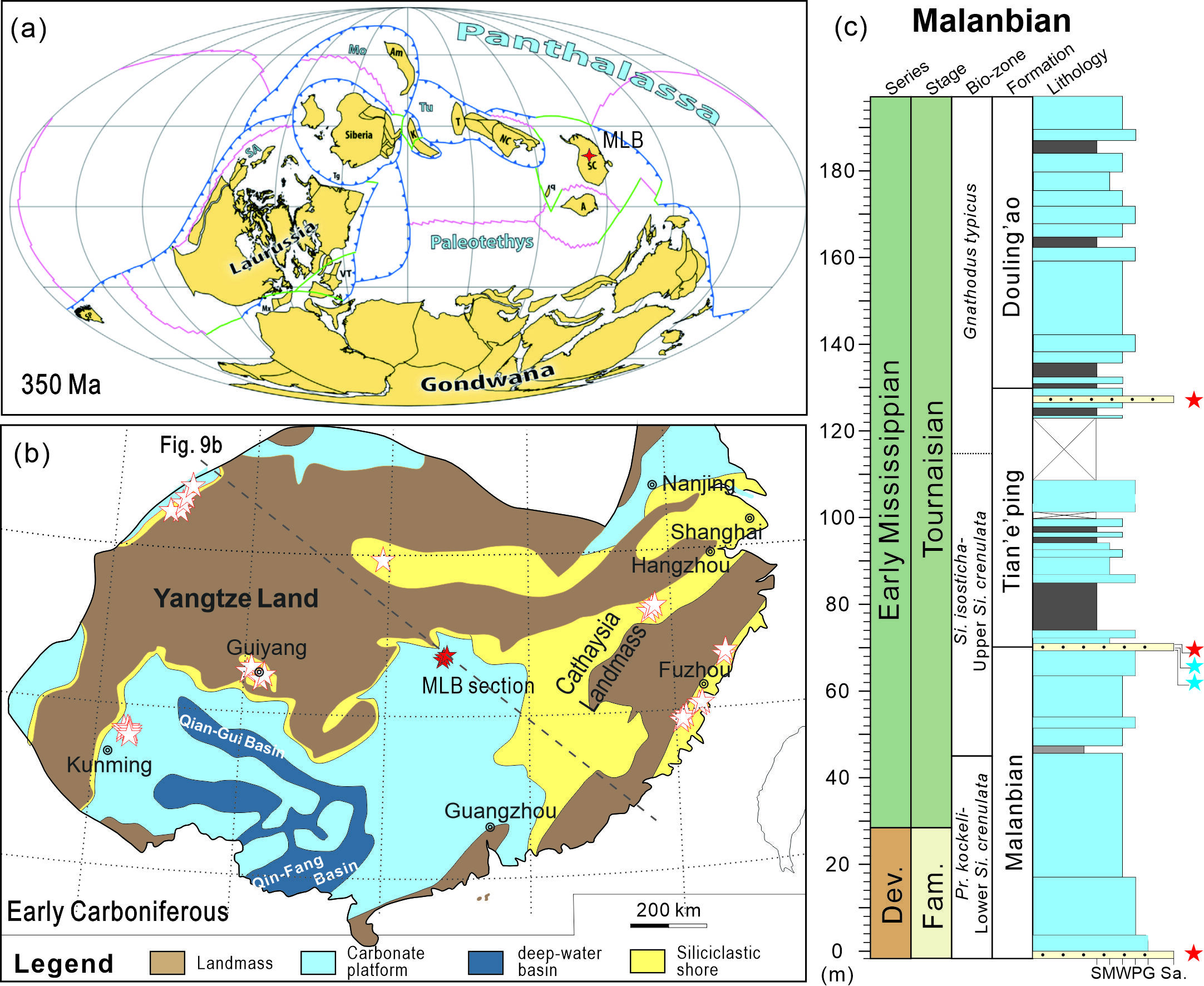
(a) Global paleogeographic reconstruction and tectonic framework at ca. 350 Ma. (b) Lithofacies paleogeography of South China in the earliest Carboniferous, showing the location of the MLB section. (c) Stratigraphic and lithological column of the MLB section, showing sample locations (stars).
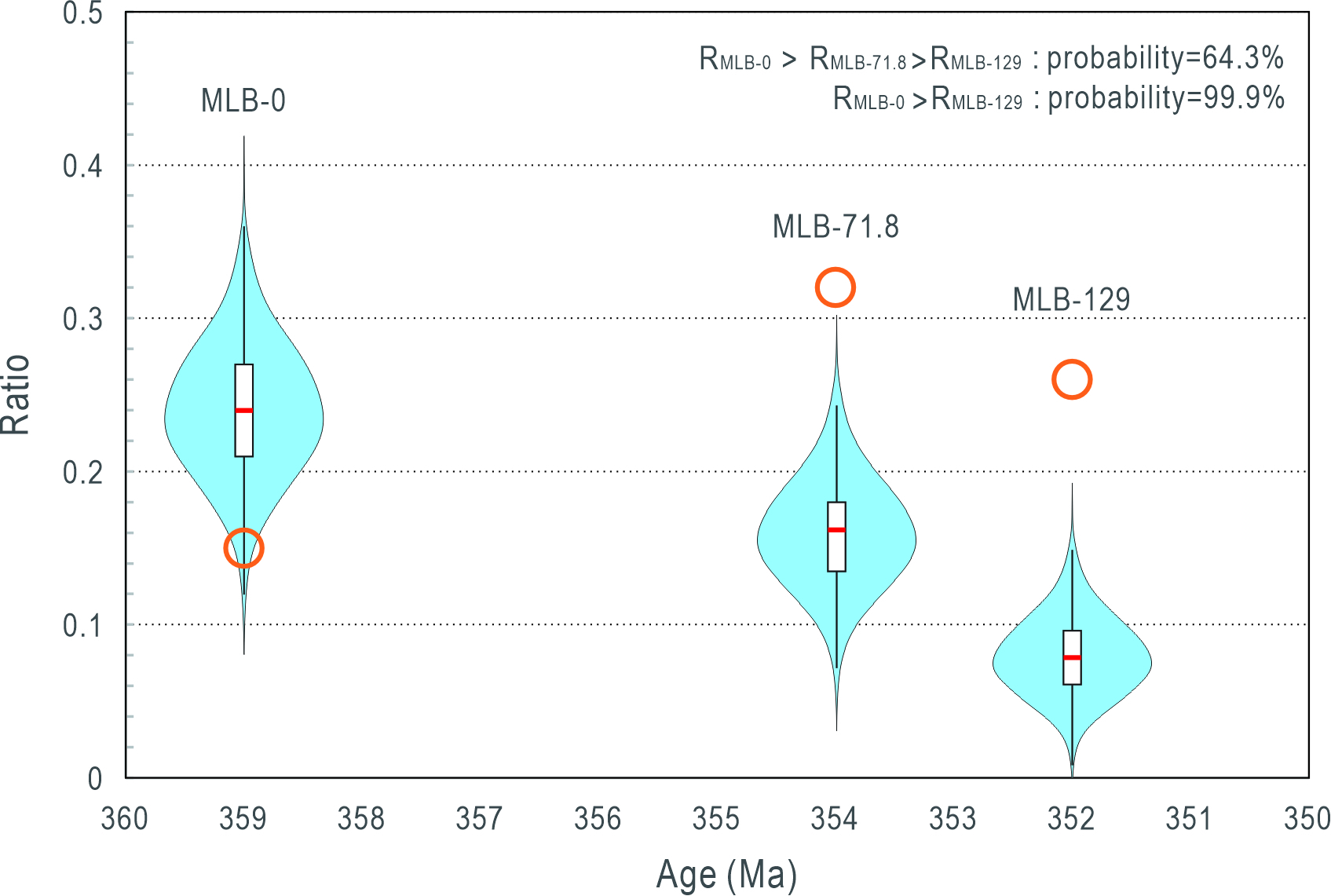
Violin plots of detrital zircon age groups from the Kwangsian orogenic belt (480–410 Ma). Orange circles represent the proportions of the zircon age cluster at 860–810 Ma.
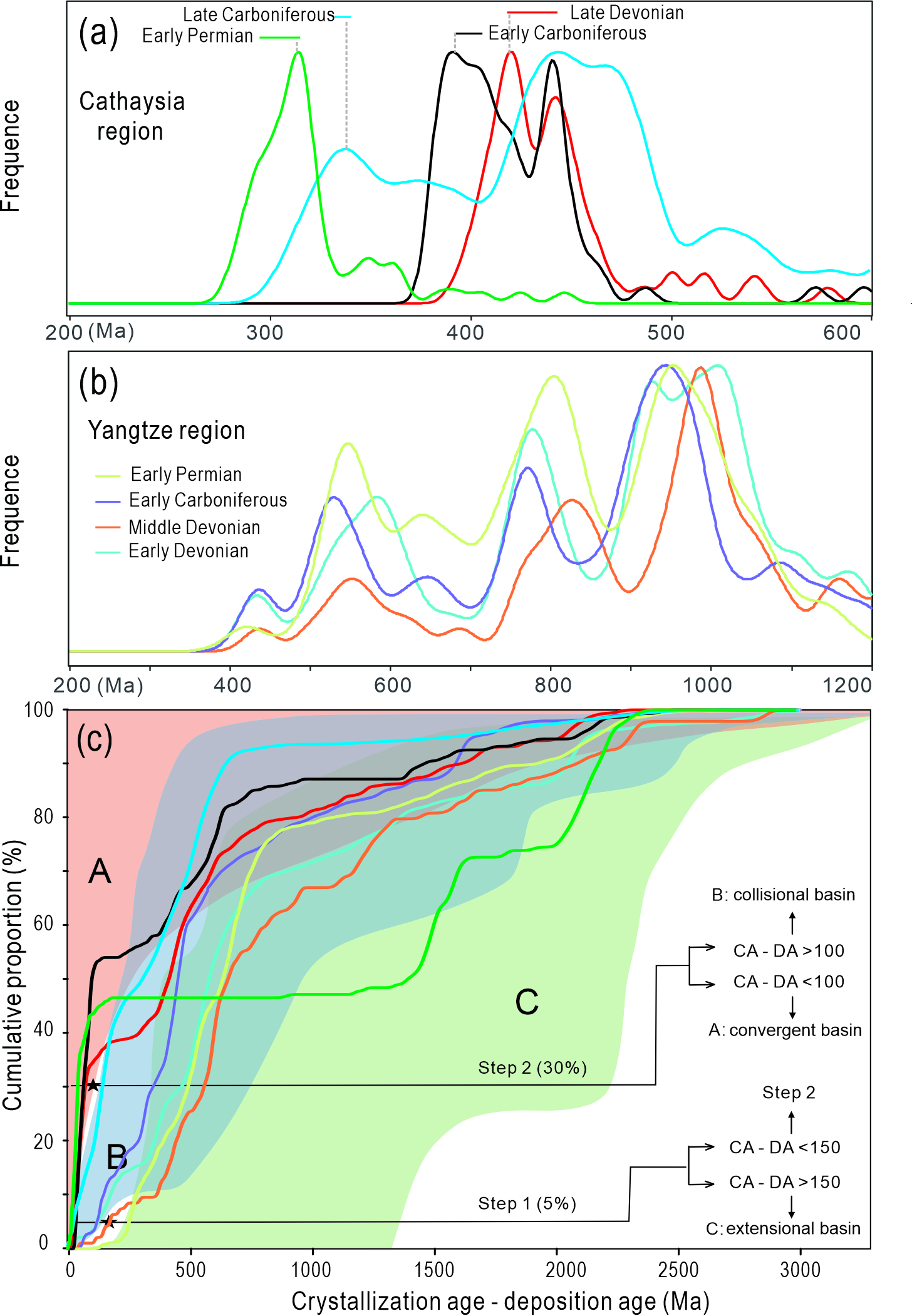
Relative probability plots for detrital zircon ages from late Paleozoic strata in the Cathaysia region (a) and Yangtze region (b). (c) Tectonic setting discrimination diagram. The lines in (c) represent these age compilations from the Yangtze and Cathaysia regions, shown in different colors.
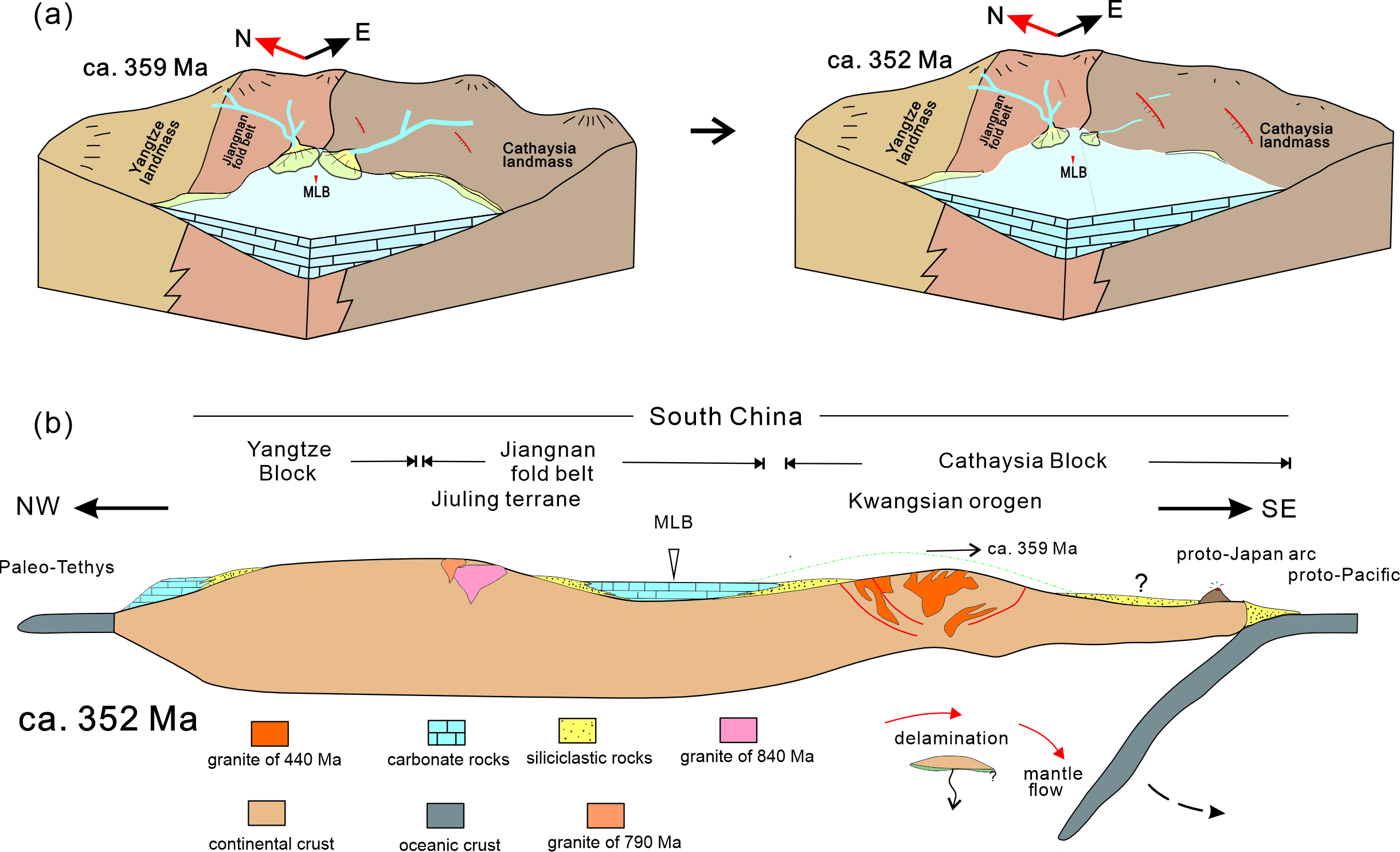
Conceptual illustration of the paleogeographic reconstruction and tectonic setting of the South China Craton during the latest Devonian to early Carboniferous. (a) Paleogeographic evolution of the provenance system of the MLB succession. (b) Tectonic and geodynamic model of South China during this interval.
Download: