
Amber is fossilized plant resin. In living plants, resin plays important roles in sealing wounds and protecting tissues against microbes, wildfires, and wood-boring organisms. Once fossilized, resin may preserve organic molecules for hundreds of millions of years and, in some cases, entrap tiny organisms such as insects, spiders, and plant fragments. For this reason, amber has long been regarded as a “time capsule” for ancient terrestrial ecosystems. Amber (resinite) are also important in coal petrology and petroleum geology. They are hydrogen-rich organic components that can undergo thermal evolution and generate liquid hydrocarbons at relatively low maturity levels. Their study therefore provides useful evidence for understanding hydrocarbon generation and assessing the petroleum potential of organic-rich strata. Despite its scientific importance, amber is extremely rare in Paleozoic rocks. Classical accounts of amber have generally regarded fossil resin as a product of seed plants, including gymnosperms and angiosperms. Until now, the earliest widely accepted amber record was from the Late Carboniferous of the United States, about 320 million years ago. The origin and earliest evolution of amber have therefore remained poorly constrained.
A new study led by Dr. LUO Cihang, under the supervision of Prof. WAGN Bo and Prof. ZHANG Haichun at the Nanjing Institute of Geology and Palaeontology, Chinese Academy of Sciences (NIGPAS), now reports amber from the Middle Devonian Hujiersite Formation of Xinjiang, northwestern China. The study was conducted in collaboration with the team of Prof. XU Honghe and Dr. YANG Huiyuan from the team of Prof. CUI Xingqian at Shanghai Jiao Tong University, together with other international collaborators. The newly discovered Hujiersite amber is approximately 385 million years old. It extends the confirmed fossil record of amber by about 65 million years and challenges the traditional view that amber was produced only by seed plants. The finding provides direct fossil evidence for the early evolution of plant resin production, terpene-based resin biosynthesis, and chemical defense mechanisms in early land plants.
The amber samples were collected from a cutinitic coal seam in the Ancient Petroleum Reservoir Section of the Hujiersite Formation, northwestern Junggar Basin, Xinjiang. This region has yielded the Hujiersite Flora, an important Middle Devonian plant assemblage that includes lycopsids, zosterophylls, iridopteridalean, and progymnosperms. These fossils make the Hujiersite Formation a key locality for understanding the structure and evolution of Devonian terrestrial vegetation. From about 10 kilograms of coal, the research team manually extracted hundreds of tiny amber particles under ultraviolet light. Most particles are only 0.1–0.5 millimetres in diameter, with the largest reaching about 1.5 millimetres. Under natural light, they range from light yellow to dark brown and vary from translucent to opaque. Under ultraviolet light, they show a distinct blue fluorescence, sharply contrasting with the surrounding black coal matrix.
Because some organic matter in coal can resemble resin in appearance or fluorescence, the team further analysed the samples using Fourier-transform infrared spectroscopy (FT-IR) and gas chromatography–triple quadrupole mass spectrometry (GC-MS/MS). FT-IR spectra showed that the Hujiersite samples share key absorption features with modern and fossil resins, including signals associated with aliphatic C–H bonds, carboxyl-related C=O and O–H bonds, and methyl and methylene C–H bonds. These results indicate that the overall chemical structure of the samples is consistent with resin or amber. The spectra also lack several features typical of some angiosperm ambers, such as the 887 cm⁻¹ peak common in fabalean ambers and the 1360–1400 cm⁻¹ triplet and 1050 cm⁻¹ peak characteristic of dipterocarpaceous ambers. Instead, the Hujiersite amber shows closer spectral similarity to gymnosperm resins, including those of Pinaceae, Cupressaceae, and Araucariaceae. Organicgeochemical analyses further confirmed the resinous nature of the samples. The Hujiersite amber contains abundant sesquiterpenoids, diterpenoids, and naphthalenic acids. Several abietane-type diterpenoids and their derivatives, which are commonly associated with conifer-type resins, were identified. By contrast, the samples lack typical angiosperm resin markers such as oleanane-type triterpenoids. Taken together, the FT-IR and geochemical data demonstrate that these particles are real fossil resin, namely amber, and that their chemical composition is most similar to gymnosperm, especially conifer-type resins.
The age of the Hujiersite amber is especially important. It predates the origin and radiation of seed plants, meaning that it was not produced by typical seed plants. Instead, it was most likely derived from other vascular plants. Based on the composition of the Hujiersite Flora, possible source plants include progymnosperms and arborescent lycopsids. This suggests that some Middle Devonian vascular plants had already evolved the capacity to produce complex terpene-rich resins.
The discovery also sheds new light on the ecological context in which resin production may have evolved. Devonian was a critical interval in the expansion of land plants and the increasing complexity of terrestrial ecosystems. During this time, plants became larger, rooting systems deepened and became more complex, secondary wood evolved, and large leaves began to appear. At the same time, early land plants faced physical injury, wildfires, and pathogen attacks. Evidence for extensive arthropod herbivory on Devonian vascular plants remains limited, suggesting that the earliest evolution of resin may have been driven less by herbivorous arthropods and more by wound sealing, recovery after fire or mechanical damage, and defence against fungal or microbial invasion.
The Hujiersite amber not only pushes back the earliest confirmed record of amber, but also highlights the need to re-examine Paleozoic coal seams and fine-grained deposits for minute resin particles. Early amber may have been extremely small, locally distributed, and easily overlooked. By combining microscopic observation, FT-IR spectroscopy, and molecular organic geochemistry, this study establishes a robust approach for identifying tiny deep-time amber particles and provides key fossil evidence for the early evolution of plant chemical defence, resin biosynthesis, and terrestrial ecosystems.
This work was supported by the National Natural Science Foundation of China, the Strategic Priority Research Program of the Chinese Academy of Sciences, and other funding sources.
Reference: Luo Cihang, Yang Huiyuan, Xu Honghe, Yang Zixiao, Wang Shengyu, Engel M. S., Liu Bingcai, Jarzembowski E. A., Boudinot B. E., Cui Xingqian, Zhang Haichun, Wang Bo. 2026. The earliest amber from the Middle Devonian of China. https://doi.org/10.1126/sciadv.aeh1266.
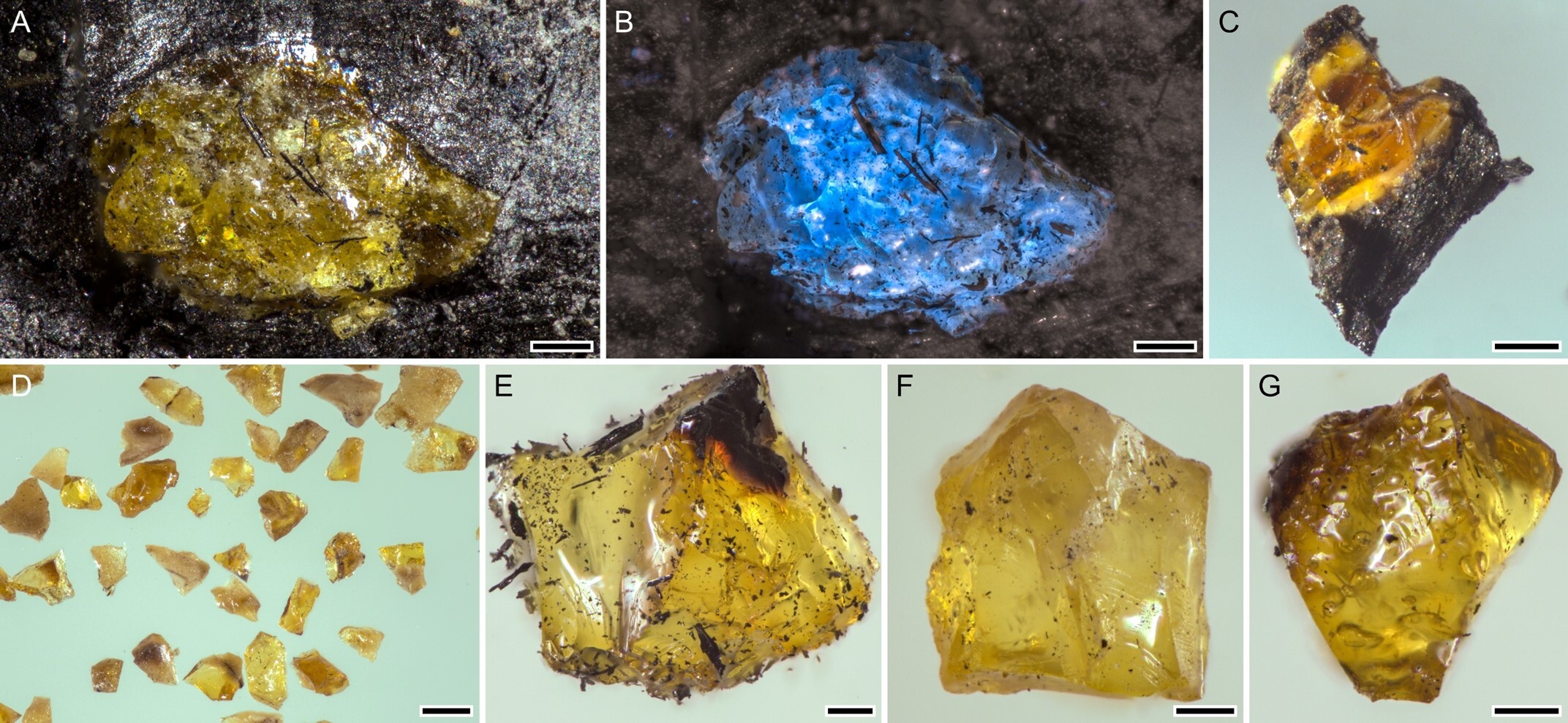
Fig.1 Middle Devonian Hujiersite amber from Xinjiang, China. The amber occurs as minute particles in coal, mostly 0.1–0.5 mm in diameter, and shows strong blue fluorescence under ultraviolet light.
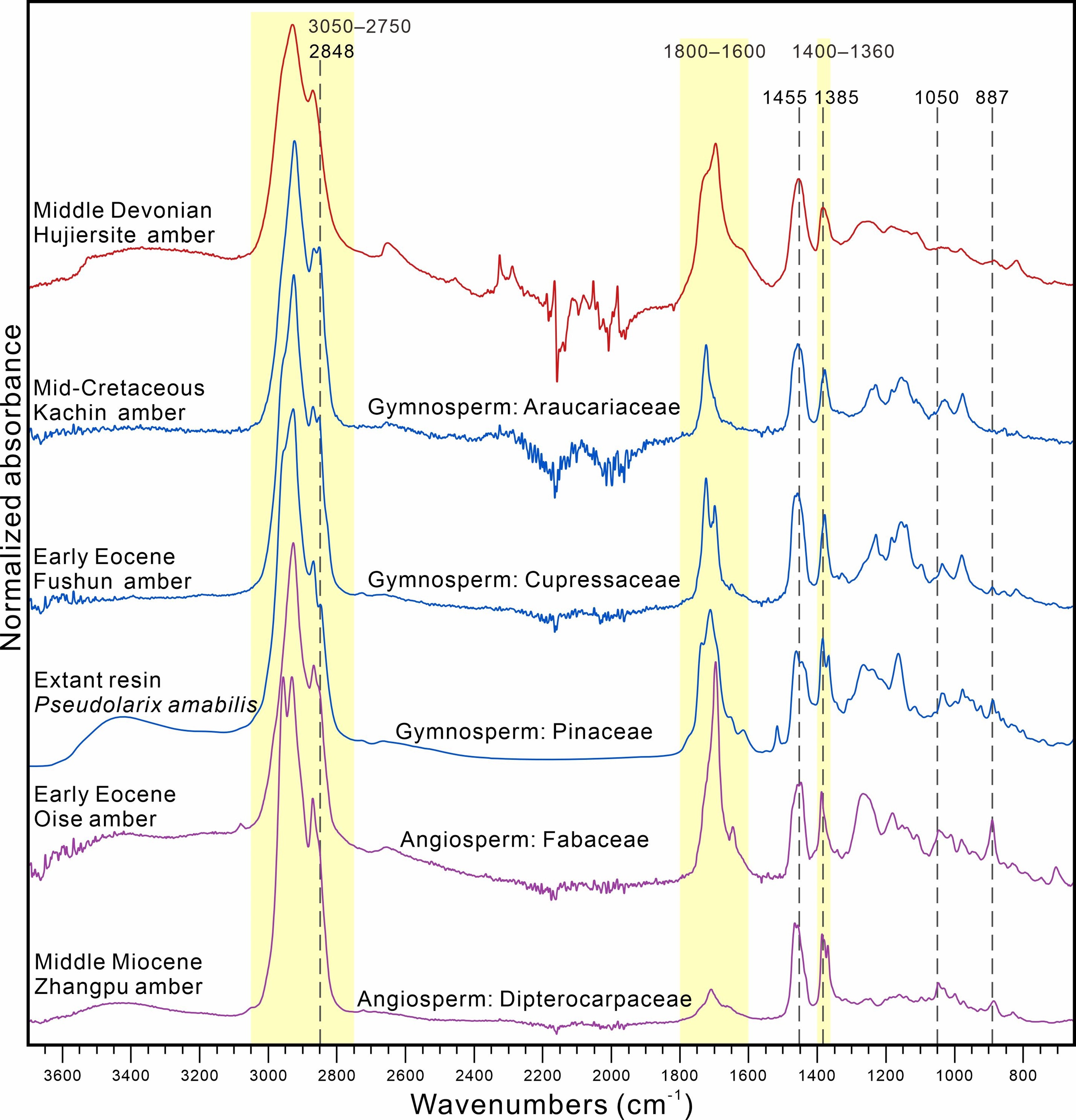
Fig.2 FT-IR spectra of Hujiersite amber and representative fossil and modern resins. Fourier-transform infrared spectroscopy shows that Hujiersite amber shares key absorption features with modern and fossil resins and displays spectral signals closer to gymnosperm resins.
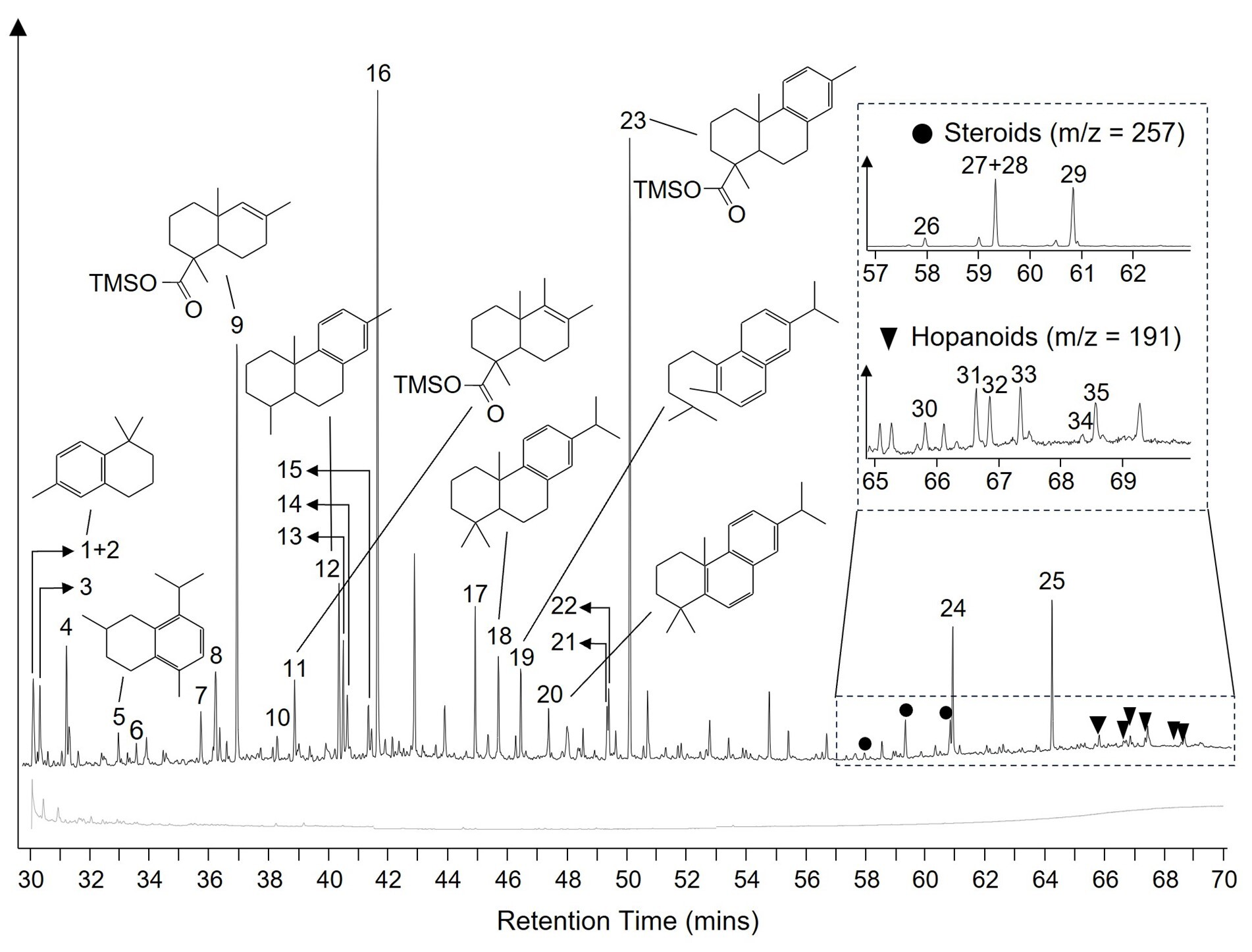
Fig.3 Chemical composition of Hujiersite amber. GC-MS/MS analysis reveals abundant sesquiterpenoids, diterpenoids, and naphthalenic acids, supporting the identification of the samples as real amber.
Download: