
The North China Craton (NCC) is one of the important ancient geological units in East Asia. During the Late Mesozoic, the NCC underwent a series of major tectonic processes, including intense lithospheric thinning, extensional basin development, and large-scale magmatism, known as the “destruction of the North China Craton”. These processes not only profoundly reshaped the regional geological framework but also had a significant impact on the evolution of terrestrial ecosystems.
Most previous studies on the evolution of terrestrial life and its responses to the NCC destruction predominantly focused on fossils from Konservat-Lagerstätten, with less emphasis on more ubiquitous fossil groups that are abundant, widely distributed, and preserved under relatively generic conditions. While fossils from Konservat-Lagerstätten offer detailed anatomical structures that are crucial for studying the morphology and evolution of significant fossil groups, these assemblages are typically confined to specific burial environments, locales, and time periods, thus complicating continuous, high-resolution studies of regional biological evolution, biodiversity, and biogeographical transitions over extended timescales. Research on Early Cretaceous non-exceptional fossil groups in the NCC offers a more comprehensive perspective on the relationship between terrestrial life evolution and the NCC destruction. The rift basins along the northern margin of the NCC preserve the most complete Early Cretaceous terrestrial sedimentary successions rich in non-exceptional fossil group - ostracods. These ostracod-bearing deposits provide a unique opportunity to explore the relationship between terrestrial ecosystem evolution and the destruction of the NCC from a broader and more general perspective.
Recently, Associate Professor WANG Yaqiong from the Nanjing Institute of Geology and Palaeontology, Chinese Academy of Sciences (NIGPAS), together with Senior Researcher Robin J. Smith from the Lake Biwa Museum, Japan, Senior Researcher Byung-Do Choi from Daegu National Science Museum, South Korea, and researcher from Nanjing University, conducted a systematic study of ostracod fossils from the Lower Cretaceous Lisangou Formation in the Guyang Basin, Inner Mongolia. The research team identified a freshwater ostracod assemblage consisting of fifteen species from ten genera of three superfamilies. The study provided the first precise biostratigraphic age constraint for the Lisangou Formation, indicating a late Aptian age. Furthermore, the ontogeny of Cretaceous Darwinuloidea was recognized and documented for the first time.
The result was published in Palaeoworld.
In recent years, the research group have undertaken extensive field studies in several Cretaceous basins along the northern margin of the NCC where the destruction was most severe, gathering substantial fossil ostracod collections. This study provides a comprehensive revision of the ostracod assemblage from the Lisangou Formation in the Guyang Basin. The ostracod assemblage of the Lisangou Formation includes several typical freshwater taxa, including Cypridea, Lycopterocypris, Candona, Rhinocypris, Timiriasevia, and Alicenula?. Some of these taxa have important biostratigraphic significance for the Early Cretaceous terrestrial deposits of East Asia. Based on ostracod biostratigraphic correlations, the first well-constrained biostratigraphic age is suggested for the Lisangou Formation, placing it in the late Aptian.
This study provided the first record of juvenile stages (A-1 to A-3 instars) of Cretaceous Darwinulidae Alicenula? custella and identified potential male individual in Alicenula? sp. A. The family Darwinulidae has garnered significant interest over the past three decades due to its potential status as one of only three “ancient asexual” groups in the animal kingdom. It has been suggested that the group has been reproducing asexually for over 200 million years due to the lack of male fossils in Mesozoic sediments. Therefore, this study not only provides new fossil evidence for understanding the long-term evolutionary history and systematic complexity of Darwinulidae but also challenges the hypothesis that this group maintained asexual reproduction for more than 200 million years.
This study also identified at least two darwinuloidean mass-mortality events coinciding with their reproductive period provides compelling evidence that short-lived environmental catastrophes episodically disrupted an otherwise stable fluvial–lacustrine system during the deposition of the Lisangou Formation.
This study advances our understanding of Early Cretaceous fossil ostracods from the destruction area of the NCC, and provides essential material for investigating the potential links between terrestrial biodiversity and the craton destruction.
This research was supported by the National Natural Science Foundation of China.
Reference: Yaqiong Wang*, Huazheng Zhu, Robin J. Smith, Byung-Do Choi, 2026. Lower Cretaceous Ostracoda (Crustacea) of the Lisangou Formation in the Guyang Basin, North China: Implications for Biostratigraphy and Palaeoenvironment. Palaeoworld 35, 201140. https://doi.org/10.1016/j.palwor.2026.201140.

Fig 1. Lower Cretaceous lithostratigraphic units of the Guyang Basin and stratigraphic columns showing lithologies and position of ostracod samples from the Lisangou Formation in the Lisangou-Yangduiyaozi outcrop (A) and two sections (B and C) newly exposed due to road construction. Photographs from the studied sections B and C showing the positions of the ostracod samples. Sample numbers in black indicate those that yielded specimens in the present work. Lower Cret. = Lower Cretaceous, Fm.= Formation.

Fig 2. Selected non-Cypridea species from the Lisangou Formation

Fig 3. Alicenula? custella
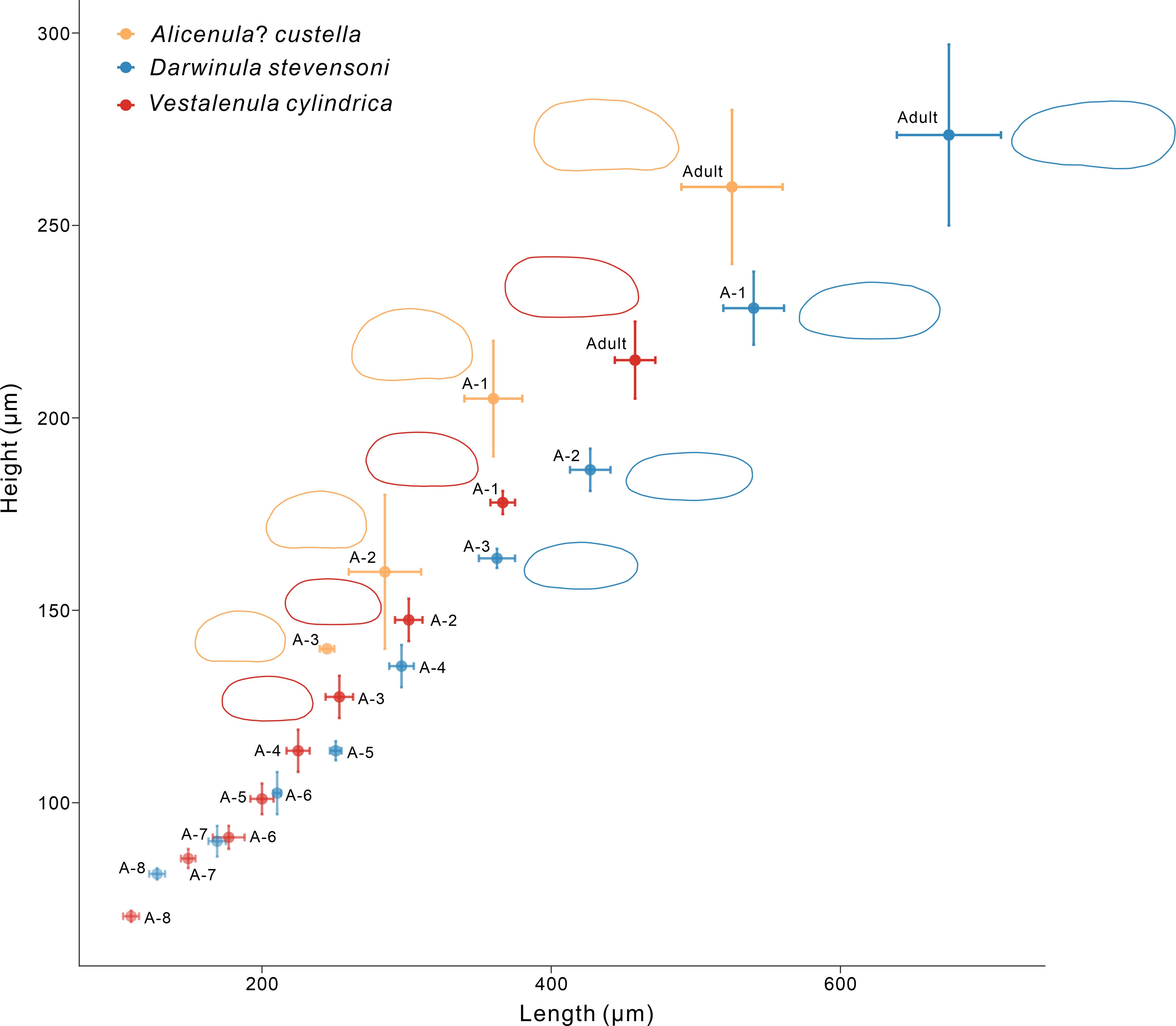
Fig 4. Size-range plot of carapace dimensions of Alicenula? custella, Darwinula stevensoni and Vestalenula cylindrica and line drawings of the carapace outlines of these three species from ontogeny stages A-3 to adult. The size and outline data of D. stevensoni and V. cylindrica are from Smith and Kamiya (2008).
Download: